
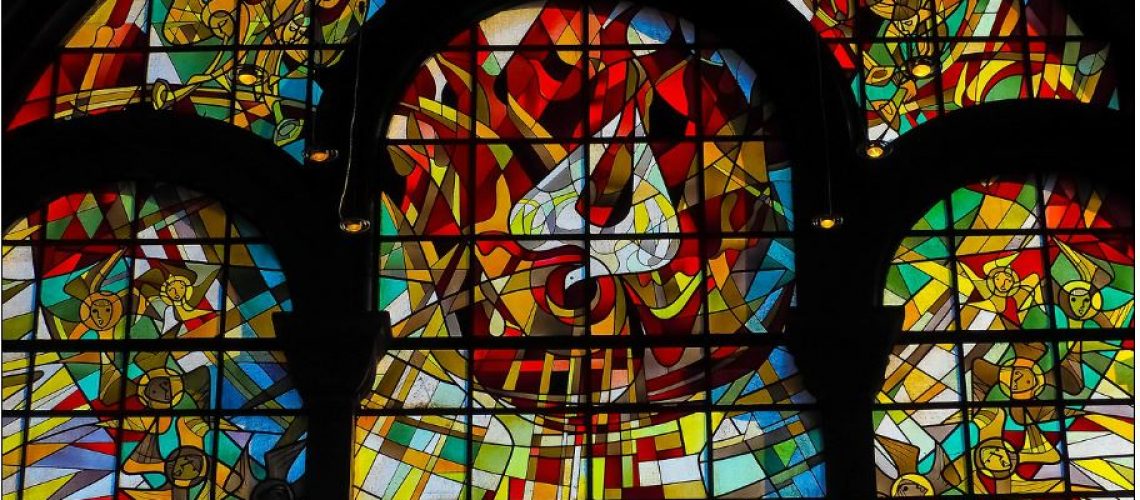
Part III: Fire That Does Not Consume
Read Dignity Restored, Glory Transfigured Part I: Passiontide: Humanity’s Dignity is Restored
Part Dignity Restored, Glory Transfigured II: Easter Octave: Wounded Glory That Heals the World
The Holy Spirit and the Dignity of Tongues
Fire usually consumes. It turns forests to ash, houses to rubble, and bodies to dust. The history of humanity is written in fire’s destructive wake, from sacked cities to burned heretics to the smouldering ruins of war. We have learned to fear fire, to control it, and to wield it as a weapon. But on Pentecost, a different kind of fire appears (Acts 2:3).
However, these flames do not burn. They do not destroy. They rest. The Holy Spirit is the fire that honours what it touches. It does not annihilate human nature; it perfects it. It does not silence human voices; it makes them heard. It does not scatter; it gathers. Pentecost is the feast of restored communication. In this restoration, human dignity finds a new foundation – the dignity of being heard by God and by one another.
Babel’s Wound
To understand Pentecost, we must first examine Babel. Genesis states the whole earth had one language (Genesis 11:1), but human pride led to the building of the city and tower, driven by a desire for fame and independence—an attempt to forge a legacy without God. This unity is based on human self-glorification, not divine will, and opposes God’s command to disperse (Genesis 9:1). Instead of spreading out, humanity centralized, creating a civilization rooted in human strength. When God sees what they’ve built, He responds with confusion (Genesis 11:7).
The Catechism of the Catholic Church teaches that Babel represents the breakdown of human solidarity caused by sin (CCC 57). Yet the Lord God does not strike them dead. He does not rain fire from heaven. He simply allows their pride to reach its logical conclusion: fragmentation. Unable to understand one another, they scatter across the earth, as they feared.
Babel is the original crisis of human dignity. We were made for communion (Genesis 2:18), yet sin produces isolation. We were made to speak and be heard, yet pride produces confusion. Babel’s wound is not merely linguistic. It is existential. We cannot reach one another, and so we cannot love one another.
Every modern echo of Babel surrounds us. Political discourse is unintelligible, not because of different languages, but because of different meanings. Families break over forgotten arguments. Social media connects us but divides us spiritually. Despite having more communication tools, we understand each other less. Pentecost is God’s answer to Babel.
The Spirit Who Breaks In
The feast of Pentecost, originally a Jewish harvest festival (Shavuot), becomes the birthday of the Church. The disciples are all together in one place. Suddenly, “from heaven there came a sound like the rush of a violent wind, and it filled the entire house where they were sitting” (Acts 2:1-2). The Catechism notes that wind and fire are traditional symbols of the Holy Spirit. Wind evokes the Spirit’s mysterious yet powerful action (CCC 696), recalling the breath of God that gave life to Adam (Genesis 2:7) and the dry bones that came to life again (Ezekiel 37:9-10). Fire evokes the transforming energy of God’s action (CCC 696), recalling the burning bush that was not consumed (Exodus 3:2) and the pillar of fire that guided Israel through the darkness (Exodus 13:21).
But the crucial detail is that the fire rests on each of them. It does not leap from one to another in a chain of destruction. It does not single out a prophet or a priest. It rested on each of them (Acts 2:3). The Catechism explains that the Spirit is the one who ‘rests’ on the Son and on the baptised (CCC 702). This is the democratisation of divine fire. At Pentecost, the Holy Spirit does not create a new hierarchy of privileged access. He descends on all who are gathered – fishermen, former tax collectors, women, the uneducated, the fearful.
That is the first restoration of human dignity at Pentecost – that no one is excluded from the fire. The same Spirit who hovered over the waters at creation (Genesis 1:2) now hovers over each baptised head. St. Peter will later quote Joel, saying that God declares He will pour out His Spirit upon all flesh (Acts 2:17; Joel 2:28). Not some flesh. Not holy flesh. All flesh.
The Dignity of Being Heard
Then comes the miracle that reverses Babel.
“All of them were filled with the Holy Spirit and began to speak in other languages, as the Spirit gave them ability.” Acts 2:4
Devout Jews from every nation under heaven (Acts 2:5) are gathered in Jerusalem. Each hears the disciples speaking in their native language (Acts 2:9-11). The list is deliberately exhaustive, leaving no one out. The crowd is amazed and astonished (Acts 2:7-8). This miracle is not glossolalia (ecstatic speech) but xenolalia – the supernatural ability to be understood across linguistic barriers.
In his Catechetical Lectures, St. Cyril of Jerusalem explains that “the Holy Spirit gave to the apostles the gift of tongues, so that those who had come together from every nation might hear the mighty works of God in their own language. This was the remedy for the confusion of Babel” (Lecture 17). Thus, whereas Babel scattered, Pentecost gathers; whereas Babel made speech unintelligible, Pentecost makes it intelligible.
The dignity of every human being lies in being addressed in their own tongue. God does not require us to learn a sacred language such as Hebrew, Greek, or Latin to approach Him. He does not require us to abandon our culture, accent, or idiom. At Pentecost, the Spirit does not make everyone speak Aramaic. He enables each to hear in their own language. The miracle lies not in the speaker’s mouth but in the listener’s ear.
The Catechism teaches that the Spirit is the principle of all the Church’s missionary and apostolic activity (CCC 852). That mission begins not with a command to be understood, but with a gift of understanding. The Church does not conquer other cultures; she speaks into them. She does not erase difference; she translates the Gospel into every tongue. This is the dignity of the listener: God comes to where you already are.
The Democratisation of Prophecy
Before Pentecost, the Holy Spirit descended on specific individuals for specific tasks — on Bezalel for craftsmanship (Exodus 31:3), on Gideon for warfare (Judges 6:34), on David for kingship (1 Samuel 16:13), and on the prophets for speech (Isaiah 61:1). After Pentecost, the Spirit is poured out on all the baptised. St. Peter, in his first sermon, declares:
“Repent and be baptised every one of you in the name of Jesus Christ so that your sins may be forgiven; and you will receive the gift of the Holy Spirit.” Acts 2:38
The Catechism affirms that by the sacrament of Confirmation, the baptised are more perfectly bound to the Church and are enriched with a special strength of the Holy Spirit (CCC 1285). Confirmation is not a graduation from faith. It is the ordinary means by which the fire of Pentecost is applied to each Christian.
In his 1986 encyclical Dominum et Vivificantem, Pope St. John Paul II wrote: ‘The Holy Spirit is the one who ‘sanctifies’ the Church and constantly ‘renews’ her, giving her the power to proclaim the Gospel to all nations” (no. 66). That power is not reserved for the clergy or religious. It belongs to every confirmed Christian. The fire that rested on the Apostles rests on the teenager praying before a difficult exam, on the mother who forgives her husband for the hundredth time, and on the elderly man who offers his suffering for the conversion of sinners.
The dignity of Pentecost is that you are not merely a recipient of grace. You are a bearer of the fire. The Spirit does not consume you; He empowers you. St. Paul writes, “All who are led by the Spirit of God are children of God” (Romans 8:14). And again, “You did not receive a spirit of slavery to fall back into fear, but you have received a spirit of adoption” (Romans 8:15). The dignity of the baptized is not that of servants but of sons and daughters; and sons and daughters inherit the family fire.
The Advocate Who Gives Us Courage to Speak
In His farewell discourse, Jesus promised not to leave the disciples orphaned (John 14:18). He would send the Advocate (John 14:16) — the Paraclete, meaning one called to stand beside as a defender, counsellor, or advocate. The Catechism explains that the Holy Spirit, the ‘Advocate’, will teach and remind them of Jesus’ words (CCC 729, cf. John 14:26). The Spirit does not bring a new gospel but gives courage and wisdom to speak the existing one.
Before Pentecost, the disciples were hidden in fear (John 20:19). After Pentecost, they boldly preach in the streets (Acts 2:14). Peter, who once denied a servant girl, now boldly accuses thousands of crucifiers of Christ. The fire has removed his fear, not his identity.
In the Summa Theologiae, St. Thomas Aquinas describes the Holy Spirit’s gifts as permanent dispositions that make a person receptive to the Spirit’s promptings. These include fortitude (courage) and fear of the Lord (reverence). Together, they enable truthful, humble, and firm witness.
The dignity of the Christian is that of the Spirit-empowered witness. You are not meant to be a professional apologist or street preacher but to speak of God’s mighty works in your own words— to your children, neighbours, colleagues, or the stranger on the bus. The Spirit provides the fire that makes your weak words heard.
The Dignity of the Sealed and Sent
The Catholic tradition links Pentecost with Confirmation, which completes baptismal grace (CCC 1285). Initially, the three initiation sacraments—Baptism, Confirmation, and Eucharist—were given together at Easter Vigil, with Confirmation sealing the Spirit (CCC 1295-1296). The chrism anointing signifies believers’ royal priesthood (1 Peter 2:9), and the bishop’s words, “Be sealed with the gift of the Holy Spirit” (CCC 1300), reflect the divine seal of love rather than slavery.
St. Paul says, “Do not grieve the Holy Spirit of God… marked with a seal for the day of redemption” (Ephesians 4:30). Pope St. Paul VI, in Divinae Consortium Naturae (1971), teaches that Confirmation empowers believers to actively spread and defend the faith. The fire on the apostles now rests on you.
The Fire That Remains
Pentecost did not end at nine o’clock in the morning on that Jewish feast day. The fire did not die down. The wind did not die down. The Spirit continues to rest on the Church — in every Mass, in every sacrament, in every act of charity, in every whispered prayer, in every tear of repentance, in every burst of unexpected courage.
The Catechism concludes its section on the Holy Spirit with a quotation from St. Basil the Great: “Through the Holy Spirit we are restored to paradise, led to the kingdom of heaven, and adopted as children of God” (CCC 736). That is the dignity restored at Pentecost. Not the dignity of isolated individuals, but that of children gathered around a common fire that does not burn.
Take-Home Message
Babel scattered us into confusion. Pentecost gathers us into understanding. Babel made us strangers. Pentecost makes us siblings. Babel was the wound of pride. Pentecost is the healing of humility. A humility that belongs to a God who speaks every language, rests on every head, and refuses to let fire be only a weapon.
Come, Holy Spirit. Fill the hearts of your faithful. And kindle in us the fire of your love. The fire that does not consume, but rests.
*NB: Unless specifically stated, all Bible quotations are from the NRSVCE.


[…] of Independence – J. BudziszewskiThe Church, The New Israel – A Treasure To Be SharedDignity Restored, Glory Transfigured: Part III – Dr. Pamela Mandela at Catholic Stand MagazineDurandus on the Liturgy of Pentecost – […]