
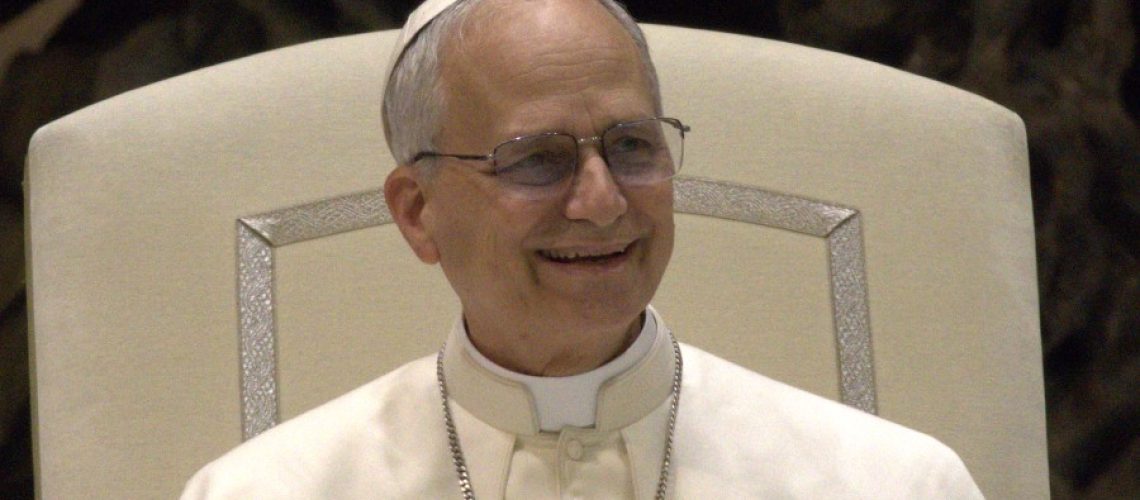
I was in Rome, Italy, on March 29, 2026, when, at his very first Palm Sunday Mass, Pope Leo XIV dared to preach words that stunned the square and echoed across the Church: “Brothers and sisters, this is our God: Jesus, King of Peace, who rejects war, whom no one can use to justify war. He does not listen to the prayers of those who wage war, but rejects them, saying: ‘Even though you make many prayers, I will not listen: your hands are full of blood.’” I almost wish we had chosen to worship in Saint Peter’s Square that morning, so that with my own ears I could have heard what I knew Pope Leo XIV was eventually going to press forward in the advancing the Church’s teaching on life and human diginity, to insisit on a more rigorous discernment of legitimate defense and a clearer recognition, given modern weapons and their immense destructive power, including the way these can make it difficult to avoid evils and disorders graver than the evil to be eliminated, and given how easily parties can pursue ‘partisan interests’ (e.g., the military‑industrial complex) rather than the universal common good, that it is often very difficult to satisfy the just-war criteria in practice.
Despite the ensuing criticism from political and Catholic commentators, Pope Leo XIV’s core move—using Isaiah 1:15 to argue that prayer cannot be reconciled with bloodshed and warfare justified by religious language – fits comfortably within the Catholic tradition. Origen, St. Clement of Alexandria, St. Cyprian of Carthage, St. John Chrysostom, St. Thomas Aquinas, and St. John Paul II all used this verse to teach that God’s “not listening” signifies a refusal of complicity with bloodshed. Even in his 2023 Vespers homily for the Solemnity of the Conversion of Saint Paul, Pope Francis explicitly cited Isaiah 1:13, 15, and 16, applying them to “sacrilegious violence” and to the scandal of Christians committing or tolerating brutality, especially wars and acts of violence. In that sense, there was nothing new in what Pope Leo XIV taught about the incompatibility of prayer with bloodshed and war when justified by religious rhetoric.
What was new or distinctive in Pope Leo XIV’s Palm Sunday homily was not the underlying logic—Isaiah’s warning that God does not accept religious devotion when violence and injustice remain unrepentant is a constant across the Fathers and modern papal teaching—but rather the rhetorical packaging he chose: “Jesus, King of Peace, who rejects war…” Traditionally, the Church has read Isaiah’s rebuke as a moral‑spiritual indictment: God rejects worship and sacrifice when they are divorced from justice and a purified heart, while “the prayers of the upright are acceptable” because righteousness is more pleasing than offering. Pope Leo XIV, by contrast, draws on that same principle but presents it with a more explicitly Christ‑centered and contemporarily applied focus—linking Isaiah’s “not listening” to Christ’s identity as King of Peace and to the practical impossibility of invoking God as a warrant for bloodshed while simultaneously praying. (Cf. Clement of Alexandria, Stromata, Book 7, Chapter 18.)
Development of doctrine, our confidence that the Spirit will guide the Church “into all truth” (Jn 16:13), never happens in an instant, as though someone simply flipped a switch. But if we pay careful attention, we can discern the direction in which the Spirit is leading the Church. For example, it was already clear that the Church would eventually move away from her earlier tolerance of state‑sanctioned killing when Gaudium et Spes decisively rejected the long‑standing acceptance of torture, teaching: “Whatever violates the integrity of the human person, such as mutilation, physical and mental torture, and attempts to coerce the will itself… are infamies indeed” (GS 27). That moment signaled a deeper moral trajectory, one that would later mature in Veritatis Splendor and culminate in the Church’s definitive judgment that the death penalty is now “inadmissible.”
Indeed, to the average person today, it may seem strange that the Catholic Church ever permitted torture at all. Since we live in a society that has largely removed torture from the administration of capital punishment, preferring the notion of a “humane” execution, the older teaching can feel alien. But for most of human history, torture was not an aberration; it was either the means by which the death penalty was carried out or its grim prelude. From 1252 onward, with Ad extirpanda (“…the podestà and rulers of the cities shall force all heretics… to confess their errors; and they may use torture, but without danger to life or limb”), the Church tolerated its use. Yet once Gaudium et Spes effectively rendered the logic of Ad extirpanda obsolete by condemning torture as an ‘infamy’, it became clear that the Spirit was leading the Church toward a deeper recognition of the inviolable dignity of the human person.
Once Veritatis Splendor re-grounded the Church’s moral theology in the person of Christ Himself, rather than in proportionalist or consequentialist calculations, it became possible to see how Gaudium et Spes had already cast a bright light on the emerging consensus within episcopal conferences around the world. The Holy Spirit’s guidance becomes visible when you trace those early signals. For example, the Indian Bishops’ Conference in 1969 called for the abolition of the death penalty on the grounds that modern society possessed “other effective means” to protect the common good. Likewise, in the United States, the USCCB’s 1974 statement urged a “presumption against capital punishment,” anticipating the deeper doctrinal developments that would follow. These early episcopal judgments were not isolated opinions; they were the first fruits of a moral trajectory that Veritatis Splendor would later anchor explicitly in Christ’s own revelation of the human person.
It would be fifty‑two years later, in 2017, when Pope Francis inserted into the Acta Apostolicae Sedis—the official record of the Apostolic See—the authoritative judgment that the death penalty is “contrary to the Gospel.” That phrase is not an innovation ex nihilo; it is the direct continuation of the Christocentric moral vision articulated in Veritatis Splendor. If the Church’s moral theology must reflect the morality of Christ Himself, then it must reflect the One who, at every turn, chose life. Even when the world gave Him death, He responded by giving His people life, and by preparing for them a path of life through the life‑giving and life‑affirming sacraments and liturgy. The Church’s rejection of the death penalty, therefore, is not a departure from her tradition but the maturation of it—an ever‑clearer conformity to the Lord who conquered death not by wielding it, but by overcoming it.
Now returning to Pope Leo’s statement that seems to strike at the heart of most wars are contrary to the Gospel, we can see that his Palm Sunday homily does not stand alone. It sits within a half‑century of magisterial tightening around the morality of war, a pattern remarkably similar to the Church’s development on the death penalty. The shift begins already in Gaudium et Spes, which famously declared that “the horror and perversity of war is immensely magnified” in the modern age and that acts of war aimed at indiscriminate destruction are “a crime against God and man” (GS 80). John Paul II deepened this trajectory by repeatedly insisting that modern warfare rarely meets the classical just war criteria, calling the Gulf War and later conflicts “a defeat for humanity” and warning that contemporary weapons make true discrimination between combatants and civilians nearly impossible. Benedict XVI continued this line, teaching that peace is not merely the absence of war but the fruit of justice and integral human development, a moral horizon that renders war increasingly incompatible with the dignity of the human person. The Compendium of the Social Doctrine of the Church (2004) stated that modern warfare “poses an enormous threat to humanity” and that the just‑war criteria must be interpreted “with great strictness.”
By the time we reach Pope Francis, the pattern becomes unmistakable. In Fratelli Tutti, he states plainly that “we can no longer think of war as a solution” and that the just‑war tradition “can be interpreted too broadly,” leading to moral distortion rather than moral restraint (FT 258). He goes further, arguing that with today’s weapons and geopolitical realities, “it is very difficult nowadays to invoke the rational criteria elaborated in earlier centuries to speak of the possibility of a ‘just war’” (FT 260). This is precisely the kind of pre‑magisterial groundwork that preceded the Church’s eventual judgment that the death penalty is “inadmissible.” Pope Leo XIV’s Palm Sunday teaching, that Christ the King of Peace “rejects war” and does not hear the prayers of those who wage it, is best understood as the next step in this same Spirit‑guided maturation. Just as the Church came to see that the death penalty contradicts the Gospel, she is now discerning that modern warfare, in its methods and effects and corporate interests, stands in similar contradiction to the peace revealed in Christ.


Saint John Paul II clearly stated “Islam is very distant from Christianity”. Leo has repeatedly claimed Christians serve the same god (allah) as do Islamists/Muslims. Why is this not refuted by the Vatican?
I’ve always appreciated being a Catholic because the church is a rock and doesn’t change with the winds of popular opinion. The new teachings on death penalty and just war just seem like rationalizations that leaves thousands of years of church doctrine blowing in the wind. Why be Catholic if we can reason ourselves into new ideas that suit the times? I also believe the reasoning on modern war being so destructive as to make it unjust in all cases is exactly backwards. An example of the church coming out of their lane and not understanding the real world. New weapons make precision strikes more possible than ever before . Please compare what’s happened in Iran with World War I and World War II. The indiscriminate bombing in London in Dresden. The fire bombing in Japan that was actually more devastating than the two atomic bombs. It is exactly backwards that modern war is too devastating to civilians.
Well-said. Leo’s attacks upon President Trump appear to lack appreciation of the fact that the islamist mullahs began “Trump’s War” (sic)” in 1979 with the murder of tens of thousands of Persians and declaring war against Israel, the United States and all Jews and Christians. The other option is that Leo knows full-well whom the aggressor against civilization is and yet chooses a political stance over a moral stance.
Blessings and Peace, Mark
Thanks for the comment, Mark. These essays are intentionally written in a more academic register because that’s the proper way to handle papal teaching—precision matters when you’re dealing with moral theology. I get that it can sound like hair‑splitting, but the Church makes distinctions so we don’t collapse serious questions about war, authority, and moral responsibility into slogans. And this project isn’t about naming geopolitical villains; it’s about explaining how Pope Leo XIV is developing the Church’s principles. Different task, different tone.
With apologies for being forthright (time is short and the day is long), please explain in layman’s vernacular how true Catholics can possible make sense of the words being issued by Leo. Words have specific meaning and declarations regarding matters of faith should likely not be confounded via convoluted phrases and high-sounding expressions. I am a life-long Catholic, a 40 year student of Scripture, have taught Confirmation classes, am a 4th Degree Knight and hold an Ivy League graduate degree – I cannot discern any reason in your words. Saint Pope John Paul II clearly stated “….not only the theology, but also the anthropology of Islam is very distant from Christianity.” – On the Threshold of Hope, circa 1994. Leo has repeatedly stated that Muslim and Christians serve the same god (Allah).Are you aware of this?
Well said Mark. This reads like a torn in half worn $10 bill taped back together and being handed to the cashier as legal tender.
That’s a wild analogy. LOL Thanks for reading it anyway!
I really appreciated this article. It was very helpful to me as it seemed that Pope Leo was speaking from the Christian non-violence tradition in his Palm Sunday holiday and I didn’t understand how this squared with the just war tradition or the obligation of states to defend their citizens (or the Church’s acceptance of the licitness of armed resistance to oppression under certain conditions). It didn’t answer my questions about self-defense or resistance to oppression, but it helped me see Pope Leo’s Palm Sunday homily as an organic development within the magisterium (whereas the non-violence tradition has been a valued stream but not the primary teaching of the magisterium).
Blessings and Peace, Megan,
That’s for following and appreciating the outline of my paper. I apologize for not spending more time on a legitimate defense, but I hoped to make the point that, from Leo XIV’s perspective, self-defense is the only legitimate defense that is not contrary to the Gospel
Great article David!
Thak you Timothy!!!
Leo wouldn’t know the gospel if it bit him in the ass. Truth.
Meanwhile, back in the real world of real responsibilities, this all sounds like college sophomores and second year seminarians performing theological gymnastics with fancy words. Yes, you guys are all very smart, TYVM. Yes, war is bad and poor decisions are made and innocents always get hurt. So…enter war with the utmost caution and forethought.
The splitting of hairs on what is just, what is unjust, what might be okay, whose prayers are heard and whose are not heard is all turning into a word salad circus by the over educated ecclesial elites.
And, of course, never call out the Muslim murderers by name. Nooo, not that, ever.
Blessings and Peace, Mark
Thanks for the comment, Mark. These essays are intentionally written in a more academic register because that’s the proper way to handle papal teaching—precision matters when you’re dealing with moral theology. I get that it can sound like hair‑splitting, but the Church makes distinctions so we don’t collapse serious questions about war, authority, and moral responsibility into slogans. And this project isn’t about naming geopolitical villains; it’s about explaining how Pope Leo XIV is developing the Church’s principles. Different task, different tone.
It seems convenient to listen to media propaganda that spreads CIA versions; they don’t know how many assassinations the US armed forces commit in various parts of the world. What is the justification, if not to defend the economic interests of corporations and the Zionist lobby?
Also, hundreds of bloody coups in various countries, which caused thousands of deaths, were instigated by the CIA.