
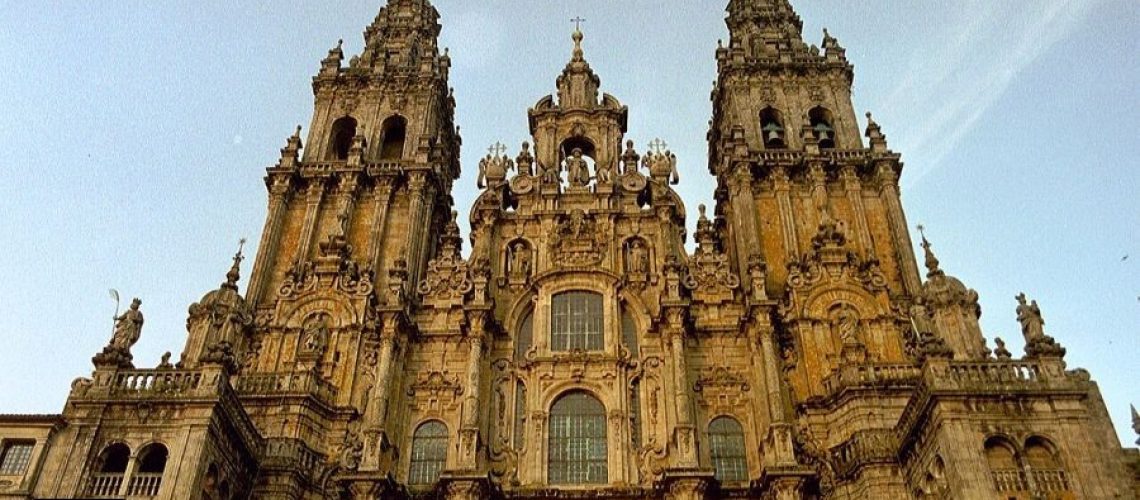
In late May I walked the Portuguese Way of the Camino de Santiago. It was a pilgrimage that was a blessing.
The Portuguese Way of the Camino de Santiago is one of many ancient routes taken by pilgrims for centuries to reach the tomb of St. James the Apostle in Santiago de Compostela. It’s one of more than 200 routes taken by pilgrims across Europe and North Africa each year. Each route ends at the Cathedral in Santiago de Compostela, in Santiago, Spain, where St. James the Apostle is entombed.
The different Camino Ways offer a variety of physical challenges, but all also offer gifts of contemplation, reflection, and penance. The paths range from short walks to long-distance treks over 1,000km taking more than 2 months.
Each journey demands endurance of both mind and body. But the various paths also reward travelers with stunning landscapes, opportunities to pray at centuries old churches, and encounters that linger long after the walk ends.
Camino pilgrims carry a passport issued by the Pilgrims’ office, the Oficina de Acogida del Peregrino. The office was established in the 18th Century, under the authority of the Cathedral of Santiago. The passport must be stamped at least two times a day, at stops along the way. Cafes, musicians, and businesses along the routes are very proud to give out their stamps, many with very ornate designs. Pilgrims who walk at least 100 km, or cycle at least 200 km, earn the Compostela certificate issued by the office.
The most popular routes are the Camino Francés and Camino Portugués. As a working professional with limited vacation time, I took the shorter Portuguese Route starting in Northern Portugal. I carried my backpack, followed yellow arrows, and stamped my credential at stops along the way.
An Unexpected Community
As I prepared for the physical aspect of the Camino, I walked quite a few miles at home. As I prepared, I usually walked alone. While walking the Way, however, I was very surprised to find that I was not walking alone. In fact, I was walking with a crowd.
Over 500,000 people walked the Camino in 2025. I initially believed that with this spread out over all the routes over a full year, I would run into few people each day. I was wrong.
Each morning, the path was teeming with pilgrims. Multiple times an hour, I would hear “Buen Camino” from someone I was passing, or more often from someone who was passing me!
Over the course of the pilgrimage, I encountered people from 6 continents. Only Antarctica was unrepresented. I met people from at least 27 countries. Ages ranged from a four-month-old infant carried by parents to an 84-year-old walker who had a better chance of finishing than me.
Men and women of every skin color walked the path. I met Catholics from nations the West often perceives as anything but Catholic including Japan and Communist China.
Pilgrims freely lent each other a helping hand regardless of ethnicity. They shared water and sometimes bandages for blistered feet. They offered directions when someone was straying from the route. Change was made for each other in coin laundromats. Language barriers sometimes made these interactions comical, but recipients expressed genuine gratitude.
These simple acts built bonds wiping away superficial differences. Everyone saw each other as someone created in the image of God. I drew the obvious conclusion. The Camino was truly diverse in the best sense. People united in a shared purpose.
Several negative forces remained absent during the walk. I noticed no resentment among pilgrims. Anger did not flare despite the fatigue. I did hear discussions about politics and even engaged in a few myself. Even in those potentially polarizing dialogues, no one lost their temper or was rude. The atmosphere fostered peace and mutual respect.
Slander Written on a Wall
During the trek, however, I observed a surprising amount of graffiti. Much of it displayed communist symbols with the hammer and sickle. Other markings promoted anarchy.
These messages appeared on walls, bridges, and trail markers. They contrasted sharply with the spirit of the pilgrimage itself.
One sign in particular caught my attention. It declared “The Camino is not Diverse,” in Spanish, and featured the homosexual rainbow flag.
Seeing this message early in my journey, my thoughts drifted back to its assertion many times. By the end of my pilgrimage, however, I knew this assertion was absolutely wrong.
Diversity or Conformity
As I approached the Praza do Obradoiro, exhaustion mixed with relief. Entering the square, I saw a large flag of the Arab Revolt hung from the Pazo de Raxoi. This building serves as the seat of the Santiago city council and houses the Galician government. The contrast struck me. The Camino itself was genuinely, organically, beautifully diverse. But the political messaging in the square seemed selective.
During the walk, I also saw Arab Revolt flags paired with “Liberate Palestine” and “From the River to the Sea.” This graffiti made me ask myself a lot of questions. It embraced some groups while excluding others. It celebrated certain identities while ignoring or condemning others.
For those claiming to seek diversity, Jewish people appear to represent the wrong kind of diversity. Although the graffiti claims to desire diversity, it seems to really want conformity. But conformity is the antithesis of diversity.
Authentic Diversity
When looking at the communion of saints, the life stories of the saints are amazing. Some saints were poor, others were kings. Some saints were soldiers, others were servants.
One can find patron saints for nearly every profession and even the obscure. Take Saint Lidwina of Schiedam as an example. She is the patron saint of ice skaters and the chronically ill. She is widely believed by modern scholars to be one of the earliest documented cases of multiple sclerosis. That is authentic diversity.
The Camino demonstrated living proof of authentic diversity through shared effort and kindness. Pilgrims from vastly different origins helped one another without demanding conformity. This stands in contrast to modern notions that weaponize diversity to exclude or punish those who do not conform.
I returned from the Portuguese Way blessed, enriched, and challenged by an absence of negativity. The path revealed humanity’s capacity for goodness when focused on a common purpose. It also highlighted tensions in today’s discourse around diversity and justice.
The Camino serves as a microcosm of the broader Christian call to walk together and help one another. We all are, after all, the fallen offspring of Adam and Eve.


[…] The Vatican Is About To “Update” Humanæ Vitæ – Anthony P. Stine, Ph.D.Finding True Diversity While Walking the Camino – Genesius at Catholic Stand MagazineCardinal Reina & Judas – Donald R. McClarey, […]