
Easter Octave: Wounded Glory That Heals the World
This article continues the meditation begun in “Passiontide: Humanity’s Dignity is Restored.” While Passiontide showed dignity purchased through humiliation, the Easter Octave reveals that same dignity transfigured — wounded, merciful, and eternal.
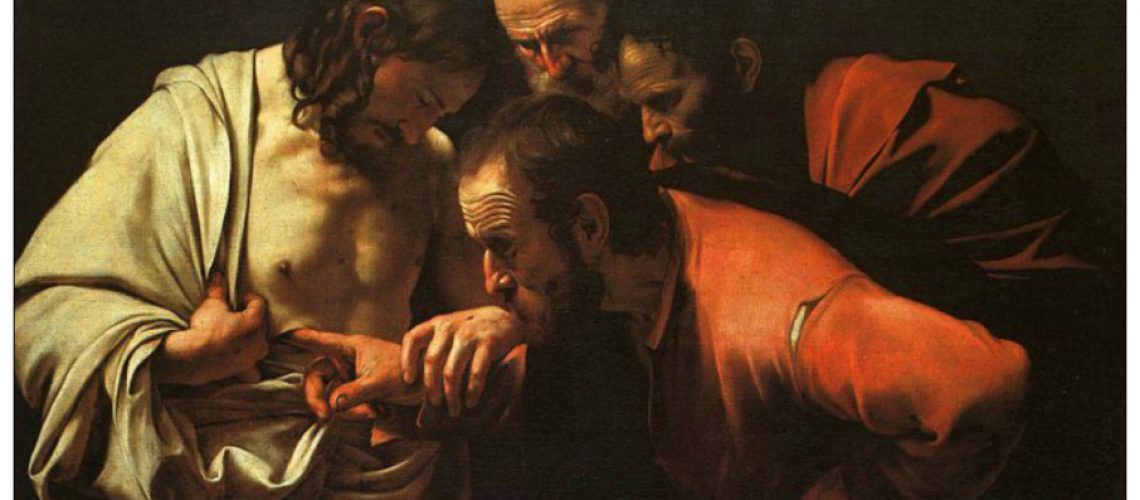
He does not return gleaming and untouchable. He returns hungry. He asks for fish. He cooks breakfast on a charcoal fire – the same kind of fire beside which Peter once denied Him (John 18:18 and John 21:9). And when Thomas, the patron saint of honest doubters, demands to see the wounds, the Risen Lord does not say, “How dare you?”
Then he said to Thomas, “Put your finger here and see my hands. Reach out your hand and put it in my side. Do not doubt but believe.” (John 20:27).
The Easter Octave (from Easter Sunday through the Second Sunday of Easter, now known as Divine Mercy Sunday) is not eight days of triumphant marching. It is eight days of a God who insists on keeping His scars. In those scars lies a truth the world desperately needs: our wounds, failures, doubts, and even our sins are not obstacles to glory. They are the very places where glory enters.
The First Gift of the Risen Lord
On the evening of that first Easter Sunday, the disciples huddle behind locked doors for fear of the Jews (John 20:19). Their Messiah is dead. Their hopes are shattered. They hide, not from Roman soldiers but from their own shame. Then Jesus stands among them. He does not rebuke their cowardice. He does not list their betrayals. The first word from His risen lips is not “Repent” or “Explain yourselves.” It is Pax vobis – “Peace be with you” (John 20:19).
The Catechism of the Catholic Church teaches that “the peace of the Risen Christ is the fruit of the victory over sin and death” (CCC 655). But it is more than a trophy. It is a gift offered to those who have done nothing to deserve it, including Peter, who denied Him three times; Thomas, who refused to believe; and the rest, who ran away. To all of them, Christ says: Peace.
In his homily for the institution of Divine Mercy Sunday (April 30, 2000), Pope St. John Paul II declared, “The Risen Christ entrusts to the Apostles the message of mercy: ‘Receive the Holy Spirit. If you forgive the sins of any, they are forgiven’ (John 20:22-23).” The first act of the risen Church is not judgement but forgiveness. The first gift of the Risen Lord is not proof but peace. This is the restoration of human dignity at its deepest level. We do not have to earn our way back into God’s presence. He comes through the locked doors of our fear and offers peace before we can even stammer an apology.
Wounds That Refuse to Disappear
But here is the strangest detail across all the Resurrection narratives: the Risen Christ retains His wounds. When He appears to the Eleven, He “showed them his hands and his side” (John 20:20). When Thomas demands proof, Jesus does not present a gleaming, flawless body. He says, “Put your finger here and see my hands. Reach out your hand and put it in my side” (John 20:27). St. Luke adds that the Risen Lord says, “Look at my hands and my feet; see that it is I myself. Touch me and see; for a ghost does not have flesh and bones as you see that I have.” (Luke 24:39). And then, almost absurdly, He asks for something to eat (Luke 24:41-43).
Why keep the Wounds? Why Not Ascend with a Body Unmarked by Suffering?
St. Thomas Aquinas addresses this directly in the Summa Theologiae (III, q. 54, a. 4). He asks whether Christ’s risen body retained its wounds. He answers yes, for five reasons. The wounds remain as trophies of His victory, as confirmation of His identity, as the permanent intercession He offers to the Father on our behalf, as an eternal rebuke to unbelief, and as the pledge of our own resurrection. Aquinas concludes that “The wounds that He accepted of His own will are a perpetual witness to His mercy.”
St. Gregory the Great, in his Homilies on the Gospels, goes further, “The wounds of Christ are the voice of mercy. Because He bears in His body the marks of His passion, He shows the Father that He has paid the price for us. And He shows us how much He loves us.”
This is the radical claim of the Easter Octave: glory does not erase suffering; it transfigures it. The Risen Christ is not someone who forgets His passion. He carries His passion into eternity, and in doing so, makes it a source of healing for the world.
Thomas: The Dignity of Honest Doubt
No figure in the Easter Octave is more beloved to modern believers than Thomas. He was absent at the first appearance (John 20:24). When the others tell him, “We have seen the Lord,” he refuses to accept their testimony. He sets his terms, saying, “Unless I see the mark of the nails in his hands, and put my finger in the mark of the nails and my hand in his side, I will not believe” (John 20:25).
How often has Thomas been mocked as Doubting Thomas? Yet the Catholic tradition has largely treated him with tenderness. St. Augustine of Hippo, in his Tractates on the Gospel of John (Tractate 121), says, “Thomas doubted for our sakes, not for his own. The Lord’s kindness allowed the doubt to remain so that when He offered His wounds to be touched, He might heal the wound of our unbelief.”
Eight days later — the Octave’s final day — the Lord Jesus returns. This time, Thomas is present. And Jesus does not scold. He invites (John 20:27). Thomas’ response is the most powerful confession of faith in the entire Gospel.
Thomas answered Him, “My Lord and my God! John 20:28
The Catechism notes that this confession is a formula of faith addressed to the Risen Christ (CCC 448). It is also the restoration of one man’s dignity. Thomas is not punished for his doubt. He is met within it. And his doubt, once transfigured by the wounds, becomes the Church’s most explicit declaration of Christ’s divinity.
Pope St. John Paul II, in Fides et Ratio (1998), wrote: “Faith and reason are like two wings on which the human spirit rises to the contemplation of truth.” Thomas embodies this. He uses reason – “I need evidence” – and then surrenders to faith. His dignity is not in having no doubts. His dignity lies in bringing his doubts to Christ and finding that Christ is not threatened by them.
Emmaus: The Stranger Who Burns Our Hearts
The Wednesday within the Octave presents the Emmaus story (Luke 24:13-35). Two devastated disciples walk away from Jerusalem. They have heard the women’s report of the empty tomb, but they do not believe. Their faces are downcast (Luke 24:17). The Lord Jesus draws near, but their eyes are kept from recognising Him (Luke 24:16). He asks what they are discussing. They pour out their broken hearts, “We had hoped that he was the one to redeem Israel” (Luke 24:21). Past tense. Hope is dead.
And what does the Risen Lord do? He walks with them. He listens. Then, beginning with Moses and all the prophets, he interprets to them the things about himself in all the scriptures (Luke 24:27). Not a magic trick. Not a flash of glory. Scripture study on a dusty road. When they reach Emmaus, they urge him, “Stay with us, because it is almost evening and the day is now nearly over” (Luke 24:29). He takes bread, blesses it, breaks it, and gives it to them. Their eyes are opened, and they recognise him. Then he vanishes from their sight (Luke 24:31).
The Catechism regards the Emmaus story as the model for the Eucharist: “The breaking of bread — which is the proper term for the Eucharist — is the means by which the disciples recognise the Risen Lord” (CCC 1346). But there is more. The Risen Lord’s dignity is not diminished by walking incognito with two failures. He does not demand to be recognised. He serves them. He opens the Scriptures to them. He breaks bread for them.
In his apostolic letter Dominicae Cenae (1980), Pope St. John Paul II wrote: “In the breaking of bread, the Lord is recognised. The Eucharist is the sacrament of the presence of the Risen One.” The dignity of the disciples – and of every communicant – lies in being served by the Risen Lord Himself. They do not ascend to Him. He descends to them.
The Touch That Transforms
On Tuesday of the Octave, we read about Mary Magdalene weeping at the tomb (John 20:11-18). She sees Jesus but mistakes Him for the gardener. He speaks her name, “Mary.” She turns and cries, “Rabbouni!” (Teacher). Then Jesus says the mysterious words, “Noli me tangere,” meaning “Do not cling to me, for I have not yet ascended to the Father” (John 20:17).
In Tractate 121, St. Augustine offers a beautiful interpretation. “Mary Magdalene, who had been a sinner, wanted to hold the risen Christ as if He were still a mortal man. The Lord says, ‘Do not touch me’ — that is, do not think of me in the flesh, but understand that I am ascending to the Father.” This is not a rejection of Mary. It is an elevation of her faith. She is being called to move beyond mere physical clinging towards a spiritual union. Her dignity lies not in holding Jesus back but in letting Him ascend and then in receiving the Holy Spirit.
St. Thomas Aquinas (Summa III, q. 55, a. 6) adds, “Christ’s ascension is the cause of our salvation, because it opens the way to heaven for us.” Mary’s willingness to let go is her greatest act of faith. The Easter Octave teaches that dignity sometimes means letting go of what we love so that God can give it back to us in a greater form.
Mercy For Peter
The Friday within the Octave gives us John 21:1-14. Seven disciples fish all night but catch nothing. The Risen Lord stands on the shore and calls, “Children, have you caught anything?” No. “Cast the net on the right side.” They do. The net is so full they cannot haul it in.
John whispers, “It is the Lord.” Peter (impetuous, shamed, and forgiven) jumps into the water and swims to shore. And there: a charcoal fire with fish already cooking. The same kind of fire beside which Peter had warmed himself while denying Jesus (John 18:18).
The Risen Lord does not mention the denial. He simply says, “Come and have breakfast” (John 21:12). He serves Peter and feeds him. Later, He asks Peter three times, “Do you love me?” One for each denial, and then commissions him to feed His sheep (John 21:15-19).
In Jesus of Nazareth: Holy Week, Pope Benedict XVI writes, “The charcoal fire is the place of Peter’s forgiveness. The Lord does not erase Peter’s past. He redeems it. The same fire that witnessed Peter’s failure now witnesses his restoration.” This is the heart of the Easter Octave. The Risen Lord does not want us to forget our wounds. He wants to meet us beside them, cook breakfast for us, and send us out to love.
Conclusion: Scars As Glory
On the Second Sunday of Easter (Divine Mercy Sunday), the Church proclaims John 20:19-31. The Octave ends as it began: with the wounds, with Thomas, with mercy. The Sequence Victimae Paschali Laudes sings, “Death and life have contended in that combat stupendous: the Prince of Life, who died, reigns immortal.” But He reigns immortal with scars.
The Catechism concludes its section on the Resurrection by quoting St. John Chrysostom, “Do not seek Christ in the tomb, for He is risen” (CCC 655). Yet we might add: do not seek a Christ without wounds. The glory of the Octave is not a glory that has forgotten suffering. It is a glory that has transfigured suffering.
St. Faustina Kowalska, the apostle of Divine Mercy, recorded in her Diary (no. 1573) the words of Jesus, “The greater the sinner, the greater the right he has to My mercy.” That is the dignity restored. Not the dignity of the flawless, but the dignity of the forgiven.
Take-Home Message
Come to the charcoal fire. Touch the wounds if you must. Eat the fish He has cooked. And hear Him say, not “How dare you doubt?” but “Peace be with you.”
The Octave is over, and Mercy has just begun. “My Lord and my God!”
*NB: Unless specifically stated, all Bible quotations are from the NRSVCE.


God bless u, Pamela for ur beautiful, inspirational & healing words! I find myself on Mother’s Day Eve alone, wishing my God daughter was here, but we’ve been separated for 5 months. It’s been such a depressing time, yet I have found God’s graces in Jesus’ wounds.
I’ve tried apologizing for being judgmental, even took blame for our separation just so we could start some communication, it’s been slow, occasional & not enough for me. Texting is not a relationship, as I told her.
Tonight, I’m drying my tears as I delete her Mother’s Day wish & an “I love u” message. How I wish I could hug her & have her back as the daughter I never had!
While I read ur article, I truly felt Jesus here w/ me & realized the importance of His wounds, Resurrection that brought me redemption. I give Him my grieving & know He will heal my wounds.
[Comment Edited due to length]