
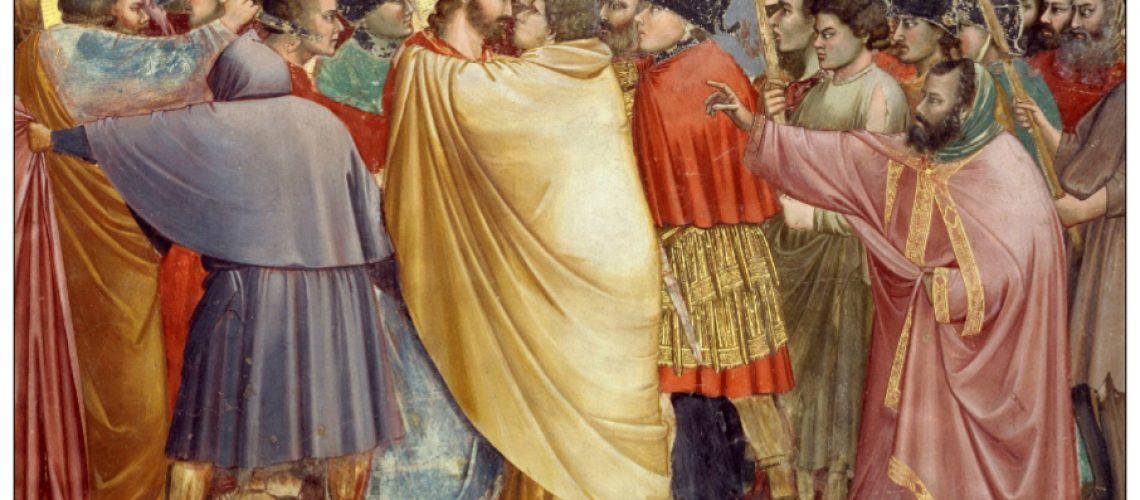
We are all familiar with the Last Supper narratives in which Jesus identifies Judas as his betrayer. However, something interesting occurs in John 13 when one of His disciples asks which one of them will betray Him. John 13:26-27 (RSV-CE) states:
‘It is he to whom I shall give this morsel when I have dipped it.’ So, when He had dipped the morsel, He gave it to Judas, the son of Simon Iscariot. Then, after the morsel, Satan entered into him.
Was this morsel the Eucharist? To arrive at the right conclusion, we need to review the narratives in the first three Gospels (called the Synoptic Gospels) regarding the Last Supper.
Synoptic Narratives
Matthew 26:17-25 tells us that as Jesus and His disciples (the Twelve) were eating the Passover meal, Jesus told those sitting closest to Him that one of them would betray Him. They inquire about the betrayer’s identity, and He responds, “He who has dipped his hand in the dish with me will betray me.” Verse 25 reveals that this person is Judas. Then, verses 26 to 29 record the institution of the Eucharist.
Mark 14 gives us the same sequence of events as Matthew. Of note, when the disciples ask Jesus who will betray Him, He responds, “It is one of the Twelve, one who is dipping bread in the same dish as me.” Both Matthew’s and Mark’s accounts state that Judas dipped His own bread during the Passover meal. By the way, Jesus’s statement, “It is one of the Twelve,” indicates that He disclosed the information about His betrayer to a few of the disciples rather than to all twelve.
In Luke’s narrative (Luke 22), the disciples prepare the Passover meal, but his account omits their eating the Passover meal and Judas dipping bread into the same dish as Jesus. Instead, Luke goes straight to the institution of the Eucharist (verses 14-23). Immediately after Jesus institutes the Eucharist, He reveals that one of the disciples will betray Him. Then, the disciples question which one of them will do this.
So, Luke’s account skips the Passover meal’s consumption and Judas dipping his bread into the dish. Luke also places the conversation about Jesus’s betrayer after the institution of the Eucharist.
John’s Narrative
John’s gospel, specifically chapter 13, completely omits the institution of the Eucharist. Instead, he begins with the Passover meal – “during supper” (verse 1-2). Then, he briefly mentions Judas’s immanent betrayal. Finally, he describes Jesus’s washing of the disciples’ feet. For more on the deeper meaning of Jesus washing the disciples’ feet, please click here.
After these events, namely, after the Passover meal and the foot washing, Jesus reveals that one of the Twelve will betray Him (vs. 21). When some of the disciples ask Him who will betray Him, He answers, “It is he to whom I shall give this morsel when I have dipped it.” Then, He gives the morsel to Judas. Verse 27 reads, “Then, after the morsel,” presumably after Judas ate the morsel, “Satan entered into him.”
Is the Morsel the Eucharist?
Notice that in Matthew’s and Mark’s versions, Jesus identifies His betrayer as the one who dips bread into the dish with Him during the Passover meal. However, John says that Jesus identifies His betrayer after the Passover meal and the foot washing. Then, Jesus gives Judas a morsel that He, Jesus, dipped.
I believe there are two conversations going on in the Upper Room. The first conversation happens during the meal itself. This is when Judas dips his bread into the dish with Jesus. The second conversation occurs immediately after the institution of the Eucharist, when Jesus again discloses the identity of His betrayer.
Notice that in John’s version, Jesus and His disciples eat the Passover meal. Then, He washes their feet. Then, they eat again (vs. 21-26). The foot washing occurs between the two meals. If the first meal (or the first part of the meal) is the Passover meal, then the second part must be the Eucharist. This comports with Luke’s narrative in which a conversation about Judas’s betrayal ensues after the institution of the Eucharist. Therefore, the morsel that Jesus gave Judas was the Eucharist.
Order of Events
When combining the gospel narratives, we discover the following order of events:
- The disciples prepare the Passover meal in the Upper Room.
- Jesus and the disciples eat the meal.
- During the meal, Jesus tells some of His disciples about Judas, and Judas dips his bread into the same dish as Jesus.
- Jesus washes the disciples’ feet.
- Jesus consecrates the bread and wine, which have become the Eucharist.
- Jesus again speaks of His betrayer.
- Jesus gives the Eucharist to Judas.
- Satan enters Judas.
If this is correct, the reason that Satan entered Judas after he ate the morsel was because, given his decision to betray Jesus, he received the Eucharist unworthily. By receiving the Eucharist unworthily, Judas became guilty of bringing judgment upon himself through consuming the Sacred Species blasphemously (see 1 Corinthians 11:27 and 29). Judas exchanged Jesus for Satan in his profanation of the Eucharist.
Please note that Satan did not enter Judas simply because he received the Eucharist unworthily. Judas was, from all accounts, an unrepentant thief who conspired with certain Jewish religious leaders to kill Jesus. Instead, Judas’s final blasphemy of unworthy reception was the proverbial straw that broke the camel’s back because it meant that he gave full consent of his will to Satan at that moment.
For more evidence about the Eucharist being Jesus, please click here.
Objection
Why would Jesus give Judas the Eucharist knowing that Judas was in a state of mortal sin and that Satan put betrayal “into the heart of Judas” (John 13:2)?
The Divine Son eternally volunteered to assume a human nature and save us from our sins by handing Himself over to both Jews and Gentiles for abuse and crucifixion. As such, Jesus’s decision to hand His Eucharistic self to His betrayer was well within His prerogative. Furthermore, Jesus continues to hand His Eucharistic self to those whom He knows will receive Him unworthily.
The Church does not have this prerogative, however. Rather, she has a duty to care for the Eucharist as a bride cares for her husband.
[Social media appeal: Hello, readers! If you think my article, or any other article at Catholic Stand, will help others better understand and/or spread the faith, please post a link to your social media account(s). Thank you!]


Hi Nate,
thank you for this insight. I was curious to see if this theology was considered.
[…] Archive in Ohio Aims to Preserve the History of U.S. Women Religious – CWRDid Satan Enter Judas Because of the Eucharist? – Nate Guyear at Catholic StandMarian Image In Rock Baffles Scientists – Fight For Mary […]
Did Judas go to hell for his betrayal of Jesus, even though he gave the money back, but he did commit suicide which is a mortal sin as Jesus taught in cutting the wheat and is thrown into the fire. Is there a teaching that Judas may be in heaven in the Bible or in the Catechism or in the Magisterium of the Church?
Yes. People eating after receiving bad news is truly perplexing (insert sarcasm).
“Furthermore, Jesus continues to hand His Eucharistic self to those whom He knows will receive Him unworthily.
The Church does not have this prerogative, however.”
If the Church’s pastors act in the person of Christ, then they most certainly do have the prerogative. In fact, your second proposition directly contradicts Jesus’ own words as recorded by Matthew.
Canon law says otherwise, Susanne. Canon 915 states, “Those who have been excommunicated or interdicted after the imposition or declaration of the penalty AND OTHERS OBSTINATELY PERSEVERING IN MANIFEST GRAVE SIN ARE NOT TO BE ADMITTED TO HOLY COMMUNION” (emphasis added).
Further, if a priest intentionally gives someone the Eucharist while knowing with certainty that the person is in grave sin, he is no longer in persona Christi. This is no different than a priest intentionally pouring the precious Blood on the floor immediately after consecration. At that moment, he would not longer be in person Christi.
Please tell me precisely which part of Matthew I contradicted in my article.
Twelve years of parochial education. Prove that I’m wrong, please.
My article proves that you’re wrong. As usual, you have nothing of substance to say. By the way, your comment proves that you have no proof to back your statements.
According to the CC, Judas did not and was not in mortal sin at the time. He knew what he
was planning was wrong. He premeditated the future act BUT had not followed through
with it because it was in the future. This does not satisfy the conditions necessary for mortal sin. And, don’t forget, Jesus told him to “do it quickly” under the impression that he was leaving to give alms. The question is, without the betrayal, none of this would have ensued without a serious rewrite of the script.
Mornin, OP! Prove what you write please.