
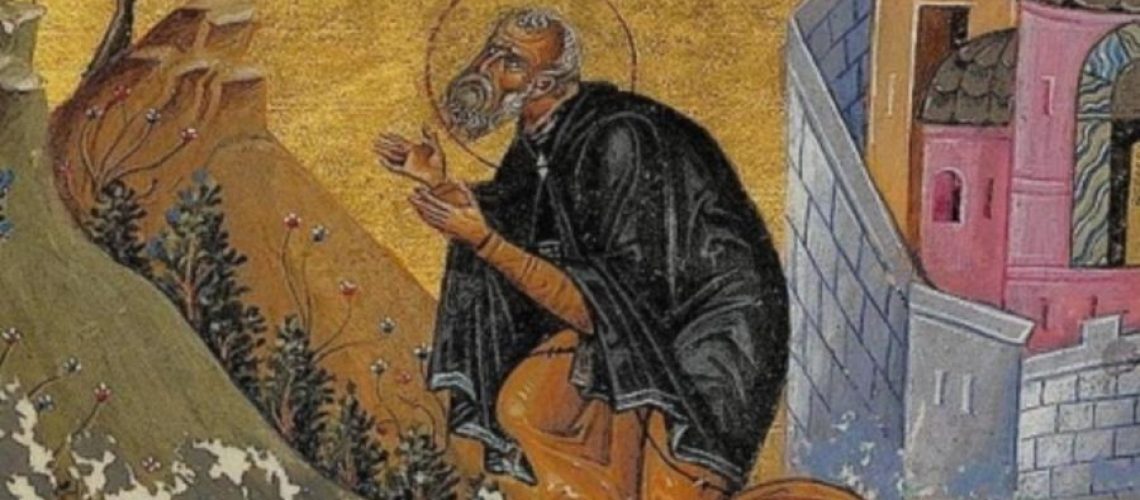
The Stillness That Roared: St. John the Silent and the Urgent Ministry of Holy Silence for the USA and Nigeria
In the United States, the percentage of adults who report currently having or being treated for depression has exceeded 18% in both 2024 and 2025, a rate that projects to an estimated 47.8 million Americans suffering in a silence that is anything but holy. In Nigeria, according to the World Health Organisation, about one in four Nigerians, nearly 50 million people, suffer from some form of mental illness, yet shockingly, fewer than 10% receive any form of treatment. Meanwhile, between July 2024 and June 2025, at least 4,722 Nigerians were abducted across 997 kidnapping incidents, while 762 were killed in attacks linked to banditry and related violence. Silence in both nations has ceased to be a spiritual treasure; it has mutated into a pathological noise‑void. The silence of the stigmatised, the burnt‑out, the digitally saturated, and the terrorised. Into this hush of pain steps a figure from the sixth century whose very surname was Silence: St. John the Silent (c. 454–558 AD), also known as John the Hesychast.
John did not flee noise; he fled the illusion that noise is life. His story, preserved by his disciple Cyril of Scythopolis, is not a quaint legend but a laboratory of interior freedom. This essay retells that story in prose, analyses the miraculous data that frame it, and then demonstrates why John’s silent witness is not an escape from the world but the only way to love it aright.
The Heir Who Became a Beggar
On 8 January 454, in Nicopolis of Pontus (modern Koyulhisar, Turkey), a son was born to Encratius and Euphemia, a family of imperial generals and governors. They named him John. His education blended Hellenistic rigor with Christian piety, but what struck observers most was his strange gravitas: as a boy he sought corners to pray, as a youth he cultivated silence before he had anything to hide.
In 471 both parents died, leaving John, then eighteen, a vast inheritance. The teenager did what few adults would dare: he liquidated his estate, built a church dedicated to the Most Holy Theotokos, and erected a monastery beside it. With ten companions he began a regime of fasting, manual labour, and unadorned prayer-years that carved out of his soul a “cavern of stillness” that would later shelter thousands of pilgrims who never met him but whose restless hearts his story still calms.
The Reluctant Bishop and the Cry for Escape
At twenty‑eight, against his vehement protests, the Metropolitan of Sebaste consecrated John Bishop of Colonia in Armenia. For nine years John fulfilled the office with monastic austerity rooted in disciplining clergy, defending the poor, and even journeying to Constantinople to petition Emperor Zeno against a rapacious governor who happened to be his own brother‑in‑law.
But the machinery of episcopal administration suffocated him. In 490, having secured imperial protection for his diocese, John did not return to his cathedra. Instead, he slipped into the Jerusalem wilderness, sobbing for a sign. One night “a bright cross appeared in the air and a voice said, ‘If you desire to be saved, follow this light.’ The light moved and pointed to the monastery of St. Sabas” (Lives of the Monks of Palestine, Cyril of Scythopolis).
The Hidden Years: A Bishop Who Plunged Toilets
At the Laura of St. Sabas, John presented himself as an unlettered peasant. The abbot assigned him the humblest duties: hauling water, serving construction workers their meals, cleaning latrines. A prince of the Church scrubbed floors, and in that scrubbing he discovered a dignity that no throne could confer.
For four years his identity remained hidden. When St. Sabas deemed him ready for ordination to the priesthood, John had no choice but to break his silence and confess his episcopal rank. The news stunned the community. A living bishop had been living among them as the lowliest of servants. The matter was brought before the Patriarch Elias of Jerusalem, who, after astonished deliberation, issued a decree as startling as it was profound: “Let him dwell alone in perpetual silence” (Benedictine Monks, 1921).
Patriarch Elias’s intervention was not a punishment but a profound spiritual diagnosis. He recognized that for a soul as advanced as John’s, the greatest episcopal service he could now render the Church was not administration but intercession. In commanding perpetual silence, the Patriarch was not silencing a voice; he was consecrating a sanctuary. For the modern world, where Pope Francis laments that in the social media era “even the most tragic and painful experiences risk not having a quiet place where they can be kept” and “everything has to be exposed, shown off, fed to the gossip mill of the moment” (CathNews, 14 Feb 2024), this decree stands as a revolutionary act. It declares that a human being’s worth is not measured by their output, visibility, or digital footprint, but by their capacity to become a living tabernacle of God’s presence. Patriarch Elias’s “perpetual silence” was the creation of a sacred zone where the noise of ego, ambition, and the world’s incessant demands were forbidden to enter. It is a prescription our burnout-ravaged, and notification-bombarded societies desperately need to recover.
Sabas assigned John a cell built against a rock face. For five days each week John tasted no food, saw no face, and uttered no word. On Saturdays and Sundays he stood in the chapel, “weeping streams of tears.” These copious tears, shed publicly at the liturgical assembly, were not tears of sorrow, depression, or despair. They were, in the language of the Desert Fathers, the “gift of tears” (donum lacrimarum). It is a supernatural grace of compunction that dissolves the hardness of the heart and brings the soul into an acute, painful, but purifying awareness of God’s love and one’s own unworthiness.
In his seventh-century classic The Ladder of Divine Ascent, St. John Climacus teaches that just as fire consumes dead brush and allows a forest to regenerate, the gift of tears cleanses the soul of the toxins of sin and egotism, allowing new, divine life to flourish.
In our modern societies, John’s weeping stands as a devastating critique. We live, as Pope Francis has observed, in a culture that suppresses tears and pathologizes vulnerability, demanding instead a curated performance of perpetual success for social consumption. The data confirms the deadly cost: the most common symptoms of loneliness reported in the 2025 APA Stress in America survey included feeling depressed or sad (65% vs. 15%) and feeling nervous or anxious (60% vs. 24%). Millions are drowning in unshed tears, suffering from what psychologists call “emotional dysregulation” — an inability to access, express, and process authentic feeling. John’s “streams of tears” were the precise opposite: a torrent of truth-telling before God that cleansed, healed, and liberated. He teaches that the capacity to weep is not weakness; it is the erosive force that breaks the dam of pride behind which the soul’s stagnant,
poisoned waters have been trapped. In a world dying of dehydrated hearts, John’s tears offer a map to the wellspring of healing.
The Lion, the Loaves, and the Long Sunset
Tradition records that brigands once approached his hermitage, advancing upon a man who possessed no weapons and offered no resistance. Suddenly, a lion emerged from the surrounding brush and stood sentinel beside the frail old man. The great beast did not roar or attack; it simply stood. A silent, golden wall of muscle and mane. The marauders, who had come prepared to face down a terrified monk, found themselves frozen before a predator that regarded them with an unnerving, steady calm. Their courage collapsed. They turned and fled into the desert from which they had come.
The twentieth-century theologian Romano Guardini, in his profound study The Lord, speaks of the “lion of God”. It is the divine majesty that is utterly tame for those who dwell in grace but fearsome and terrifying to the forces of darkness. The lion at John’s cave was no mere trained animal or convenient coincidence. It was a theophany. A visible, and physical manifestation of the divine protection that always surrounds the soul consecrated to God. This is not a legend of a pet lion but a revelation that holiness creates a force field against evil.
For the terrified faithful of Zamfara, Katsina, Kaduna, and Kebbi States in Nigeria, where mass abductions involving up to 100 victims are recorded in a single month and entire villages are targeted for terror, this story is not a quaint fable but a battle cry for supernatural hope. The lion at John’s cave declares that there exists a divine protective presence that armed bandits cannot overwhelm. When human security forces are outnumbered, outgunned, or absent, as they so often are in Nigeria’s vast, poorly governed rural spaces, the “Lion of the tribe of Judah” Himself takes up the watch. This does not promote passivity; it promotes prayer that is active, militant, and expectant. It calls the Nigerian faithful to sanctify their villages through ceaseless prayer, confident that the same God who dispatched an angelic lion to guard one solitary monk can dispatch legions of holy angels to guard a consecrated community. For the body of Christ in Nigeria under siege, St. John’s lion is a spiritual intelligence report from the heavenly realm: the forces guarding the righteous outnumber the forces of evil, and faith is the key that unlocks that unseen dimension of protection.
Furthermore, a disciple named Roubâ, blinded by carnal expectation, once presented himself at the elder’s cave and demanded a festive Easter meal befitting the Resurrection. He wanted, in that austere desert, a tangible, edible proof of God’s abundance. A sign that the feast day was real. John, who had lived beyond the tyranny of the palate for decades, counseled patience and trust in divine providence. But Roubâ’s faith was too weak, his hunger too loud. He stormed away in disbelief, his emptiness now filled with the bitter food of resentment.
Then, the story takes a Eucharistic turn. A complete stranger, a man neither had ever seen, appeared at John’s cave bearing a miraculous provision: hot white loaves, wine, oil, freshly made cheese, and golden honey. The fragrant steam of the bread, the aroma of the wine, the richness of the dairy, and the sweetness of the honey, combined to transform the barren cave into a chamber of divine hospitality. When Roubâ returned, perhaps to mock or perhaps to confirm his cynicism, he discovered the feast. The evidence of divine generosity overwhelmed his doubts, and he “recognized his own lack of faith and prostrated himself shamefacedly before the elder” (Ghezzi, 2006).
Roubâ is the living portrait of every soul whether in Lagos, New York, or London who stands hungry in the midst of plenty. He represents the Christian who has access to the inexhaustible treasury of God’s grace yet lives in spiritual starvation because faith has been replaced by the demand for visible, immediate, tangible proof. In a world where global food production is sufficient to feed every human being, yet the UN’s Food and Agriculture Organization reports that between 713 and 757 million people faced hunger in 2023, approximately one in eleven people globally, the rich hoard while the poor starve.
However, the deeper famine is spiritual: the hunger for meaning, for purpose, for the transcendent. The stranger who appeared at John’s cave is Christ the Provider, who is never outdone in generosity.
The hot white loaves prefigure the Eucharist, the Bread of Life given for the life of the world. The wine, cheese, oil, and honey signify the overflowing richness of a life nourished by grace, not merely by material consumption. Roubâ’s prostration teaches that the solution to the world’s hunger crisis, both physical and spiritual, begins not with policy, though policy is necessary, but with penitent faith. When the human heart, humbled and repentant, opens to divine providence rather than storming away in cynical demand, the cave of scarcity becomes a banquet hall of abundance.
In 503, factionalism temporarily expelled Sabas from the Laura, and John retreated further into the desert. Six years later, with the abbot’s return, John came back too. He lived forty more years in the silence he had so fiercely guarded, dying on 8 January 558, aged one hundred and four. He had spent seventy‑six years in monastic solitude, interrupted only by nine years of episcopal service.
Part II on June 2nd


[…] & Armenian Patriarch Talk about a “Third Vatican Council” – Rorate CæliA Sixth-Century Answer to a Twenty‑First‑Century Emergency – Catholic Stand MagazineJesuits Leave Liege After 450 Yrs; Ecological Transition More […]
[…] “Safe Environment Training”, V.I.R.T.U.S. : Diocesan Bureaucracy. . . – Rorate Cæli8. A Sixth-Century Answer to a Twenty‑First‑Century Emergency – Catholic Stand Magazine9. Benedict’s Resignation: The Question of the Frozen […]