
May: The Month of Mary
Mary is the month of May, and the faithful who wish to live in her must be like May flowers (St. Louis de Montfort).
For centuries, the Catholic Church has set aside the month of May as a special time to honour the Blessed Virgin Mary. This tradition, which fully blossomed in the nineteenth century, invites the faithful to crown statues of Our Lady, pray the Rosary, and set up small “May altars” in homes and parishes. It is a month of flowers, filial love, and gentle devotion. It is a time when even the most distracted Catholic pauses to remember the Mother of God.
But there is a danger in any long-standing tradition: we can mistake the gesture for the grace. We crown Mary with roses, yet fail to ask what made her worthy of the crown. We recite Hail Marys, yet never contemplate the interior dispositions that made her full of grace. We honour her from a distance, as if she were a statue in a niche—beautiful yet remote, perfect yet unreachable. The Church, however, offers us May not as a sentimental escape but as a school of discipleship. Mary is not a distant queen to be admired from afar; she is a mother to be imitated from within. The month of May is therefore not merely a time to honour Mary, but to learn from her—to study the postures of her heart and, by grace, ask to make them our own.
Let us explore four such postures—Fiat, Theotokos, Memorare, and Stabat Mater—that together form what we might call the Marian Vocation. It is a vocation offered to every baptised Christian, who, like Mary, is asked to say yes, to carry Christ, to ponder in silence, and to stand at the cross. May, then, becomes not just a month of crowning but a month of becoming.
What Does It Mean to Be “Called to Be Mary”?
At first glance, the phrase seems impossible. Mary is the Mother of God, conceived without sin and assumed into heaven. How could an ordinary Christian—tired, flawed, and often afraid—ever answer such a summons? Yet the Catholic tradition has always offered a gentle yet firm paradox: Mary is unique in her role but universal in her posture. What she lived perfectly, every disciple is invited to live truly. The Second Vatican Council, in Lumen Gentium, called Mary the “type” or “model” of the Church. She is the first and most perfect disciple—not because she did extraordinary things, but because she said “yes” with an extraordinary heart.
To be “called to be Mary” is to embody four deep postures of the soul: radical consent (Fiat), carrying Christ into the world (Theotokos), pensive pondering (Memorare), and faithful presence at the cross (Stabat Mater). When lived daily, these four postures transform an ordinary Christian life into a living gospel.
Fiat: The Posture of Radical Consent
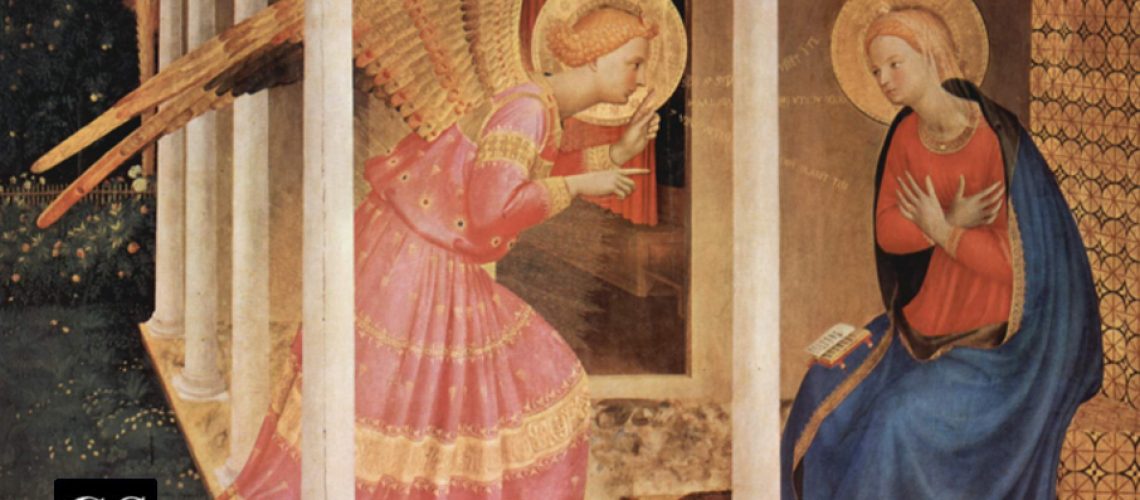
At the Annunciation, Mary faced a request that defied reason and reputation. She was young, poor, and unmarried, and an unexpected pregnancy could mean death. Yet she replied: “Behold, I am the handmaid of the Lord. Let it be done to me according to your word” (Luke 1:38).
This Fiat is not passive resignation. It is active, trusting surrender. St. Thomas Aquinas taught that Mary’s yes was uttered in the name of all humanity: a willingness to cooperate with God’s saving plan. St. Irenaeus echoed: “Mary, by her obedience, became the cause of salvation for herself and for the whole human race.”
How does an ordinary Christian live the Fiat? St. Joseph is the silent master. When he discovered his betrothed was pregnant, the law and his wounded heart told him to walk away. But when an angel spoke in a dream, Joseph offered his own Fiat without a single recorded word. He laid down his plans, his reputation, and his understanding—and he obeyed.
Blessed Maria Catherine of St. Augustine (1632–1668) embodied the daily Fiat when, at sixteen, she left home to serve as a nurse in the brutal conditions of New France (Canada). She spent her short life caring for the sick. Her Fiat wasn’t a single dramatic moment—it was a thousand small “yeses” offered in dirt, disease, and sacrifice.
To live the Fiat today means to stop negotiating with God. When a difficult marriage, an unwelcome diagnosis, or a sudden change arrives, the Marian disciple whispers: “Lord, I don’t understand, but let it be done.”
Theotokos: The Posture of Carrying Christ
The Council of Ephesus (AD 431) defended the title Theotokos—”God-bearer”—because it safeguarded the truth that Jesus is fully God and fully man. But the Fathers also saw in Mary’s biological motherhood a spiritual pattern for every believer. St. Augustine preached: “Mary heard God’s word and kept it, and so she is blessed. She kept God’s truth in her mind, a nobler thing than carrying his body in her womb.”
St. Paul echoes this: “My little children, for whom I am again in the pain of childbirth until Christ is formed in you” (Galatians 4:19). And again: “Christ in you, the hope of glory” (Colossians 1:27).
To carry Christ means that our primary identity is Christ‑bearer. Every encounter becomes a potential “womb” where Christ is secretly formed and then brought to light. A kind word to a frustrated coworker, a diaper changed with patience, a truthful email written without malice—these are acts of spiritual pregnancy.
St. Thérèse of Lisieux, the Little Flower, never left her cloistered convent. Yet she is a Doctor of the Church because she discovered the “Little Way”—the conviction that small acts of love carry Christ to the ends of the earth. She prayed for missionaries she would never meet, offering her tiny sacrifices as spiritual dynamite. No act of love is too small to be a Theotokos moment.
Living this posture means asking every morning: “Where is Christ waiting to be born through me today?” And then answering not with grand projects, but with faithful presence in the ordinary.
Memorare: The Posture of Pensive Pondering
Luke’s Gospel twice notes that Mary “treasured all these things, pondering them in her heart” (Luke 2:19, 2:51). The Greek word symballousa suggests “throwing together”—as if Mary gathered the confusing fragments of her life and held them before God, refusing to rush to judgment.
The Desert Fathers regarded this posture as the highest form of prayer. John Cassian taught that “the Lord makes the chief good consist in meditation; i.e., in divine contemplation.” St. Bernard of Clairvaux, the great Marian Doctor, offered a practical rule: “In dangers, in doubts, in difficulties, think of Mary, call upon Mary. Let not her name depart from your lips, never suffer it to leave your heart.”
Memorare (Latin for “remember”) is the name of the famous prayer to Mary, but it is also a way of being. In a world that demands instant reactions and constant noise, the Marian disciple cultivates the lost art of holy pondering. She doesn’t panic when she doesn’t understand. She holds the mystery in silence and waits.
St. Mary Magdalene de Pazzi (1566–1607), a Carmelite mystic, was known for profound ecstasies. But her pondering became the source of extraordinary practical wisdom. People came to her for counsel because she had learned to sit with God in silence before speaking to others.
To live the Memorare posture today means building a “pondering pause” into your day. When something confusing or painful happens, stop for ten seconds. Place a hand on your heart. Say: “I will not react yet. I will ponder this with Mary.” That small pause is the difference between a life of chaos and a life of depth.
Stabat Mater: The Posture of Faithful Presence at the Cross
The most searing image of Mary in Scripture is found at the foot of the cross (cf. John 19:25). The Latin hymn Stabat Mater (“the Mother was standing”) captures this moment: Mary did not flee, faint, or despair. She stood. Love stood.
St. Ambrose of Milan observed that while the other Gospels mention the earthquake and the darkened sun, only John records Mary’s presence. Her standing was the quietest yet most powerful sign of all. She was the first to drink the chalice of her Son’s Passion, and she did not flee.
The Stabat Mater posture is the test of authentic discipleship. It is easy to say “yes” when the sun is shining. It is another thing entirely to stay present when life falls apart—when a marriage fails, a child rebels, or a grave illness strikes.
St. John of the Cross lived this posture from within a cold, dark prison cell. Imprisoned by his own brothers, he had no comfort, no explanation, no visible hope. Yet from that cell came The Dark Night of the Soul. He did not run from suffering; he found God inside it.
St. Gemma Galgani (1878–1903) offered herself as a “victim soul,” uniting her intense physical and spiritual sufferings to the cross for the conversion of sinners. She received the stigmata and endured constant trials, yet she never abandoned her Stabat Mater. She stood.
To live this posture means to identify one “cross” in your life today that you are tempted to run from, and then to choose, with Mary, to stand. Not to fix. Not to understand. Just to stand. That faithful presence is already a participation in Christ’s own Paschal mystery.
Becoming a Living Icon
The four Marian postures are not a ladder to be climbed in sequence. They are a constellation—each shines in a different season of life. There are days when the only grace you can manage is a whispered Fiat. There are seasons when you are called to carry Christ through relentless care for others. There are nights when all you can do is ponder in bewildered silence. And there are mornings when you wake already standing at a cross you never chose.
The invitation of the Catholic tradition, witnessed by the Fathers and lived by the saints, is this: you do not need to be perfect to be Mary-like. You only need to be available. You need a heart that learns to say yes, a life that carries Christ into the ordinary, a soul that ponders before reacting, and a will that stands firm when standing is hardest.
Mary did not do extraordinary things by worldly standards. She lived in a small town, married a carpenter, raised a son, and stood in hard places. That is exactly why she is our hope. If Mary could say yes, so can you. If Mary could carry Christ, so can you. If Mary could ponder, stand, and remain—so, by grace, can you. And when you do, you become what Mary was: a living gospel, a small incarnation, a yes that stands.
A May of Becoming
As May draws to a close and we remove the flowers from Our Lady’s altar, the real work of Marian discipleship begins. Crowning a statue is easy; crowning one’s own heart with humility, surrender, and faithful presence is the labour of a lifetime. The Church gives us May not as a thirty-day escape, but as a thirty-day immersion in the only life that truly matters—a life lived, like Mary’s, in the quiet sanctuary of God’s will. So take these four postures with you beyond May. Let your Fiat echo through June’s ordinary Tuesdays. Let your Theotokos bearing of Christ continue in the July heat. Let your Memorare pondering steady you in August’s anxieties. And let your Stabat Mater standing anchor you whenever any season brings its inevitable Friday.
Mary is not the Mother of May alone. She is the Mother of every month, every moment, every ordinary breath. And to be called to be Mary—even imperfectly, even falteringly—is to discover that the yes she spoke in Nazareth is still bearing fruit, still standing at crosses, still pondering mysteries, still carrying Christ into a world that desperately needs him. This May, and every day thereafter, may we become, by grace, what Mary already is: a living fiat, a faithful stabat, a bearer of the Word. Amen.
Presented in gratitude to the Blessed Mother and in memory of the holy men and women—known and unknown—who have stood, pondered, borne, and said yes before us.


[…] Pope Francis & Now Pope Leo: The Evil & Cover-Ups Continue – Gene Thomas GomulkaThe Yes That Stands: Four Postures for Month of May – Dr. Pamela Mandela at Catholic Stand MagIsrael To Build ‘Pride City’ Near Ancient Sodom […]
This essay is a lovely synthesis of four Marian postures, all related but each one distinctly applicable to a different season of life. I appreciate the precision of your writing. Thank you!