
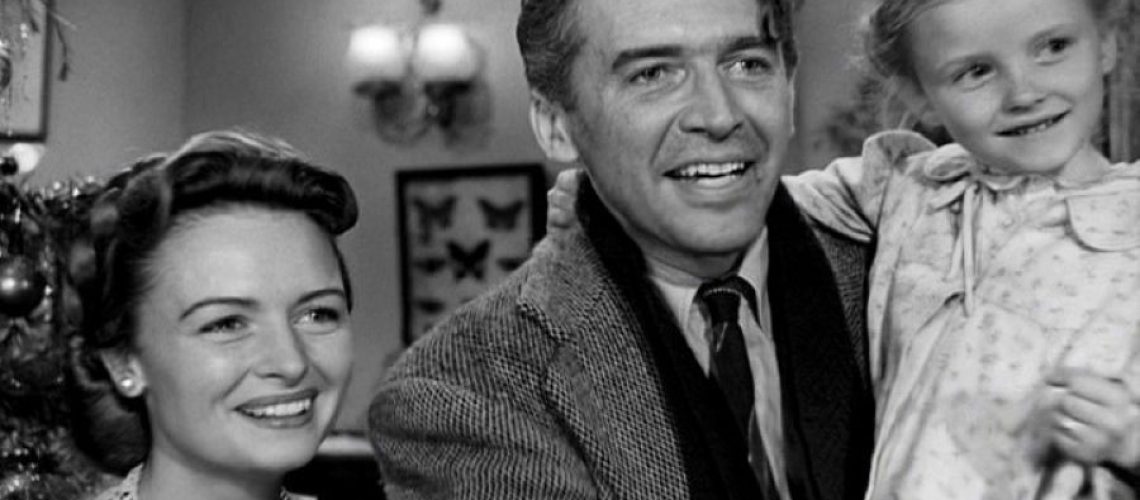
My community theater company’s 2025 holiday production got an unexpected and unprecedented advertisement by none other than the Pope himself. In November, Pope Leo XIV announced that his favorite movie is It’s a Wonderful Life, Frank Capra’s 1940s classic, based on the story, “The Greatest Gift” by Philip Van Doren Stern. Our troupe of thespians was already in rehearsal for this title when we learned of the Holy Father’s preference. What a stroke of luck it was to be able to advertise, “We’re doing Pope Leo’s favorite show!”
Why Does Pope Leo Like This Movie?
Naturally, upon hearing the Pontiff’s favorite movies, our first thoughts go to what might be the reasons for his preferences. In the case of It’s a Wonderful Life, several elements of the plot illustrate Gospel themes.
Most obvious is the pro-life message in It’s a Wonderful Life. Faced with financial ruin after spending his life sacrificing and doing good for others, George Bailey contemplates suicide. Monitoring George’s crisis from the heavenly realm, the angels lament the possibility of George throwing away “God’s greatest gift.” Later, George tells his guardian angel, Clarence, “I wish I’d never been born.” After showing George what his community would be like if he had never existed, Clarence comments, “Strange, isn’t it? Each man’s life touches so many other lives. When he isn’t around it leaves an awful hole.” The angel’s words attest to the intrinsic value of each person.
A second aspect of Frank Capra’s film that reflects Christian values is the presence of prayer. As he sinks into despair at a counter in Martini’s restaurant, George prays, “God, dear Father in heaven, I’m not a praying man, but if you’re up there and you can hear me, please, show me the way.” At home, when his children realize that George is in trouble, their first response is to ask their mother if they should pray for their daddy. Their mother’s response is, “Yes, pray very hard.” In fact, the first scene in the movie is of multiple voices, George’s neighbors, family, and children, asking God to help George. What a blessing it would be if Hollywood would provide more examples of people turning to God in their need.
Themes of Sacrificial Love and Helping Neighbors
Sacrificial love is a major theme in It’s a Wonderful Life. From his childhood, George Bailey makes sacrifices in service of others. He loses his hearing in one ear after jumping into freezing waters to save his younger brother from drowning. He endures a beating while preventing the town druggist from inadvertently putting poison in capsules for a sick patient. He gives up his plans for college and travel so that he can stay home and run the family Building and Loan business when his father passes away. The Building and Loan is instrumental in helping his struggling neighbors to have decent homes. Ironically, George’s sacrifices imitate those of the Lord he claims not to know very well.
The theme of neighbors helping each other extends to characters in George Bailey’s community. First, his wife, Mary, has been devoted to him since her childhood. She donates their honeymoon money when a bank crisis threatens to close the Building and Loan. She works to make an old broken-down house into a home, and supports George even when he is at his worst.
Set during World War II, the story includes the charitable work that ordinary people did to help the war effort: scrap drives, rubber drives, women in the community running the USO. Not to spoil the ending for those readers who have not watched It’s a Wonderful Life, let us just note that there is a moving spectacle of neighborly love in the film’s conclusion as well.
Some Problematic Content
Being a creation of Hollywood, It’s a Wonderful Life contains a few instances of problematic content from a theological perspective. The story presents a common confusion about angels and saints. The dialogue of the guardian angel, Clarence, reveals that he once lived an earthly, human life, and that he has been waiting over a hundred years to get his angel wings. This implies that after death, humans become angels, which is, of course, incorrect. As the catechism instructs, angels are noncorporeal spirits, while humans are composed of body and soul. Humans and angels are two different creatures. Humans do not become angels when they die.
Then there is the very appealing proverb, “Every time a bell rings, an angel gets his wings.” Poetic as it sounds, this is simply a fairy tale.
Finally, the heavenly spirit who reports that George is about to throw away God’s greatest gift also presents flawed theology. God’s greatest gift to humanity is his Son, Jesus Christ, the Incarnation, present in the Eucharist. Life is a great gift, yes, but greater still is God’s coming to be with his creatures, to make possible our entrance into eternity with Him.
Ordinary Humans as True Neighbors
Despite the flawed theology and George’s occasional inappropriate outbursts (he actually says, “You call this a happy family? Why’d we have to have all these kids?”), It’s a Wonderful Life presents ordinary humans, who struggle, pray, sacrifice, and act as true neighbors to one another. Whether these are the aspects of the film that appeal to our Holy Father, we cannot know. But we can appreciate the advantage of having a Holy Father who hails from our homeland and shares a treasured piece of our culture.


[…] Charms Curia with Sugar Not Vinegar: Annual Papal Christmas Message – Fr. A.J. McDonaldA Review of Pope Leo XIV’s Favorite Movie – Mary Ennis Meo at Catholic Stand MagazineFidelity! Fidelity! Fidelity: Leo’s Apostolic […]