
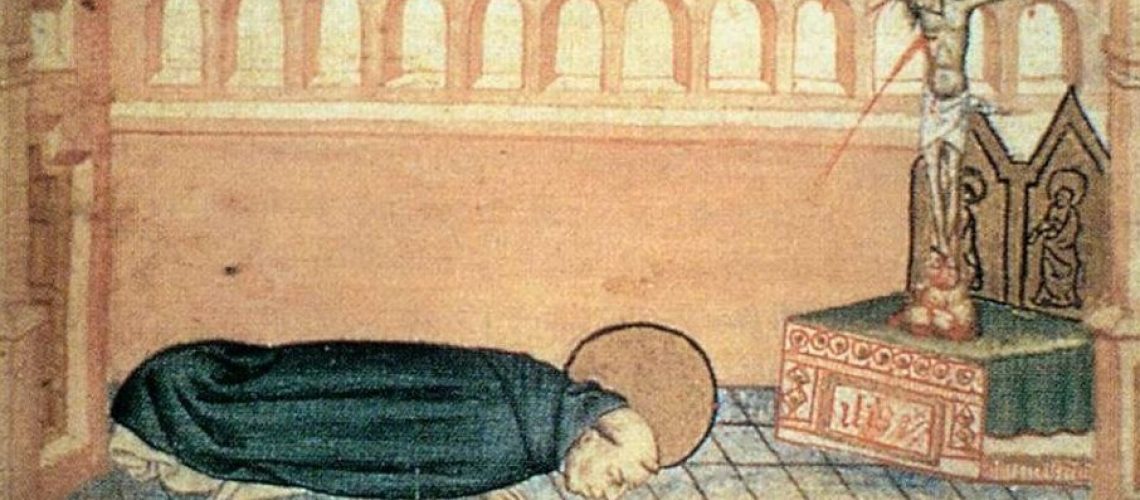
This essay examines the life and legacy of St. Dominic de Guzmán (c. 1170–1221), verifying thirty-one of forty discrete historical claims against primary sources, identifying three pious traditions that require qualification, and correcting two widespread misconceptions: Dominic did not found the Inquisition, which was formally established in 1231, ten years after his death; nor did he receive the Rosary in the fully developed form associated with the fifteenth century and Blessed Alan de la Roche.
The great majority of the article is historically well supported. Beyond biography, it explores Dominic’s fourfold method of public debate, apostolic poverty, education, and community life—first in response to Catharism in Languedoc and then in relation to contemporary challenges in Nigeria, the United States, and the United Kingdom. Dominic’s approach to governance, intellectual formation, evangelical poverty, common life, incarnational theology, peaceful engagement, and contemplative prayer offers valuable insights for societies facing political polarisation, educational decline, clerical abuse scandals, loneliness, confusion about human identity, and growing mental-health concerns. The essay concludes with seven intercessory prayers for different vocations and states of life.
Dominic was born around 1170 in Caleruega, Old Castile, to noble parents, Félix de Guzmán and Juana de Aza, who was beatified in 1828. His death occurred on 6 August 1221 in Bologna, Italy, at the age of fifty-one, and his relics are venerated in the Basilica of San Domenico. Recognising his holiness, Pope Gregory IX canonised Dominic on 13 July 1234, only thirteen years after his death, making his canonisation one of the most rapid in Church history. The universal Church celebrates his feast on 8 August (Calendarium Romanum, 1969).
The young Dominic studied the liberal arts and theology at the studium generale of Palencia from approximately 1184 to 1191. During the great famine of 1191, he reportedly sold his books, clothing, and furnishings to provide food for the starving, declaring that he “could not prize dead skins while living bodies were dying of hunger” (Jordan of Saxony, Libellus, n. 10). By 1196, he had entered the cathedral chapter of Osma, becoming a canon regular and later sub-prior.
Between 1203 and 1205, Dominic accompanied Bishop Diego de Acebo on a diplomatic mission to Denmark. The mission, connected with a proposed royal marriage, required two journeys and took them through Toulouse, where they encountered the flourishing Cathar movement. This experience would profoundly alter the course of Dominic’s life.
From 1205 to 1215, Dominic devoted himself to preaching in Languedoc. He travelled on foot, often barefoot, engaged Cathar Perfecti in public theological disputations, and sought to win people through preaching, reason, Scripture, and the example of evangelical poverty. Although the Albigensian Crusade began in 1209, Dominic was not a military participant and his vocation was fundamentally apostolic rather than political or military.
In 1206, he established the monastery of Notre-Dame-de-Prouille, which became a community for women converted from Catharism and an important centre of Dominic’s missionary work. Prouille also became the first foundation associated with what would develop into the Dominican family. In opposition to the Cathar rejection of material creation and marriage, Dominic proclaimed the goodness of creation, the dignity of the human person, and the Christian understanding of the Incarnation.
In Toulouse in 1215, Dominic gathered the first community that would become the Order of Preachers. Pope Honorius III formally approved the Order on 22 December 1216 through the bull Religiosam Vitam. Dominic helped establish a distinctive form of religious governance: superiors were elected, authority was exercised through provincial and general chapters, and the friars embraced evangelical poverty, depending upon alms rather than accumulating personal wealth.
The friars were sent out “two by two,” and foundations soon appeared in Paris (1217), Spain (1218), Bologna (1218), and Rome (1219). By 1300, the Order had expanded to approximately sixty provinces and 8,000 friars. It would eventually provide the Church with several popes and produce some of the great theological and philosophical minds of the medieval Church, including St. Thomas Aquinas.
The canonisation investigations of 1233, conducted in Bologna and Toulouse, recorded sworn testimony concerning miracles attributed to Dominic’s intercession. Among the most remarkable was the reported raising of the young Napoleone Orsini from the dead. Other testimonies concerned the multiplication of bread for the friars at Bologna and numerous healings associated with Dominic’s prayers and the sign of the cross (Processus canonizationis S. Dominici, ed. Walz, 1935).
Witnesses also described Dominic’s intense devotion at Mass, including his tears and the radiant appearance of his face. Jordan of Saxony famously wrote that Dominic spoke only “to God or about God” (Libellus, n. 27). He rejected personal honours, served his brothers humbly, and devoted himself tirelessly to preaching. Later Dominican tradition developed the familiar iconography of Dominic: the dog carrying a torch, associated with his mother’s prophetic dream; lilies symbolising purity; a book representing his preaching and theological teaching; a star; and the distinctive black-and-white Dominican habit.
Correcting Two Popular Traditions
Two popular associations with St. Dominic require historical qualification.
First, Dominic did not found the Inquisition. The papal Inquisition was formally established under Pope Gregory IX in 1231, ten years after Dominic’s death. Dominic served as a papal preacher in Languedoc, but there is no reliable evidence that he served as an inquisitor.
Second, there is no reliable thirteenth-century evidence that Dominic received the Rosary in the fully developed form familiar today. The traditional association between Dominic and the Rosary became especially prominent through the preaching of the Dominican Blessed Alan de la Roche in the fifteenth century. Dominic’s authentic legacy, however, includes the Order’s strong tradition of Christ-centred repetitive prayer and its later promotion of the Rosary throughout Europe.
These distinctions do not diminish Dominic’s importance. Rather, they allow his historical legacy to emerge more clearly from later devotional traditions.
Dominic and the Cathar Challenge
Catharism contained a strong dualistic tendency, distinguishing sharply between spiritual reality and material existence. Its rejection of the goodness of creation had significant consequences for its understanding of the sacraments, marriage, the priesthood, and the resurrection of the body. The Perfecti embraced an austere way of life, while ordinary believers, known as Credentes, often postponed receiving the consolamentum until the end of life.
Dominic responded not primarily through political power or force but through a distinctive fourfold approach:
- Public debate, using Scripture, reason, and theological argument.
- Evangelical poverty, demonstrating that Catholic preachers could embody the ascetic seriousness that Cathar preachers claimed for themselves.
- Education and formation, particularly through Prouille and the developing Dominican communities.
- Common life, offering a visible witness to the Church as a community of faith, charity, worship, and sacramental life.
Organised Catharism eventually disappeared as a major religious movement, although its decline resulted from a combination of preaching, theological controversy, political developments, and military action.
A Contemporary Challenge
The underlying dualistic tendency has not disappeared; rather, it has taken new forms. In Nigeria, for example, one can identify contemporary tendencies that sometimes separate spiritual aspirations from a balanced Christian understanding of material and human reality. These include certain forms of prosperity preaching, anti-sacramental religious movements, online forms of spiritual Gnosticism, and traditional spiritual interpretations involving competing forces of good and evil.
Dominican communities in Nigeria continue to respond through catechesis, education, theological formation, preaching, and evangelisation. In this sense, the Dominican method remains remarkably relevant: encounter error with truth, respond to confusion with formation, and offer an alternative through the witness of Christian community.
Threshold Insight: Every young person scrolling through a spiritually charged video stands before questions remarkably similar to those faced by earlier generations: What is the human person? What is the purpose of life? Is the material world good? Where is truth found? Dominic’s answer was not coercion but encounter—not condemnation but conversation, and ultimately, not argument alone but the witness of a Christian community.
Dominic and the Challenges Facing the West
The charism of this Castilian saint also speaks with remarkable relevance to the contemporary challenges facing the United States and the United Kingdom.
First. Democratic Governance and Political Polarisation
Dominic’s system of elected superiors and representative chapters created a distinctive form of shared governance within religious life. Authority remained real, but it was exercised through structures of accountability, consultation, and communal responsibility.
At a time when political polarisation in the United States and distrust within British public life have weakened confidence in institutions, the Dominican model offers an important reminder: authority need not be either authoritarian or ineffective. It can be strong while remaining accountable, participatory, and ordered toward the common good.
Second. Intellectual Rigour and the Erosion of Educational Purpose
For Dominic, study was not an optional academic pursuit. It was essential to preaching the Gospel faithfully. The Dominican Order consequently established itself within the great intellectual centres of medieval Europe, including Paris and Oxford.
Today, Catholic institutions of higher education face a different challenge: how to preserve education as more than vocational preparation or economic advancement. Dominic’s vision challenges Catholic universities to recover education as a search for truth—ultimately, for Truth who is a Person.
Institutions such as Georgetown, Notre Dame, Boston College, St Mary’s Twickenham, and Blackfriars Oxford stand within a tradition that can still draw deeply from this Dominican commitment to the integration of faith, reason, and intellectual inquiry.
Third. Evangelical Poverty and the Scandals of Affluence and Abuse
Dominic’s commitment to evangelical poverty was not simply an expression of personal asceticism. It was part of his credibility as a preacher. He sought to demonstrate through his life that the Gospel could not be separated from self-sacrifice.
The Church’s experience of clerical abuse and institutional failures has made questions of power, wealth, accountability, and status especially urgent. Evangelical poverty cannot by itself prevent abuse, but it can challenge the culture of entitlement, secrecy, and excessive attachment to institutional power that can allow wrongdoing to flourish.
The Dominican Sisters of St. Cecilia in Nashville and the Dominican community at Blackfriars in Oxford offer contemporary examples of religious communities seeking to unite intellectual formation, common life, apostolic work, and evangelical poverty.
Fourth. Community Life and the Epidemic of Loneliness
The modern epidemic of loneliness reveals one of the deepest wounds of contemporary society. People can be surrounded by technology and yet experience profound isolation.
Dominic understood that Christian discipleship could not be lived as an entirely private experience. He sent his friars “two by two” and rooted them in common prayer, shared meals, study, preaching, and chapter life.
Dominican lay communities in the United States and Britain continue this tradition by bringing prayer, friendship, formation, and service into parish and family life. In an increasingly atomised culture, the Church’s common life can become a powerful witness to the truth that human beings are created for communion.
Fifth. The Goodness of the Body and Contemporary Questions of Human Identity
Against Cathar dualism, Dominic proclaimed the goodness of creation and the Christian truth of the Incarnation. Christianity does not regard the body as a prison from which the soul must escape. The body belongs to the human person and participates in his or her dignity.
Contemporary debates about sex, gender, and human identity raise difficult questions that cannot be answered adequately through either ideological slogans or political hostility. Thomistic anthropology offers a framework in which body and soul are understood as a unity and human dignity is grounded in the reality of the person.
The work of institutions such as the Thomistic Institute in Washington, DC, and Blackfriars in Oxford demonstrates the continuing relevance of this intellectual tradition.
Sixth. The “Spiritual but Not Religious” and the Need for Encounter
Many people today describe themselves as “spiritual but not religious.” Some have rejected organised religion because of negative experiences; others have never encountered a compelling presentation of Christianity. Still others construct highly individualised spiritual systems from meditation, New Age beliefs, psychology, and popular culture.
Dominic’s method offers an important lesson. He did not retreat from difficult questions. He travelled, listened, debated, preached, studied, and lived visibly as a Christian.
The Dominican digital apostolate provides contemporary expressions of this approach. Projects such as the UK’s Godzdogz and the US-based Aquinas 101 seek to bring Catholic intellectual formation into the digital public square.
Seventh. The Rosary, Contemplation, and the Search for Interior Peace
Although the fully developed Rosary postdates Dominic, the Dominican tradition has played an enormous role in promoting this prayer throughout the centuries.
The Rosary brings together the physical rhythm of the beads, the imagination engaged by the mysteries, and the mind and heart directed toward Christ. In an age of constant stimulation, this repetitive, contemplative prayer can provide a disciplined space for silence and reflection.
Its value should not be reduced to a psychological technique. For Catholics, the Rosary is fundamentally a prayer with Mary that leads the believer more deeply into the mysteries of Christ.
Threshold Insight: In every age, the Church is tempted to answer the world’s errors with the world’s weapons—power, mockery, or withdrawal. Dominic chose another path. He walked into the argument, trusted the power of truth, and embodied the Gospel he preached. His witness reminds us that truth spoken with charity can transform hearts more profoundly than force ever can.
The Flame Endures
According to Dominican tradition, Dominic’s final days were marked by concern for his brothers and by a profound spirit of charity. He died in Bologna on 6 August 1221, exhausted by his labours but surrounded by members of the community he had founded.
The flame of Dominic’s apostolic vision did not die with him.
For the United States and the United Kingdom, a new Prouille may not mean a single physical monastery. It may mean networks of intentional Christian communities, schools, parishes, houses of formation, and digital apostolates capable of welcoming the spiritually homeless and forming the intellectually curious.
Dominic’s example suggests that renewal begins not with anger at the culture but with holiness within it; not with retreat from difficult questions but with the courage to enter them; and not with the abandonment of reason but with the conviction that faith and reason ultimately lead toward the same Truth.
Final Threshold
A man who sold his books to feed the hungry and devoted himself to preaching rather than taking up the sword has become a lasting witness to the power of truth, charity, study, and prayer. His intercession is needed by those searching for justice, by those seeking meaning, by those wounded by division, and by two weary democracies searching for a renewed sense of purpose. Nothing is too broken for the intercession of a saint who understood that nothing was too small to receive the love of God.
St. Dominic’s Intercessory Prayers
First. For Future Priests
Holy Father Dominic, obtain for young men the courage to lay down their lives at the altar, to study sacred truth with hunger, and to shepherd God’s people as servants. Amen.
Second. For Religious Sisters
Guardian of Prouille, intercede for consecrated women, that they may be signs of spousal love and places of refuge for the wounded. Amen.
Third. For Married Couples
O Saint who honoured the goodness of creation, pray for spouses in cultures that have forgotten the sacred dignity of the body, that their homes may become true domestic churches. Amen.
Fourth. For Those Living the Single Life
Walk with those who are alone—whether by circumstance, choice, or waiting—and help them discover in their solitude a garden of prayer and a place of encounter with God. Amen.
Fifth. For Dominican Friars and Religious Brothers
Preserve in your sons the charity of communal governance, the poverty of the apostolic road, the discipline of study, and the joy of preaching the Gospel. Amen.
Sixth. For Catechists and Teachers
Bless all who hand on the faith with clarity of mind and patience of heart. Give them wisdom to teach the young and courage to place the light of truth into many hearts. Amen.
Seventh. For the Persecuted and Falsely Accused
Stand beside those who suffer unjust condemnation: refugees, prisoners of conscience, the persecuted, and all who have been silenced. Obtain for them courage, justice, protection, and hope. Amen.


[…] Analysis, Punditry, and News from Around the Catholic Blogosphere:The Truth in the Flame: St. Dominic’s Charism – Vincent Obiajulu at Catholic Stand MagazineThe Lord is Near the Brokenhearted – Diana […]