
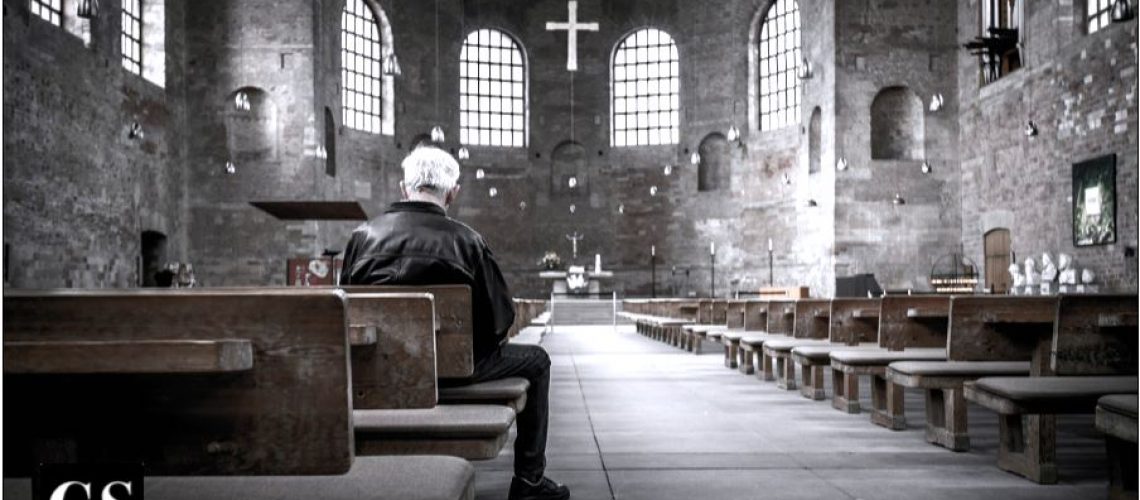
When Donald Petrie’s 1993 hit Grumpy Old Men became a movie sensation, many of us instantly related to the title, chuckling to ourselves while thinking, Humm, grumpy old men? —yeah, I know some of them.
And what is it about age that would make a man grumpy?
- Declining testosterone?
- A feeling of impotence against an ever encroaching and rapidly eroding culture?
- Being dismissed as a member of a failed generation, a purveyor of now frequently derided values?
- Demonized for being plain-spoken, insensitive, and politically incorrect?
Yes, yes, yes, and yes. And, of course, all of the above also occur within a faith-community setting, and thus we have grumpy, crabby old Christians—of both sexes.
It seems that, for the first twenty years of their lives, we attempt to form our children in our own image, and for the next twenty years, they attempt to form us in theirs. I, for one, am sometimes glad of it. It was one of my sons who recently gently hinted that I might be on the verge of grumpy-old-man syndrome, and that, as such, my effectiveness in all areas of endeavor might suffer. I am deeply indebted to him for that. It is hard, at this age, to prevent righteous indignation from degenerating to mere grumpiness—the latter requiring much less fortitude than the former.
And, that said, I think the difficulty applies to most of us. When does righteous indignation become just a rant? It becomes so when it is composed more of emotion than it is of fact or wisdom. This flawed approach to thinking and communicating affects far more than the aged among us. Many of our young have become old—ancient before their time—for their uber-emotional diatribes often resemble the floundering rants of a fading, set-in-their-ways, impotent generation than they do the rise of eternal youth: the well-spring, the wisdom of the ages.
Am I a grumpy old Catholic? I can be. Heaven knows, there is plenty to be grumpy about. What are the things that get under my skin? Well, to start with, there are points 2 through 4 as listed above. A recent homily I heard lamenting the division within both the political sphere and the Church comes to mind. This poor priest attempted to extoll unity without spending an ounce of effort probing the source of all disunity: sin. Unity, dear clergy—like happiness—is a result, not a goal unto itself. A prayer for unity must be a prayer to end that which creates the disunity, and that is always sin.
But big battles aside, it is often the smaller ones that wear us down—they wear us down because a big part of us says that they should not exist; that a friendship, an alliance, should be true, not compromised. But then, we are, after all, humanity: nearly everything we touch is compromised. Let me see if I can describe something that bugs me without launching into a rant.
Toward the end of the fourth century, St. Jerome translated Holy Scripture into Latin, known to us now as the Vulgate; that is, the vulgar, the common, the language of the peasantry. Latin was not the language of scholars—that was Greek. The Church’s adaptation of the common language for its liturgy was an accommodation to the common man; it was the adaptation of the vernacular—or was it?
The Roman empire was huge and Roman culture had, to some extent, been imposed upon the masses, and yet, while it was universal throughout the empire, other languages continued to be spoken within the realm, a fact that set Latin on a different level, a notch above the local language—the true, regional vernacular—at least, in terms of its universality.
Latin has, in the course of time, become a dead language, a fact that makes it extremely useful to the Church, because a dead language does not erode from generation to generation; it is unnegotiably definitive. This makes it irreplaceable for theological treatises, canon law, and for the creation of the liturgical template from which all vernacular liturgies are derived, but does it somehow make it the most appropriate language for the celebration of the Mass?
As an altar boy, I learned all of the Latin responses and spent two years in high school studying Latin. I enjoy listening to classical Latin hymns and chant, but I am not conversant in the language, and when the switch to English was made in my early teens, I was glad of it.
Did the Church err in adopting the vernacular? What if the Church had persisted in the use of classical Greek, the language of the New Testament and the Duo Canonical books? What if more than the Kyrie Eleison had been retained from the Greek for the celebration of Mass?
The Church adopted the vernacular, in both historical instances—the ancient transition from Greek and the Vatican II transition from Latin—to better feed the flock. We can quibble all we want about the speed bump of vernacular liturgies gone woke, but speed bump is what they are—a passing, immature fascination with the do-your-own-thingness of our times.
Mature Catholics recognize what is important in the Mass: The liturgy of the Word and the liturgy of the Eucharist—all else, lovely or vain, is peripheral. It is cliché now, in writing about liturgy, to drop little pejorative verbal hand grenades like “effeminate”, “guitar Masses”, or “felt-banners” as though the presence of a musical instrument or a piece of art was somehow definitive of the musician, the artist, or the relative reverence of the celebration of the Word and the Eucharist.
And while we’re on the subject, if I may be allowed a bit of gratuity, the guitar is a percussion instrument, a very useful thing for establishing musical meter, which is, in turn, a very useful thing for leading a congregation in song. Unison, a great thing in the faith, is also a great thing in music. The pipe organ is the antithesis of a percussion instrument. It’s a great instrument for leading congregational singing, unless, of course, you’re a poor musical sap like me who has a penchant for everyone beginning a word and note in unison. Just saying.
Aesthetics are important, but we need to put them into context. Parishes are growing where the Latin Mass and more traditional music are the norm; they are growing because the parish is homiletically and sacramentally well-nourished. They are growing because parish life there is family and life centered, and because the traditions of the Church are revered. Putting undo emphasis on the aesthetics is an error all its own.
While I have fond memories of things in the past, I rather despise nostalgia, that emotional wallowing in the good old days. These are the only days of my life; the others are already spent. Dead. So, while I have no desire to return to the Latin Mass, I have a fond respect for it. I like to attend one on occasion. I think it should be available and revered. But do we have to toss verbal hand-grenades to make that point? Do we have to blandly demonize something to make an argument for something else? Or more pointedly, do we need to denigrate a good in order to elevate another good?
Our world has become a grumpy old world. The Gospel calls us to be signs of contradiction, but it does not call us to be petty agitators. Agitated allies don’t perform well. Our relative wisdom is displayed in our choice of battle. If I am just another grumpy old man, a crabby old Catholic, who will I influence? —how will my rant, my message, stand out in what has become a grumpy old world?
Our culture is in winter, a winter that is a nasty diatribe, a deadly cold and impersonal rant; it respects no one and no thing. A brutal winter filled with summer nostalgia may be less brutal, but it’s still winter. But spring is coming. All things can be, once again, made new. The sun of truth and the dew of infinite love are, as always, warming the soil and nurturing the seedlings.
But, in the dead of our cultural winter, there is a war going on—a war to make sure that spring never returns. The hierarchy is in disarray. The family is in danger. Life itself hangs in the balance. The enemy would disarm us. The Word and the Eucharist are our weapons, Christ our Captain.
Let the quibbling cease. Please. Choose your battles very carefully. Know and pray for your allies. Pray for your enemies. Point out sin to save the sinner. Invoke the angels and saints. Say a rosary. Speak truth without ranting, without insinuating, without beating around the bush.
Words are sacred; do not waste them. Purify your vocabulary. And if your mouth must incessantly move, let it be in prayer—the only instance where words, even when unnecessary, can never be wasted.


Brilliant !!