
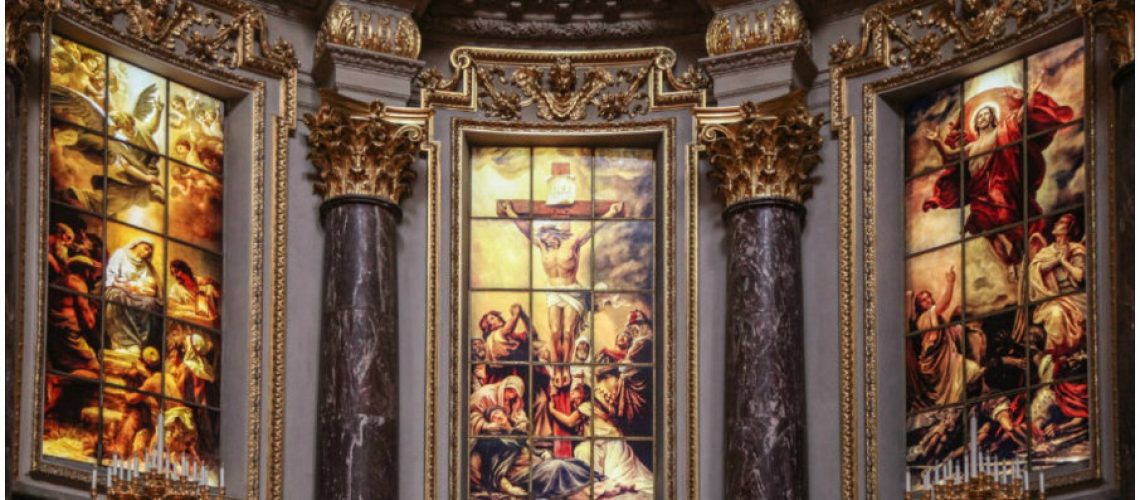
Just like church buildings are all different, so too, are parishes.
Catholic churches and cathedrals differ dramatically in appearance and style across the globe. Some are massive with pointed Gothic arches and steeples that stretch upward to heaven. Others may be humble stone churches that have survived the test of time.
Older churches in particular display fingerprints of the generations who prayed within their walls. Uneven floors and worn steps testify to countless souls who knelt, rejoiced, and repented.
Contrast these older edifices with the more modern churches. Many newer buildings are geometric in construction. They reflect the mid-century approach of their era.
Just as churches are different, each parish throughout the world is also different. Each has its own personality. Some parishes are large, and some are relatively small. Senior citizens are the majority in some parishes while in others there are mostly younger people. And some parishes are very vibrant with many ministries. Some parishes, however, are more sedate.
Every parish and church building, however, has a common thread. Parishioners must maintain the building and property. Many places of worship still exist solely because of donations generously given by multiple generations of the faithful.
Where did all the Churches come from?
For centuries, the people who worshiped in the church physically built the church. Prior to the Industrial Revolution, parishioners did not simply donate money. Many parishioners didn’t even have money to donate. Instead they donated their sweat, their skills, and their time. They built with what they had.
Construction over the centuries looked nothing like construction today. There was no Home Depot, no Lowe’s, no aisles of pre‑cut lumber or pallets of uniform bricks.
If a church needed bricks, parishioners cast them from clay and straw. The bricks were fired in crude kilns. Parishioners also often cut any stone required in nearby quarries. And every block bore the distinctive marks of the cutter.
A high altar did not arrive on a truck ordered from a faraway vendor. Local carpenters or stone masons carved the altar. Each chisel left behind a subtle signature unique to its craftsman.
In the Middle Ages churches often took decades to build with multiple generations contributing the needed labor. A grandfather might quarry stone for the walls. A father might raise beams for the trusses and roof. And a son might carve the altar rail. Each left something of himself imbedded in the project. Churches became a living testament to the faith of its people.
Parishioners poured their hearts into the work, and the church became a reflection of their devotion. The builders did not offer treasure but instead offered their skills and time. They donated their time and talent. Their sacrifice was not financial; it was personal and physical.
This historical reality should challenge modern Catholics to reconsider their relationship with their parish. Churches were never meant to be maintained solely by committees and contractors with the lowest bid. They were meant to be sustained by the faithful themselves.
The early Church understood this deeply. St. Paul reminded the Corinthians that “For we are God’s co-workers; you are God’s field, God’s building” (1 Corinthians 3:9). The physical church is an extension of the spiritual one. Caring for the building is an act of faith, not merely an act of maintenance.
Sub‑Contracted Sweat
The Industrial Revolution impacted many aspects of the world. Mass production standardized building materials. Lumber and bricks now arrive in uniform sizes with little variation. Sheetrock replaced lath walls with hand‑mixed plaster. Construction became faster, cheaper, and more predictable.
The prosperity it brought to the common man is undeniable. But the prosperity mass production brought also had negative effects.
At first, parishioners still built (or rather assembled) their churches using now purchased materials. Over time, however, the work shifted from parishioners to contractors, many of which were not Catholic. These contractors built efficiently, but they did not build with devotion.
Today the people who worship in a church rarely build it. Construction companies now build our churches. Parish committees solicit architectural designs and award contracts.
The result is often a sterile, modern church that lacks the personal touch that once made sacred spaces feel alive. Gone are hand carved decorations, imperfect lumber, and hand‑hewn beams.
This modern approach has unintended consequences. When parishioners no longer build their churches, they begin to see them as someone else’s responsibility. They forget that the church is theirs. They forget that they are stewards, not spectators.
Taking on Little Tasks for the Parish
Small things often matter and can impact the experience of those in attendance.
One parish had a pew reserved for parishioners needing assistance during Communion. A simple printed sheet of paper was taped to the pew. After months, the paper tore, curled, and faded. It looked temporary, neglected, and forgotten.
One parishioner noticed. Without asking, he ordered engraved plates and replaced the papers with a permanent signs. It was a small act costing maybe $20, but people noticed. In particular those using the pews.
Another parishioner painted miniature Warcraft figures as a hobby. He noticed a statue in the church with some damage and chipped paint. He asked permission, took it home, and touched it up. His leisure skill became a gift to the parish.
A teenager took on the project to maintain literature and other resources in the church basement gathering space of her parish. The shelves and display were no longer disheveled. She decorated the area and reset it several times a week. What appeared to be a forgotten corner, was given life.
These examples illustrate a simple truth: parishioners can take responsibility for maintaining their parish. They can offer their skills, even small ones, to improve the church. They can act without waiting for committees, budgets, or formal approval to serve in simple small ways.
Scripture affirms this spirit of service. St. Peter urges “As each one has received a gift, use it to serve one another as good stewards of God’s varied grace” (1 Peter 4:10).
Consider Offering Your Skills and Talents
Maintaining a parish requires people with a variety of skills. Parishes need all of them.
A gardener or landscaper can organize volunteers to maintain the church grounds. A parish with tidy trimmed hedges surrounded by mulch beds, void of weeds, communicates reverence.
Many pastors struggle with administrative burdens. An accountant can assist with parish bookkeeping. A skilled accountant can bring clarity, accuracy, and stewardship to parish finances.
A teacher can offer to teach Sunday classes. Youth can thrive when knowledgeable skilled instructors deliver Catechesis.
A contractor can oversee, or take on, maintenance projects. Fixing a railing, repairing a door, or patching plaster can save the parish thousands of dollars. It can also preserve the character of older buildings that contractors might otherwise replace with modern materials.
A graphic designer can create flyers. A musician can help with liturgical events. Someone with computer skills can assist with parish websites. A woodworker can restore pews. A seamstress can mend vestments. A parishioner who enjoys photography can document parish history.
Every parishioner, from the youth to the senior, possesses skills of value to the parish.
A parish is more of a family than a building. And families thrive when everyone helps with the chores.


Even if our mothers aren’t as good as other mothers, we still love and support them as a family.
[…] ÆdificemusMaking Michaelmas Memorable – Dorothy McLean at Traditional Catholic Social DancingOffer Your Skills & Talents to Your Parish – Genesius at Catholic Stand MagazineCeuta & the Church – Serre Verweij at Rorate […]
Nice article. I’ve been the unofficial computer guy at my parish for a few years, and the part about small skills adding up really hit home. A lone volunteer can’t do everything, but taking on just one small task makes a real difference. Hope more people give it a shot.
No I won’t help an apostate homosexual hierarchy