
The meaning of the Sunday Mass Readings for March 2026 is made clearest by Catholic doctrine. Doctrines are the essentially unchangeable clarifications of Revelation and Faith that only the pope and bishops have the God-given authority to make, that must be accepted as true knowledge of reality in order to be Catholic, and that not even the pope and bishops may contradict.
Let’s learn always-true doctrines in the Catechism of the Catholic Church that we can take away from this March’s Readings.[1]
March 1, The Second Sunday of Lent
From the First Reading we should take away that Abraham is the “father of all who believe” (CCC 146[2]). It was “to gather together scattered humanity [that] God calls [Abraham] from his country, his kinsfolk, and his father’s house” (CCC 59). “The people descended from Abraham [became] the chosen people, called to prepare for that day when God would gather all his children into the unity of the Church” (CCC 60). “[O]nly . . . at the time of Christ’s glorious return . . . will all the just from the time of Adam . . . be gathered together in the universal Church” (CCC 769).
From today’s Second Reading we should realize that the “design and grace bestowed on us in Christ Jesus” stems from “Trinitarian love” (CCC 257). It was the superabundant love among the Father, the Son, and the Holy Spirit that sent the Son to save us. The purpose for which God creates every person is “entry . . . into the perfect unity of the Blessed Trinity” (CCC 260).
Relatedly: “Death puts an end to human life as the time open to either accepting or rejecting the divine grace manifested in Christ” (CCC 1021). “Each man receives his eternal retribution in his immortal soul at the very moment of his death, in a particular judgment . . . : either entrance into the blessedness of heaven—through a purification or immediately—or immediate and everlasting damnation” (CCC 1022).
The Transfiguration of Jesus described in today’s Gospel is a preview or “foretaste of the Kingdom” (CCC 554). “The Transfiguration gives us a foretaste of Christ’s glorious coming [on the Last Day], when he will change our lowly body to be like his glorious [Risen] body” (CCC 556).
- From the First Reading[3] (Genesis 12:1-4a): Gn 12:1-4 is cited in CCC 145; Gn 12:1 in CCC 59; Gn 12:2 in CCC 762 and 1669; Gn 12:3 in CCC 706 and 2676; and Gn 12:4 in CCC 2570.
- From the Second Reading (2 Timothy 1:8b-10): 2 Tm 1:9-10 is cited in CCC 257 and 1021.
- From the Gospel (Matthew 17:1-9): Mt 17:1-8 is cited in CCC 554 and Mt 17:5 in CCC 444.
March 8, The Third Sunday of Lent
The water that quenches the Chosen People’s thirst during the Exodus in today’s First Reading and the water offered by Jesus to the Samaritan woman in today’s Gospel signify “the Holy Spirit’s action in Baptism . . . the water of Baptism truly signifies that our birth into the divine life is given to us in the Holy Spirit” (CCC 694).
In today’s Gospel, Jesus mentions the Spirit. Jesus “little by little alludes” to the Spirit during His public ministry, as when speaking with the Samaritan woman, but He “does not reveal the Holy Spirit fully, until he himself has been glorified through his Death and Resurrection” (CCC 728). “On [Pentecost], the Holy Trinity is fully revealed” (CCC 732).
From the Responsorial Psalm, we should take away the importance of adoration, which “exalts the greatness of the Lord who made us” and is “homage to the King of Glory” (CCC 2628).
- From the First Reading (Exodus 17:3-7): Ex 17:1-6 is cited in CCC 694; and Ex 17:2-7 in CCC 2119.
- From the Responsorial Psalm (Psalms 95:1-2, 6-7, 8-9): Ps 95:1-6 is cited in CCC 2628.
- From the Second Reading (Romans 5:1-2, 5-8): Rom 5:5 is cited in CCC 368, 733, 1820, 1964, and 2658; and Rom 5:8 in CCC 604.
- From the Gospel (John 4:5-15, 19b-26, 39a, 40-42): Jn 4:6-7 is cited in CCC 544; Jn 4:10-14 in CCC 694 and 1137; Jn 4:14 in CCC 728, 1999, 2557, and 2652; Jn 4:21 in CCC 586; Jn 4:22 in CCC 528 and 586; and Jn 4:23-24 in CCC 586 and 728.
March 15, The Fourth Sunday of Lent
In today’s Gospel, Jesus “makes use of signs to heal” (CCC 1504)—mud and water in this case. Here and other times Jesus uses signs, and not only His words, to heal. This is one of the ways we know that Christ Himself instituted the Sacrament of the Anointing of the Sick (CCC 1503-1513).
Jesus’ “healings [themselves] were signs of the coming of the Kingdom of God” (CCC 1505). One way to think of what existence in the Kingdom will be like is to imagine all of Jesus’ miracles of healing happening to the same person—perfect sight, perfect hearing, perfect health from illness and injury, freedom from death, and freedom from sin.
- From the First Reading (1 Samuel 16:1b, 6-7, 10-13a): 1 Sm 16:1 is cited in CCC 436; 1 Sm 16:12-13 in CCC 436; and 1 Sm 16:13 in CCC 695.
- From the Responsorial Psalm (Psalm 23:1-3a, 3b-4, 5, 6): Ps 23:5 is cited in CCC 1293.
- From the Second Reading (Ephesians 5:8-14): Eph 5:8 is cited in CCC 1216; Eph 5:9 in CCC 1695; and Eph 5:14 in CCC 2641.
- From the Verse before the Gospel (John 8:12): Jn 8:12 is cited in CCC 2466.
- From the shorter form of the Gospel (John 9:1, 6-9, 13-17, 34-38): Jn 9:6 is cited in CCC 1151; Jn 9:6-7 in CCC 1504; Jn 9:16-17 in CCC 595; Jn 9:16 in CCC 596 and 2173; and Jn 9:34 in CCC 588.
- From the longer form of the Gospel (John 9:1-41): Jn 9:22 is cited in CCC 575 and 596; Jn 9:31 in CCC 2827; and Jn 9:40-41 in CCC 588.
March 22, The Fifth Sunday of Lent
From today’s Second Reading, we should take away that “Jesus, like all men, experienced death and in his soul joined the others in the realm of the dead” (CCC 632). Death is “the separation of the soul from the body” (CCC 997).
We should also take away “not only that the immortal soul will live on after death, but that even our ‘mortal body’ will come to life again” (CCC 990), as we profess in the Apostles Creed (“I believe in . . . the resurrection of the body”) and the Nicene Creed (“I look forward to the resurrection of the dead”).
So, eternity for all persons will include not just their souls, but also their transformed bodies. “All the dead will rise, ‘those who have done good, to the resurrection of life, and those who have done evil, to the resurrection of judgment’” (CCC 998) at Christ’s Second Coming (CCC 1001). The “resurrection of life” places them in the Kingdom of God. The “resurrection of judgment” places them in Hell. Everyone will have eternal bodies and souls whether they are in the Kingdom or Hell.
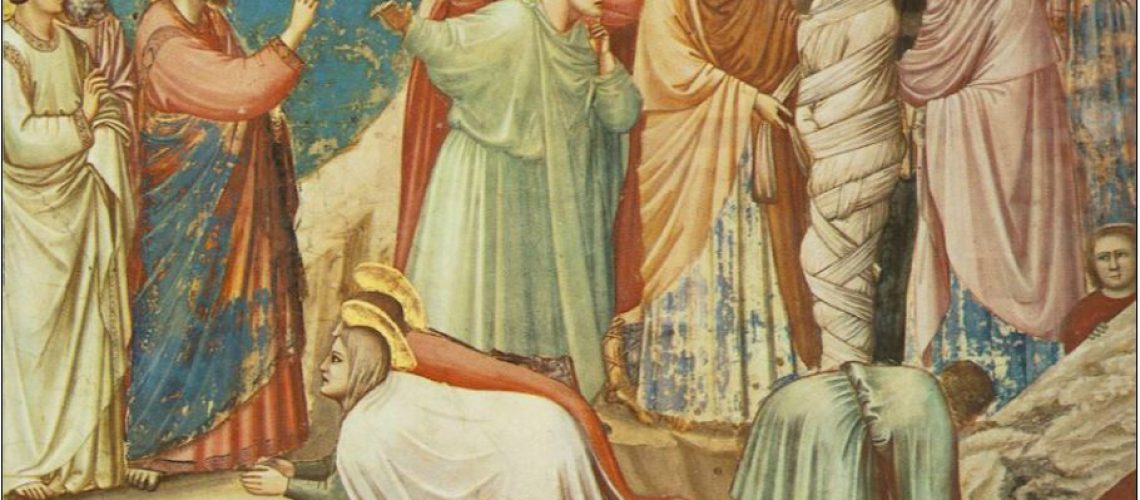
Today’s Gospel has the magnificent and moving account of Jesus raising Lazarus from death. However, when Jesus rose from the dead, He “had not simply returned to earthly life as had been the case with Lazarus” (CCC 640). Jesus’ Resurrection is “of another order” (CCC 994) and so will be the resurrection of the dead on the Last Day.
There is another difference between the experience of Lazarus and the experience of Jesus. Although Jesus really died, His body did not corrupt, as Lazarus’ body had begun to corrupt. “But because of the union which the person of the Son retained with his body, his was not a mortal corpse like others” (CCC 627).
- From the First Reading (Ezekiel 37:12-14): Ez 37:1-14 is cited in CCC 715.
- From the Second Reading (Romans 8:8-11): Rom 8:9 is cited in CCC 693; and Rom 8:11 in CCC 632, 658, 695, 989, and 990.
- From the Verse before the Gospel (John 11:25a, 26): Jn 11:25 is cited in CCC 994.
- From the shorter form of the Gospel (John 11:3-7, 17, 20-27, 33b-45): Jn 11:24 is cited in CCC 993 and 1001; Jn in CCC 11:25 994; Jn in CCC 11:27 439; Jn 11:28 in CCC 581; Jn 11:34 in CCC 472; Jn 11:39 in CCC 627; Jn 11:41-42 in CCC 2604; and Jn 11:44 in CCC
- From the longer form of the Gospel (John 11:1-45): Jn 11 is cited in CCC 994; and Jn 11:28 in CCC 581.
March 29, Psalm Sunday of the Lord’s Passion
From the account of the Last Supper in today’s Gospel, we should take away that Jesus instituted the Eucharist “at that moment” (CCC 611). “[T]his is my body” and “this is my blood” mean that “[i]n the Eucharist Christ gives us the very body he gave up for us on the cross, the very blood which he poured out” (CCC 1365). The consecrated bread and wine are actually, not merely symbolically, the Body and Blood of Christ.
The Consecration of the bread and wine at Mass makes present the Last Supper and the Crucifixion (CCC 1363-64, 1382). When we go to Mass, the Last Supper and the Crucifixion are brought to us. At Mass, we are given the astonishing grace to be in the Upper Room with Christ the night before He died and to be at the foot of the cross with Our Savior at His death.
In saying “for this is my blood of the covenant, which will be shed for the forgiveness of sins,” Jesus reveals that His Crucifixion is “the unique and definitive sacrifice” (CCC 613) for the forgiveness of sins.
- From the Procession with Palms – Gospel (Matthew 21:1-11): Mt 21:1-11 is cited in CCC 559; and Mt 21:9 in CCC 439.
- From the First Reading (Isaiah 50:4-7): Is 50:4-10 is cited in CCC 713; and Is 50:4 in CCC 141.
- From the Responsorial Psalm (Psalms 22:8-9, 17-18, 19-20, 23-24): Ps 22 is cited in CCC 304.
- From the Second Reading (Philippians 2:6-11): Phil 2:6-11 is cited in CCC 2641 and 2667; Phil 2:6-9 in CCC 1850; Phil 2:6 in CCC 449; Phil 2:7 in CCC 472, 602, 705, 713, 876, and 1224; Phil 2:8-9 in CCC 908; Phil 2:8 in CCC 411, 612, and 623; Phil 2:9-11 in CCC 449 and 2812; Phil 2:9-10 in CCC 434; Phil 2:10-11 in CCC 201; Phil 2:10 in CCC 633 and 635.
- From the Verse before the Gospel (Philippians 2:8-9): see above.
- From the Gospel (Matthew 26:14-27:66): Mt 26:17-29 is cited in CCC 1339; Mt 26:20 in CCC 610; Mt 26:26 in CCC 1328 and 1329; Mt 26:28 in CCC 545, 610, 613, 1365, 1846, and 2839; Mt 26:29 in CCC 1403; Mt 26:31 in CCC 764; Mt 26:36-44 in CCC 2849; Mt 26:38 in CCC 363; Mt 26:39 in CCC 536 and 612; Mt 26:40 in CCC 2719; Mt 26:42 in CCC 612; Mt 26:52 in CCC 2262; Mt 26:53 in CCC 333 and 609; Mt 26:54 in CCC 600; Mt 26:64-66 in CCC 591; Mt 26:64 in CCC 443; Mt 26:66 in CCC 596; Mt 27:25 in CCC 597; Mt 27:39-40 in CCC 585; Mt 27:48 in CCC 515; Mt 27:52-53 in CCC 633; Mt 27:54 in CCC 441; and Mt 27:56 in CCC 500.
[1] There are too many citations, or references, in the Catechism to the verses in a month of Sunday Readings to identify all the pertinent doctrines. The bullet points allow you to explore further the Biblical basis of Catholic doctrine.
[2] CCC abbreviates Catechism of the Catholic Church. Any number after it is the number of a paragraph in the Catechism. For example, “CCC 145” means paragraph 145 of the Catechism.
[3] If a Reading is not listed, then none of its verses is cited by the Catechism.


[…] Analysis, Punditry, and News:The Sunday Readings & Catholic Doctrine for March 2026 – Marty Dybicz at Catholic StandPope Leo XIV Said to Be Preparing First Major Curia Reshuffle […]