
Scientists accept almost the entirety of their knowledge of science, even in their area of expertise, on faith in the testimony of others regarding the instrument dependent measurement of the properties of material things. This renders science gnostic in practice, though not in principle. Science is removed from everyday personal experience because it is technology-dependent, e.g. microscopy, biochemistry and atomic physics. The typical assent to science is not only faith-based, but science itself is elitist. Although assent to revelation is also faith-based, it is not gnostic or elitist in principle or practice. It is compatible with one’s knowledge of philosophy, which is based on one’s immediate everyday experience. Of course, ultimately science too is based on everyday experience, but proximately it is based on technology, beyond common purview.
On the one hand, we have assented to science based on faith in humans, but lacking an immediate confirmation in our personal knowledge. On the other, we have assented to revelation based on faith in the Catholic Church immediately compatible with our personal knowledge of philosophy. For example, the standard of human behavior in revelation is compatible with the standard of human behavior known from philosophy. The morals of revelation is a slightly larger set than the ethics of philosophy. In contrast, our knowledge of God and our relationship to him through philosophy is meager compared to such knowledge in revelation, but compatible with it. However, something more than mere compatibility is needed for the assent to faith in revelation. It is a sign.
Catholic Revelation
Revelation is by definition beyond the scope of unaided human reason. Although the Catholic faith is a grace from God, its authenticity as revelation requires a sign. This is because grace does no violence to nature, including human reason. Our situation is beautifully expressed by Blaise Pascal as quoted by Blessed John Paul II in Fides et ratio, paragraph 13, “Just as Jesus Christ went unrecognized among men, so does his truth appear without external difference among common modes of thought. So too does the Eucharist remain among common bread.” It is remarkable that the central miracle of our faith is accepted by us as such without any appearance of its being a miraculous sign.
Our faith is filled with the acknowledgment that the authenticity of revelation requires a sign. Phillip implies the need for a sign, “Show us the Father. That will be enough for us.” Jn 14:8. The apostle Thomas claimed that his faith could not be based on the testimony of others, but upon an immediate sign to him, “Unless I see the mark of the nails in his hands and put my fingers into the nail marks and put my hand into his side, I will not believe.” Jn 20: 25. St. Paul received a dramatic sign of whom he asked, “Who are you, sir?” The reply was, “I am Jesus whom you are persecuting.” Acts 9:5. None of us expects any sign so dramatic, including that of changing water into wine at Cana, “Jesus did this as the beginning of his signs in Cana in Galilee and so revealed his glory, and his disciples began to believe in him.” Jn 2:11.
The Catholic Revelation was complete 2000 years ago in Jesus (CCC 66). Lumen Fidei, paragraph 38, notes:
I cannot possibly verify for myself something which happened so long ago. . . . Faith’s past, that act of Jesus’ love which brought new life to the world, comes down to us through the memory of others — witnesses — and is kept alive in that one remembering subject which is the Church. . . . The love which is the Holy Spirit and which dwells in the Church unites every age and makes us contemporaries of Jesus, thus guiding us along our pilgrimage of faith.
The sign, that the Church is who she says she is, consists in the internal coherence of all that the Church teaches us in our day and in its compatibility with our everyday human knowledge, which is the foundation of all human knowledge. In view of the intricate beauty of the subject matter, this self-consistency and philosophical compatibility are beyond mere human capacity.
One Sign- God was Humiliated
In this essay, I wish to highlight just one sign, one thing that the Church teaches that could not be invented by man. Almighty God is humble, humble enough to be humiliated for the sake of his love for us.
As a youth, I attended the Saturday matinee at the movies. If we were lucky, it consisted of a double feature of cowboy movies. Good triumphed over evil because the good guys were more skillfully violent than the bad guys. From the trailers on TV, I surmise that the action heroes of today’s films enforce justice and punish evildoers with incredibly greater feats of power and violence. We judge the US to be a great nation because of its military and economic power, enforcing good and punishing evil.
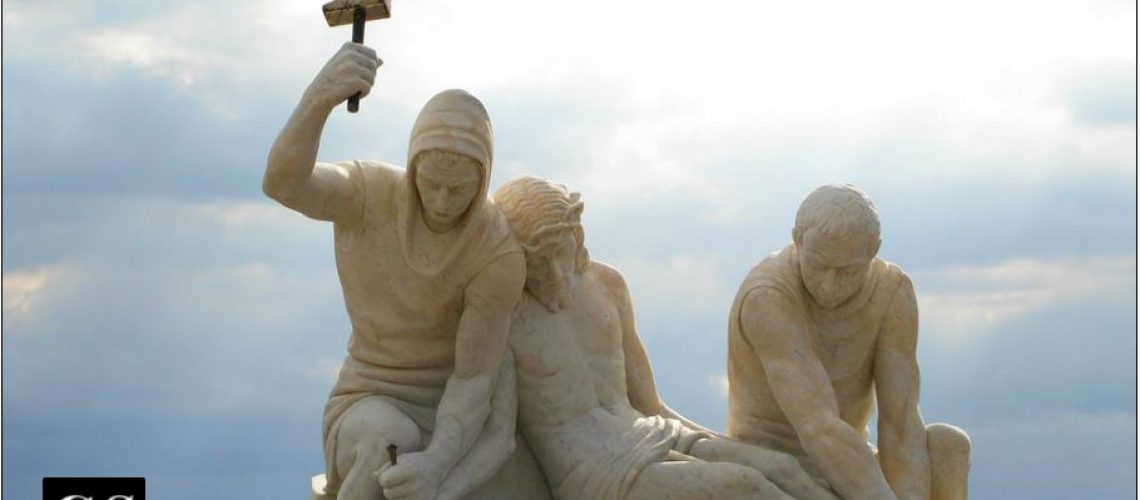
Consider the ultimate action hero in the guise of Jesus of Nazareth. Prior to his execution, he is crowned with thorns and mocked as King of the Jews in opposition to Rome. He seemingly bides his time, accepting the humiliation. On the way to the site of execution, he tells the sympathetic women of Jerusalem, “Weep not for me, but for yourselves and for your children.” Lk 23:28. In the audience, we know he needs no sympathy. We are sure he is about to turn the tables on his tormentors crushing them with his power. Yet, at the site of execution, he is hanged, initiating a slow death. Surely the almighty action hero will respond to the final taunt of his tormentors, “Let the Messiah, the King of Israel, come down now from the cross that we may see and believe.” Mk 15:32. Instead, he dies. It is his corpse, which must be taken down from the cross.
Apparently, Jesus, as God, was not the ultimate action hero. As almighty God, he apparently was the humble father in his tale of the prodigal son. The father enables the free will of his son, giving him the inheritance due to the father’s death. The son winds up with the choice of humbly returning to the father or pridefully entrenching himself in hatred of the one whose love alone, he now knows, yields happiness.
In accepting the humiliation of a tortured death at the hands of those he loves, almighty God humiliates our sense of justice in which the reward of good is earned by the skillful and the punishment of evil is inflicted by force. If we see this as foolishness for the foolish, we fail to see one sign. If we recognize this as the act of the ultimate revolutionary, humiliating our judgment that justice is achieved by force, we see in Jesus the face of the Father, Almighty Humility, and accept the Holy Spirit’s witness through the Church.

