
This article is a translation of my article written in French and published simultaneously in Quebec,
Canada and in Europe, Switzerland, in 1995. This was the year when my full family prepared to join the Catholic Church in Montreal (The Hamas-Israel War In Light of My Conversion From Judaism to Catholicism», 25 October 2023). I was visiting professor at a Montreal university from my permanent position in France. The article was printed under a pseudonym, but today, thirty years later, I translated it and published under my name.
I recently purchased a small book from a used bookstore entitled Joys and Sorrows of the Home. More than fifty years ago, its author, Father Albert Brossard, S.J., a member of a distinguished Quebec family, preached a Lenten sermon at the Gesù. I later learned that one of his brothers served as a justice on the Supreme Court of Canada.
The Gesù, located on Bleury Street, is one of Montreal’s most beautiful churches. I have often availed myself of its hospitality—perhaps more than I should—while working alone in an office tucked away on some forgotten upper floor of one of the towering buildings that dominate downtown Montreal. As a stranger in the city, I found in the Gesù a welcome refuge from the anonymity and bustle of the urban landscape.
So, what was this Jesuit talking about in the spring of 1942, in that terrible spring for my Russian homeland, ravaged by war?
If le Seigneur does not build the house, they who build it labour in vain (Psalm: 127).
Yes, in Montreal ,in 1942, people were talking about a happy home, that is to say, about the Quebec family … and my family? What happened to my family that spring?
I was born in Russia just before the 1941-1954 war. The last pre-war family photo, the only one that has been preserved, was taken a month before the start of hostilities. The photo shows four men (an officer, a military pilot, an engineer, and a retiree), two women, and a baby — me. When the war ended, there were three of us left: two women and a child. The men perished in the inferno of war, along with 20 million of my compatriots, victims of a terrible plot by the Devil. It was in the summer of 1941 that my father disappeared without a trace, along with the infantry battalion under his command.
But why read this old book? Isn’t it more important for a foreigner, in the spring of 1995, to learn about how family is discussed in a contemporary Quebec daily? One can read, for example:
It’s astonishing that a minister in a government that claims to be social-democratic would write to the mayor of Montreal to oppose the opening of a daycare in front of his residence. That the minister should use government letterhead bearing the inscription “1994, Year of the Family” is ironic. But that the municipal administration should also fall for it and decide to exploit regulations to block the project — that’s where the cynicism truly takes root (Le Devoir, 17 mai 1995).
I found in Quebec a straightforwardness and simplicity of behavior, the generosity of an open and courageous spirit, an instinctive and kind hospitality.
I love you because your history is a prodigious testament to the creation of a beautiful and free nation over the past three hundred years. And I, an exiled Russian scientist, at once skeptical, troubled, and envious, can only admire this miracle : my poor homeland, endowed with all natural riches but crushed for eighty years by wars and Marxist totalitarian power, still cannot rediscover its love, its destiny, and its freedom!
This is the vision that inspired the illustrious Quebec Jesuit, and which speaks to my wounded Russian heart with his convincing force:
After three centuries of inflexible resistance and superb loyalty, have we forgotten the religious beauty of our origins, all the lessons of our history, to the point of betraying, in these very serious circumstances in which we are engaged today, our past of faith and love, of honor and courage? The secret of this past — we know it well — lies in the silent heart of this old house, not always rich, more often poor, but within whose walls burned, like a sanctuary, the fervor of family virtues and Christian traditions, the very soul of our race : the immutable soul of those saints of the hearth, who transmitted to their children more than life, the splendor of grace, the powerful serenity of their faith, the love of sacrifice, effort, and purity, the unwavering respect for all divine laws, that balance of mind and that distinction of heart, living, eternal stones of the hearth, upon which must always lean, to remain strong, pure, happy, and fruitful, the races and societies that wish neither to fall nor to die.
I was exiled from my homeland at the age of forty, with no experience of life outside Soviet Russia, no passport, no money, no books… no hope of return. In short, like an anti-Soviet cosmonaut, I was sent to another planet. How was I to live?
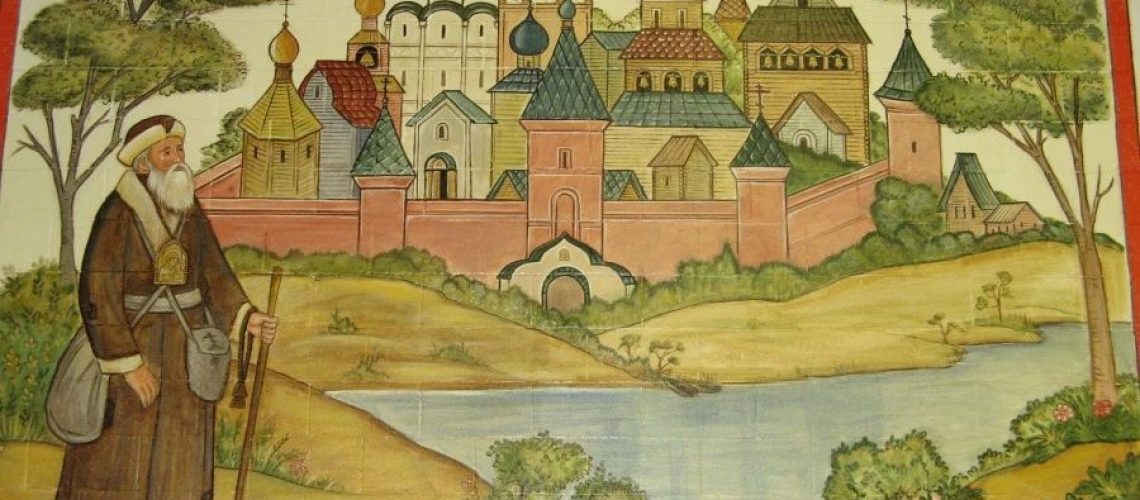
“To live”? What does that word mean to an exile with no right of return ? Let’s be honest : to live in exile means to live as a beggar. One begs for citizenship, language, work, culture, a gesture of friendship, love… for oneself, for one’s family, for one’s fellow exiles, for one’s homeland in distress. And one remains forever an ungrateful beggar … But not me! I don’t know by what grace I have become “a strannik” and “bogomolets” — a pilgrim of God.
This deeply Russian tradition is the only thing, admirable and real, that I brought with me and that no one could take from me. And so, like John Paul II, I kiss the soil of every country where I find myself for work or a short pilgrimage, I venerate its sanctuaries and sacred relics, I “drink” the spirit of its Christian piety, and I “consume” its historical sacrifices.
I admire you, Catholic Quebec, and I love you with all my heart :
- It was here in your home that I was adopted into the Quebec family of the miraculeuses of Saint-Anne-de-Beaupré.
- It was here, in your home, that Our Lady of Cap-de-la-Madeleine opened my eyes to the
extraordinary and wondrous beauty of a freely Christian destiny in a Christianly free country.
It was here, in your country, that I was comforted by the Catholic spirituality of your high priests and scholars, by the eloquence and refinement of your pastors’ homilies, and by the kindness and regal dignity of your nuns. For such a small nation, so far removed from all the centers of the world, you have lived and seen wonders in your own home.
But I am under no illusions : today, you are in the majority (in Russia they say “crushing majority”, which literally means “that which crushes the minority”) the daughters and sons of your revolution, just as my compatriots were once the children of ours.
But the difference is significant. Our revolution was extremely bloody, while yours was peaceful. Ours inflicted destructions on us unprecedented in world history. And yours? Father Albert Brossard, with his astonishing perspicacity, not only sensed the danger, but also calculated the precise dates :
The gravity of this moral conflict is such that in twenty or thirty years, the fate of our authentically French and Catholic family will be decided, for our happiness or our misfortune. Tomorrow it will be too late to react.
After Stalin’s death, I searched for a way out for my soul. I thirsted for the Truth, among those countless little truths. I found it in the fate of our Christian martyrs : never in the history of Christianity has a people suffered such martyrdom for the faith !
We, too, had our clairvoyant “fathers”. Here is how a great Russian spiritual leader (Vladimir Soloviov, 1853-1900) prophesied before his untimely death in 1900 :
I sense the approach of the times when Christians must gather for prayer in the catacombs. Everywhere the faith will be persecuted, perhaps less than in the days of Nero, but more subtly and more cruelly : through lies, deception, and falsification.
No doubt, Vladimir Soloviov underestimated the coming Russian disaster. But let us listen what our admirable Père Brossard tells us :
And it is through you, my Brothers, that the fate of our homes and our race will have been decided. Through you, fathers and mothers, guardian souls and consciences of our homes today, through you, young men and young women, guardian souls and consciences of our homes tomorrow, the family, your family, will be, through the faithful virtues of your faith and your trust in God, a strength in a living home, — or through your selfishness, your willing infidelities, all the compromises of your conscience, through the religious neutrality of your life, it will be a moral ruin in a dead or abandoned home.


I listen to your words, Dr. Belaga, for you have Wisdom gleaned from many sources…
+
pax
Thank you, dear Patricia D. for your sage comment. Good luck to you !