
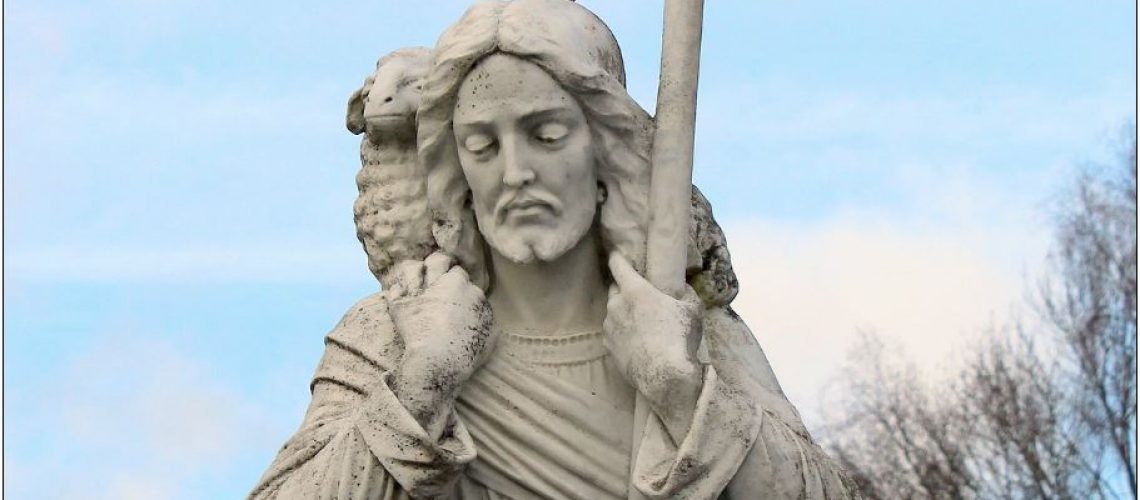
I am the good shepherd, and I know mine and mine know me, just as the Father knows me and I know the Father; and I will lay down my life for the sheep (John 10: 14-16).
A shepherd in ancient Palestine, by necessity, had a very close relationship with his sheep. It was especially important when they were out to pasture. He called them by name and tended to their needs one by one as they left in the morning and returned in the evening. The shepherd himself acted as a kind of “gate” by guarding the opening of a makeshift fence that kept the sheep safe. Jesus used the analogy of shepherding to indicate the close relationship that he sought to have with his disciples in terms that were familiar and understandable to those who had “ears to hear.” We read in the Gospel of John:
Very truly I tell you, I am the gate for the sheep. All who have come before me are thieves and robbers, but the sheep have not listened to them. I am the gate; whoever enters through me will be saved. They will come in and go out, and find pasture. The thief comes only to steal and kill and destroy; I have come that they may have life, and have it to the full (John 10:7-10).
Jesus, the sheepgate, prefigures St. Peter (Christ) at the pearly gates, while the sheep in ancient Palestine prefigure the souls who seek to gain admittance to Heaven. Just as a shepherd tends his flock, God watches over the whole of creation in a way beyond human comprehension that can only be understood through analogy. The parable of the lost sheep illustrates how precious each one of us is in the eyes of Jesus, the good shepherd. The following passage indicates the Agape love that God has for his children, especially those who have lost their way:
The tax collectors and sinners were all drawing near to listen to him, but the Pharisees and scribes began to complain, saying, “This man welcomes sinners and eats with them.” So to them he addressed this parable. “What man among you having a hundred sheep and losing one of them would not leave the ninety-nine in the desert and go after the lost one until he finds it? And when he does find it, he sets it on his shoulders with great joy and, upon his arrival home, he calls together his friends and neighbors and says to them, ‘Rejoice with me because I have found my lost sheep.’ I tell you, in just the same way there will be more joy in heaven over one sinner who repents than over ninety-nine righteous people who have no need of repentance (Luke 15: 1-7).
It has been said that if there had been just one individual on Earth, Jesus would have gone to the cross for his or her salvation. “One sinner who repents” will bring about more joy in Heaven than ninety-nine who don’t feel the need. Jesus makes it a point to say that the Father’s will is that he will not lose “anything” of what was given him to be raised up on the last day. Forgiveness through repentance, the good news of the Gospel, is illustrated below:
Everything that the Father gives me will come to me, and I will not reject anyone who comes to me, because I came down from heaven not to do my own will but the will of the one who sent me. And this is the will of the one who sent me, that I should not lose anything of what he gave me, but that I should raise it [on] the last day. For this is the will of my Father, that everyone who sees the Son and believes in him may have eternal life, and I shall raise him [on] the last day (John 6:37-40).
May we be vigilant as we anticipate Pentecost this Easter season, and the Second Coming of Christ when we will all be “raised up on the last day.” We strive to follow the path of God’s will here on Earth as we hope for the glorious arrival and passage through the pearly gates of Heaven.

