
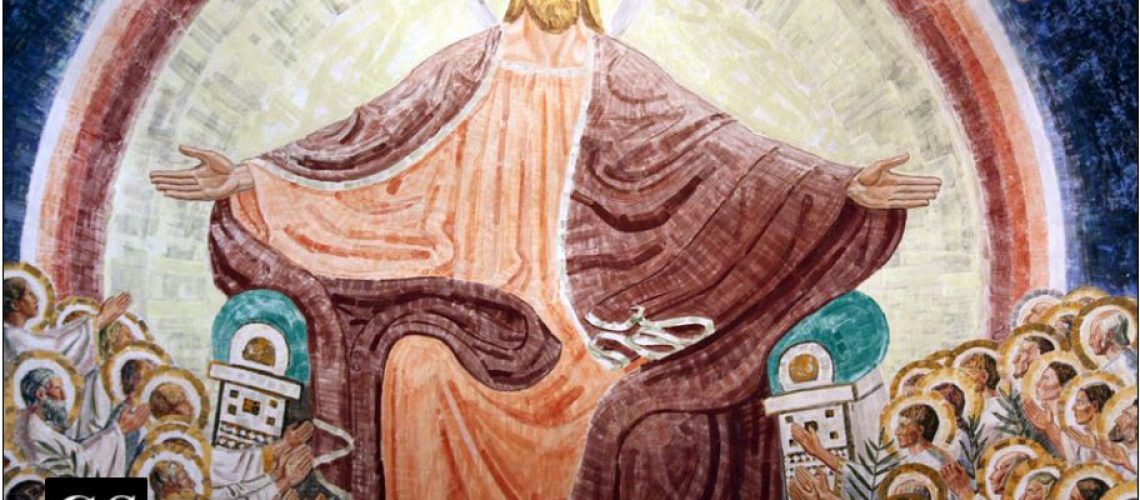
One definition of “love”:
In religious use: the benevolence and affection of God towards an individual or towards creation; (also) the affectionate devotion due to God from an individual; regard and consideration of one human being towards another prompted by a sense of a common relationship to God. Cf. charity n. 1. Oxford English Dictionary.
INTRODUCTION
At our Calix Society zoom meeting (29 December, ’22) we did a Lectio Divina session on St. Paul’s ode to love, 1 Corinthians 13. After the meditation, someone remarked that this reading is the most read at Wedding Masses. I thought to myself, “Hmmn... Did she mean that Paul referred to romantic love for one’s spouse? I think he had a different kind of love in mind.”
What did St. Paul have in mind? I’ll set forth my ideas below.
LOVE = AGAPE IN CORINTHIANS 13:13
If you go to the original Greek of the New Testament you’ll see the following:

From Abarim Publications
THE FOUR LOVES OF C.S. LEWIS
In his book, “The Four Loves,” Lewis discusses four different types of loves, as the Greeks defined them. Among the excellent discussions of his work on the internet, this one on the official C.S. Lewis site is the best, I believe. I’ll summarize this appraisal, but urge the reader to go to the original (and the book). Here are the four:
Storge (στοργη):”affection,” the feeling one has for familiar things that one likes, including family members. This quotation from “The Four Loves” expresses it best, I believe: “It lives with humble, un-dress, private things; soft slippers, old clothes, old jokes, the thump of a sleepy dog’s tail on the kitchen floor, the sound of a sewing-machine…”
Philia (φιλια) : “friendship,” sometimes expressed as “brotherly love.” The love or feeling between friends, two males, two females, or a male and female. Again, a quote helps us understand: “Friendship must be about something…even if it were only an enthusiasm for dominoes or white mice. Those who have nothing can share nothing; those who are going nowhere can have no fellow-travellers.”
Eros (εροσ): “romantic or sexual love.” As Lewis notes, philia—friendship—between a man and a woman can sometimes develop into eros (and the converse, also). Also, there is the element of “passion” in eros, total energy applied to the love object. Perhaps music or art can best describe eros: the love scene in Berlioz’s Romeo and Juliet, “symphonie dramatique,” or Torvill and Dean’s ice dance to Ravel’s Bolero. Sometimes words fail.
Agape (αγαπη): “charity or selfless love.” As the linked article notes, all of the three types of love mentioned above could (and should) develop into or compete with agape. And what is the love-object for agape? God. And fellowship with others in that love. The OED definition given at the beginning of this articles is, I believe, close to what agape means. But, as with all definitions, it is incomplete. We read and hear at Mass about Christ’s love for the Church; that is agape. Scripture tells us of Christ’s love for us; that is agape.
FINAL THOUGHTS
As sometimes happens, the shoe has not dropped. There is no bang-up ending to this article. I hope I’ve planted a seed for reflection that will grow, watered by reading Lewis’s book and commentaries thereon.
NOTE
In doing a web search for this piece I found out that the Greeks had not only four words for love, but nine. See here. Isn’t English wonderful? All these different meanings in one word, “love” and we get to figure it out from context.


Feb gem…seed planted merci
[…] ISSUE: Gorgeous New Mosaics at St. Michael’s Abbey in California – New Liturgical Movement The Four Kinds of Love – Bob Kurland, Ph.D., at Catholic Stand 18th Century Stations of the Cross in the Baroque […]
And I believe that Philia is the most fragile.