
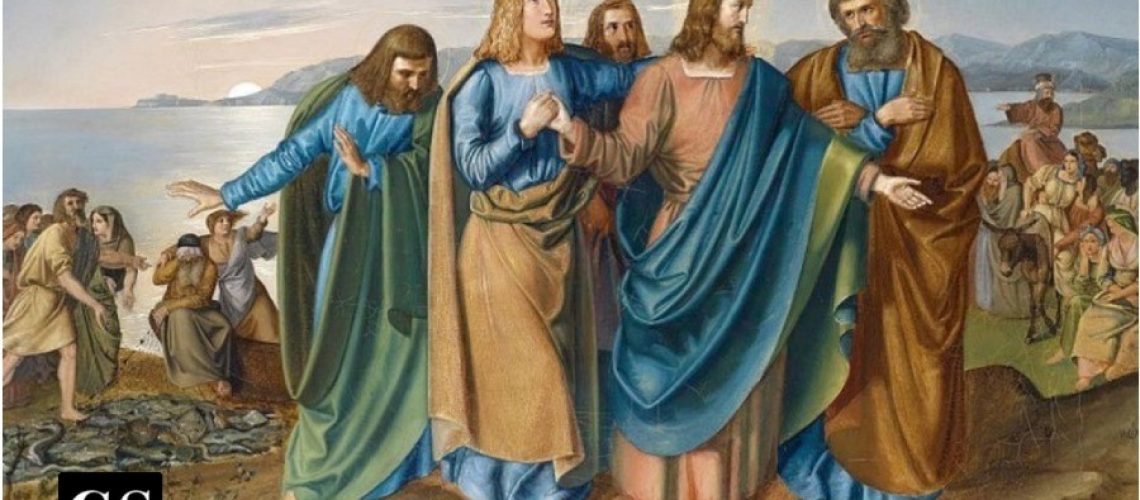
I have heard some Protestants try to use Matthew 18:20, “… where two or three are gathered in my name, there I am,” as a reason for not being Catholic. They rationalize their avoidance of all things Catholic (and sometimes organized religious activities in general) by opining that if God is present where any two or three Christians gather, then being a Catholic or going to Mass is unnecessary. This article will show why their interpretation of this verse is wrong. Before we go further, please click here to read Matthew 18:15-20 for context. The abridged passage follows:
If your brother sins against you, … tell it to the church; and if he refuses to listen even to the church, let him be to you as a Gentile and a tax collector. Truly, I say to you, whatever you bind on earth shall be bound in heaven, and whatever you loose on earth shall be loosed in heaven. Again, I say to you, if two of you agree on earth about anything they ask, it will be done for them by my Father in heaven. For where two or three are gathered in my name, there am I in the midst of them (RSVCE).
The Audience
First, we need to know to whom Jesus was speaking. Verse 1 tells us that He was speaking to His disciples. In the Gospel of Matthew, the word “disciples” always refers to the Twelve as a whole or to some portion of the Twelve. For instance, Matthew refers to Peter, James and John as disciples who followed Jesus up the Mount of Transfiguration. Further, when Jesus speaks to followers other than the Twelve, Matthew refers to them as “the crowds.” This happens 38 times in Matthew’s Gospel.
Returning to Matthew 18:15-20, we now know that Jesus was speaking to the Twelve when He told them that He is present wherever two or three gather. This is important because the context of the passage, along with the target of Jesus’s message, means that Jesus was talking about a gathering of decision-making disciples to exercise authority rather than a cadre of lay Christians for worship.
The Context
Second, notice that Jesus instructed His disciples on how to deal with a sinning brother, a Christian who sinned against another Christian. He ultimately told them that they were the final authority on matters such as this. We know this because the very next verse says, “Whatever you bind on earth shall be bound in Heaven…,” which was the same authoritative language Jesus used when He promised to give Peter the keys to the kingdom two chapters earlier (Matthew 16:18-19). Thus, whatever their decisions were, it bound (or loosened) the person/s to whom they applied.
The Authority
Third, after giving the disciples this authority, Jesus told them, “If two of you agree on earth about anything they ask, it will be done for them by my Father in Heaven.” This simply meant that the disciples, in union with the Father, could loose and bind disciplines on sinning Christians.
Finally, we must look at the last verse, verse 20, the one in question. Jesus told his disciples (the Twelve) – not all followers – that where two or three of them gathered, there He would be. Jesus’s use of “of them” communicated the very simple idea that two or three of the leadership could gather to decide a matter and that He would be there guiding them. It in no way meant or implied that two or three “Christians” could simply get together and worship God however they desired.
Please note that the “whatever” and “anything” language in the foregoing passage meant that the Twelve and whomever they chose as their successors could arbitrate on other important matters such as disciplinary and doctrinal issues. Jesus nowhere restricted their authority to matters of sin alone. Nor did He restrict His disciples from passing His authority to their successors.
Additional Reading
For more on the Catholic Church, please click here. Regarding the humility it takes to be Catholic, please click here. For confession to a priest, please click here.
[Social media appeal: Hello, readers! If you think my article, or any other article at Catholic Stand, will help others better understand and/or spread the faith, please post a link to your social media account(s). Thank you!]


Absolutely true Nate. I think “where two are three are gathered in my name” could be the most mistranslated and abused bible passage of our modern times It’s used frequently to try to justify all kinds of heresy, schism, etc.
I completely agree, Matt! Thank you for commenting!
Interesting, as a Catholic I never really thought about this passage in terms of Mass and worship (i.e. as long as 2 or 3 laity are at Mass) since we must have a priest present to even pray a Mass. Plus, a priest can say Mass alone too making the “protestant” understanding of this passage as it relates to Christ being present during Worship irrelevant to me but it’s good to understand context of Scripture all the time. Just today, at daily Mass we had only 7 laity attending because the snow storm kept most at home but we still needed our pastor to show up 😉 Otherwise, it would have been simply a visit to the Tabernacle for private prayer…..
Interesting, two or three out of a dozen is a quorum.