
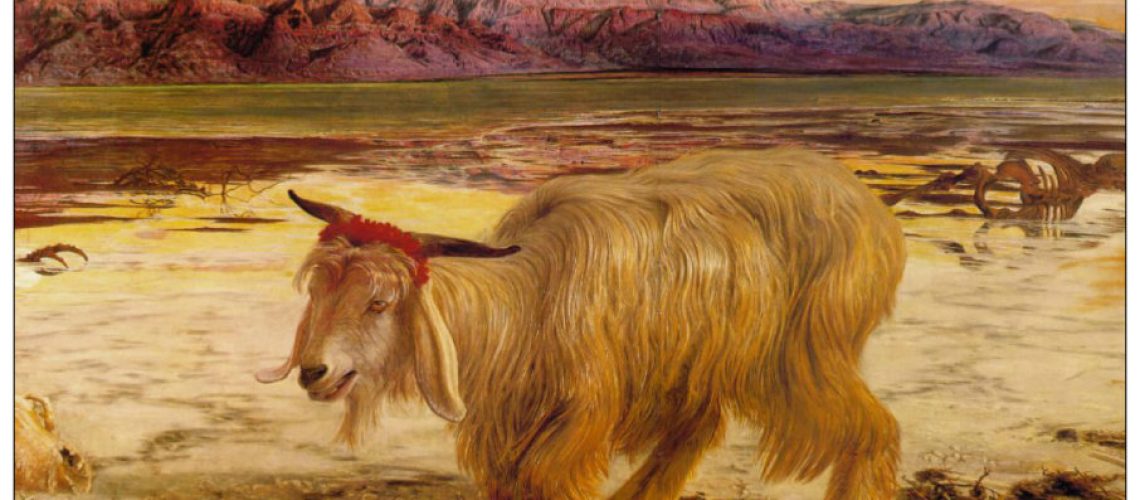
When we act like a victim sacrifice, suffering for our own failings or like a scapegoat who suffers as the result of others sins, we might like to think of ourselves as saintly martyrs, but our suffering is anything but holy. Suffering like a scapegoat is an act of pride because it usurps Christ’s redemptive work in us. There is a need for grace in all suffering to redeem it. Without God’s grace, we end up stealing Christ’s job by trying to save ourselves.
Christ is the Only Sacrificial Lamb
Christ came to suffer and die on the cross for our sins. He is the sacrificial lamb who takes away all sin. He is like the scapegoat of the Old Testament, burdened by the sins of the people who by his death and resurrection, justifies everyone by the power of His blood in the eyes of God the Father.
It takes humility to realize that our miserable, self-inflicted suffering does not save anyone, least of all ourselves. Accepting Jesus as our Saviour really goes against our grain as human beings, because most of us want to earn our salvation, purify ourselves by suffering out of a misplaced sense of guilt. Ironically, it usually takes suffering to break down our ego and pride. Once exhausted by trying to save ourselves, we often must hit bottom before we are desperate enough to change, to let go of our pride and control and surrender in humility to Christ our Saviour. Only the drowning man even realizes that he needs to be saved, only a sick man grasps the truth that he needs to be healed.
But He was pierced through for our transgressions,
He was crushed for our iniquities;
The chastening for our well-being fell upon Him,
And by His scourging we are healed (Isaiah 53:5 NASB).
The Origins of the Scapegoat
In the Old Testament, the Azazel goat, translated as a scapegoat, was one of two goats chosen for a ceremony on The Day of Atonement. The first goat was sacrificed, but a priest would lay hands on the second goat and symbolically transfer all the sin and guilt of the community onto this animal. The scapegoat was then driven into the desert, to die, thus cleansing the community of its sin.
And when he has made an end of atoning for The Holy Place and the tent of meeting and the altar, he shall present the live goat; and Aaron shall lay both his hands upon the head of the live goat, and confess over him all the iniquities of the people of Israel, and all their transgressions, all their sins; and he shall put them upon the head of the goat, and send him away into the wilderness by the hand of a man who is in readiness. The goat shall bear all their iniquities upon him to a solitary land; and he shall let the goat go in the wilderness (Leviticus 16:20-22 RSV).
Every society, every culture has a tradition of a scapegoat; someone to blame and punish for the sin of that particular society. It follows then that at the beginning of the spiritual life when we are confronted with our own sinfulness and those around us, most of us are conditioned to act like the scapegoat.
When I Act Like a Scapegoat
When I take on the identity of a scapegoat, even if I live a devout, disciplined, ascetic lifestyle with a daily round of mass, rosaries, Eucharistic Adoration and frequent confession, I still fall into the scapegoat trap. It is a trap that all of us fall into as we try to become devoted disciples of Jesus. It is a piety that in the end focuses on ourselves, our actions, our devotions and our effort. I am at the front and centre, not God.
To make a shift from an egocentric lifestyle to a God-centred lifestyle is a tricky business. Thank heavens the Catholic Church has always understood the need for spiritual directors. But the fundamental difference between self-centred piety and true, vibrant life in Christ is when we give up trying to save ourselves and surrender to Jesus. When we consciously choose Christ, the switch is immediate from misery to joy, even if we seem to suffer just as much in our external lives we are no longer pitiful scapegoats.
PART OF THE MASS
A: We proclaim your death, O Lord,
and profess your Resurrection until you come again.
B: When we eat this Bread and drink this Cup, we proclaim your death, O Lord,
until you come again.
C: Save us, Saviour of the world, for by your Cross and Resurrection, you have set us free.
Redemptive Suffering?
Yes, there is a place for redemptive suffering but what most of us experience is far from redemptive because our suffering is not in union with Christ’s; we are simply falling into the scapegoat trap. We have to learn positive participation in the redemptive suffering of Christ through long years of “practice” in offering the suffering. Only God’s grace gives us the ability to do that – and grace usually works slowly! We have to ask for it in order to grow.
Redemptive suffering is not long-faced misery, but in fact joyful because it is life-giving and life-affirming as we live in, with and through Christ our Saviour. It might involve physical pain, but it is lived in the Light, in peace and in joy. When we are no longer the centre of attention, but Jesus is the centre; all heavy, psychological despair and mental anguish dissipates like insubstantial mist under the burning sunlight.
Come to Me, all who are weary and heavy-laden, and I will give you rest. 29 Take My yoke upon you and learn from Me, for I am gentle and humble in heart, and you will find rest for your souls. 30 For My yoke is easy and My burden is light (Matthew 11:28-30 NASB).


Peter Darcy: 1Peter 5:5-7 tells us that we will be lifted or exalted in due time when we cast all of our care on God. God determines the due time. It can be immediate to long-term. Humility towards God is a surrender of our human strength and effort to merit peace and strength from God, so that we can receive them from God by opening up to them.
I wonder if due time depends upon the extent of our willingness to be humble towards Him. Due time does vary. I don’t recall being taught this type of humility during my entire Catholic upbringing even though it is a part of Divine Revelation. I later learned of it directly from Scripture, and it has been an essential component of my Catholicism ever since.
That’s a fair question, Peter. First, it doesn’t fit within the faculty of reason. If the people of
California voted on a proposition that absolved them from all guilt and consequence by using the Edsel model the overwhelming majority of Americans would conclude that mass psychosis might be the reason they ‘dreamed that up’. The symbolism of the OT seems to have been carried to an extreme, responsible not only for Christian ritual but the strange idea it is a necessary attachment to the concurrent age of Christianity and the NEW testament. I guess you can lay the foundation for my faith, in part, at the feet of my eight years of Jesuit education. However, having spent ten years participating in Shabbat services, praying what I feel are some of the most beautiful prayers ever composed, I also came away with how distinct Judaism is, that it is a separate theology unable to graft (at this time) onto the Vine I hope this helps explain the flippant term used to surmise my observations.
Very, very helpful, my dear new friend in Christ. Also, a challenge for this 74-year-old widow and mother and grandmother, ardent Catholic, who has suffered severe anxiety my entire life. It is a suffering that I somehow seemed OBLIGED to bear if I were going to call myself a good Catholic, but in the last month–after a bout of Omicron which brought its own anxieties and discomfort and isolation–I had begun to wonder if the psychological suffering is really required; and at the same time was beginning to realize just how resistant I am to truly submitting to the Lordship of Christ in my life. This brings things together and will give me much to think about. Thank you, and thanks to the commenters who added to what you say. Joy
Thank you for taking the time to comment. Just remember that most humans are wired just like you and face the same dilemmas.
Joy Payne…joy in the midst of pain is possible when we are united to Christ, keep our eyes on our Saviour
I can not help but come back to the pitiful image of the scapegoat and question the
complexity of a peoples(s) who took the 600 plus sins listed in their Torah and expected
these personal and public transgressions could infect an animal which was condemned
to die so they could be cleansed. Fast forward today, I think of the 1959 Ford Edsel, synonymous with the goat, and all of America’s sins loaded into the trunk, front and back seats, then driven to a cliff where it was pushed off – and wonder who would take such a culture seriously.
The Mosaic Law was given by God as a schoolmaster to bring us to Christ (see Galatians 3:24-25). The animal sacrifices prefigured the sacrifice of Christ on the cross.
The Law was not intended by God to be the last word, but it was the preparation for Christ.
An Ordinary Papist: How do you decide what was dreamt up in the Bible and what was not?
[…] How to Reach New People & Find New Donors – Brice Sokolowski at CatholicFundraiser.net Redemptive Suffering? – Melanie Jean Juneau at Catholic Stand Detailing & Stenciling on Church […]
Peter Darcy: The question is: how do we unite our sufferings to those of Christ?
I think that we do this when we cast all of the worry or anger associated with the sufferings on God. Spiritual fruitfulness usually revolves around faith and trust in God.
Couldn’t agree with you more, Peter. I would only add that this is a long-term process of purification of the will and cannot be done on human strength or merit alone. We need God’s grace to become conformed to Christ’s sufferings. It’s a grace we need to ask for regularly.
That’s like saying the destruction of Jerusalem prefigured the Holocaust. God did not tell
these people to use an imaginary and utterly bizarre remedy on one of His creatures. They
dreamt it up and that was the gist of the hypothetical question I posed.
Oh, Melanie! This is wonderful. I didn’t get a chance to read yesterday. I do I hope you still see my comment. I so relate to what you say –
“When we are no longer the centre of attention, but Jesus is the centre; all heavy, psychological despair and mental anguish dissipate like insubstantial mist under the burning sunlight.”
I needed to hear this with everything that has been happening in my life these last weeks.
Thank you!
When I live in my wounded emotions, rather than in the Holy Spirit, the emotional weight is crushing. I slowly learned that when I centre on Christ, a switch is flipped and the weight disappears. I suppose we could call it Christian cognitive therapy…thoughts proceed emotions, not the other way around.
When I choose to suffer without looking to Christ to save me from myself, I am choosing to be a scapegoat.
I’m not sure if Paul was adding to the sufferings that Christ endured as part of His Redemption, or whether Paul was speaking of his participation in the ongoing sufferings that the Church will endure as servants of Christ. I don’t see how we can improve on the Redemption once it was completed: we can only benefit from it. Christ did say that “The servant is not greater than his lord. If they have persecuted me, they will also persecute you” (John 15:20). This is why I’m reluctant to use the word redemptive in relation to our Christian suffering even though suffering is inevitable.
Hi Peter, Melanie was right in citing Paul’s Galatians quote: “what is lacking” in the sufferings is Christ is the sticking point. Paul certainly is not denying the unique and unrepeatable act of Calvary as the sole source of salvation. He’s saying we participate in that through time by our own sufferings united to His. We don’t “improve on” Redemption. That is not what Paul is saying. We apply the fruits of that redemption through our own sufferings united to His. That is what we call “redemptive” suffering without the claim that we are the redeemers. Christ does it through us. We could call it “participative” suffering or “vicarious” suffering as some do, but the term “redemptive” highlights the fact that it is spiritually fruitful. We are emphasizing the spiritual power of it, not our own virtue.
Redemptive suffering was done by Christ. The man Christ Jesus is the one mediator between God and us. All that we can do to be redeemed is to receive His Spirit within us by humbling ourselves towards Him (see 1Peter 5:5-7 and Philippians 4:6-7).
Being redeemed by Him opens us up to the inner peace and strength to deal with our human weakness that is called the law of sin (see Romans 7:14 thru 8:2 and Galatians 5:22-23). This law is something that we all are born with and experience regardless of any outer sufferings which may come our way. When we understand this, hitting rock bottom is not required for us to realize that we need God in our lives.
Without abandoning ourselves to God through Christ, all of our religious efforts and practices are not enough to bridge the gap between God and us.
I hope that what I have written here is a rephrasing of what is in this article.
I am pleased that your comment is the first one on my article and will be the last comment future readers will see; you clarify my thoughts and experience by using more traditional, theologically correct terms.
However, your statement that ONLY Christ’s suffering is redemptive is wrong because the saints suffering was and is redemptive:
Colossians 1:24: “Now I [Paul] rejoice in my sufferings for your sake, and in my flesh I complete what is lacking in Christ’s afflictions for the sake of his body, that is, the church.”
Paul is united to Christ in his Church and is offering his sufferings to Christ for the sake of the Church.