
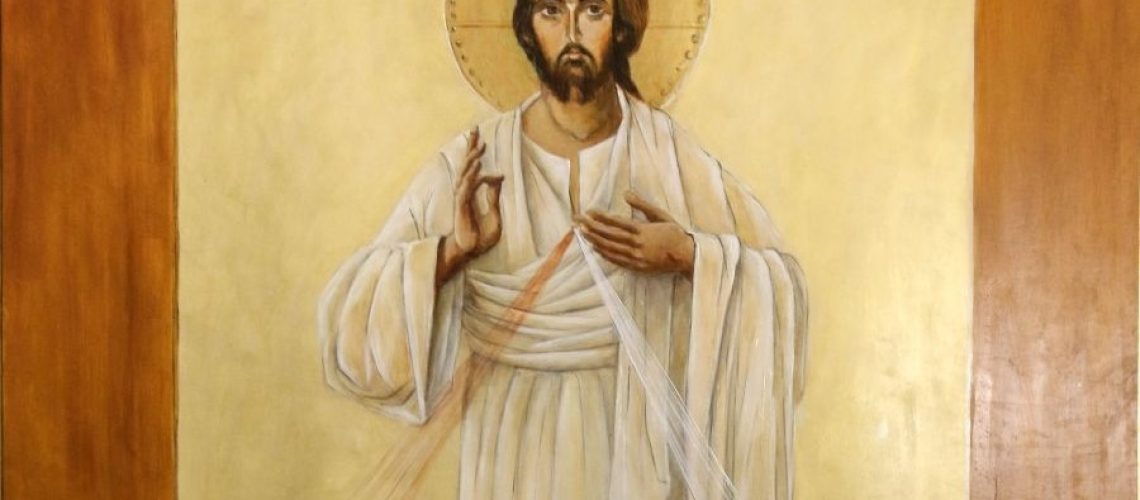
Or Absolute Accountability To God’s Justice for the Sins of Mankind?
Does Divine Mercy offer the sinner unconditional pardon for one’s transgressions, irrespective of the Justice of God? Or, are Divine Mercy and Divine Justice essentially one, leading all who are repentant toward an ever-increasing holiness?
Any consideration of these questions must begin with a foundational truth:
[M]ercy is the central nucleus of the Gospel message; it is the very name of God, the Face with which he revealed himself in the Old Covenant and fully in Jesus Christ, the incarnation of creative and redemptive Love. May this merciful love also shine on the face of the Church and show itself through the sacraments, in particular that of Reconciliation, and in works of charity, both communitarian and individual. May all that the Church says and does manifest the mercy God feels for man, and therefore for us. When the Church has to recall an unrecognized truth or a betrayed good, she always does so impelled by merciful love, so that men and women may have life and have it abundantly (cf. Joh 10:10). From divine mercy, which brings peace to hearts, genuine peace flows into the world, peace between different peoples, cultures and religions.[1]
The reality expressed here – is that God is merciful love itself. That Christ is the incarnation of creative and redemptive Love. Thus, the Love of God underlies all that He undertakes for the conversion of mankind, leading each of the faithful to greater holiness, and ultimately toward redemption – Eternal Life with Him forever in Heaven.
As regards mankind, justice and mercy are two different realities:
Justice and mercy, justice and charity on which the Church’s charity is hinged, are two different realities only for the human person. For we distinguish carefully between a just act and an act of love. For us “just” means “what is due to the other,” while “merciful” is what is given out of kindness.[2]
Therefore, a just act undertaken for the true good of one’s neighbor, is in accordance with what is due him or her, what he or she deserves as a child of God:
Justice is the moral virtue that consists in the constant and firm will to give their due to God and neighbor. Justice toward God is called the “virtue of religion.” Justice toward men disposes one to respect the rights of each and to establish in human relationships the harmony that promotes equity with regard to persons and to the common good. The just man, often mentioned in the Sacred Scriptures, is distinguished by habitual right thinking and the uprightness of his conduct toward his neighbor. “You shall not be partial to the poor or defer to the great, but in righteousness shall you judge your neighbor” (cf. Lev 19:15). “Masters, treat your slaves justly and fairly, knowing that you also have a Master in heaven” (cf. Col 4:1).[3]
An act of mercy toward one’s neighbor differs from a just act, in that it is: “The loving kindness, compassion, or forbearance shown to one who offends…”[4] One makes a conscious decision to act out of love or charity toward one who offends. One who offends another, is not due this compassion as a matter of justice.
One can see an example of God’s Mercy and Justice, in the parable of the rich man and Lazarus, in the Gospel of Luke:
There was a rich man who dressed in purple garments and fine linen and dined sumptuously each day. And lying at his door was a poor man named Lazarus, covered with sores, who would gladly have eaten his fill of the scraps that fell from the rich man’s table. Dogs even used to come and lick his sores. When the poor man died, he was carried away by angels to the bosom of Abraham. The rich man also died and was buried, and from the netherworld, where he was in torment, he raised his eyes and saw Abraham far off and Lazarus at his side. And he cried out, ‘Father Abraham, have pity on me. Send Lazarus to dip the tip of his finger in water and cool my tongue, for I am suffering torment in these flames.’ Abraham replied, ‘My child, remember that you received what was good during your lifetime while Lazarus likewise received what was bad; but now he is comforted here, whereas you are tormented. Moreover, between us and you a great chasm is established to prevent anyone from crossing who might wish to go from our side to yours or from your side to ours.’ He said, ‘Then I beg you, father, send him to my father’s house, for I have five brothers, so that he may warn them, lest they too come to this place of torment.’ But Abraham replied, ‘They have Moses and the prophets. Let them listen to them.’ He said, ‘Oh no, father Abraham, but if someone from the dead goes to them, they will repent.’ Then Abraham said, ‘If they will not listen to Moses and the prophets, neither will they be persuaded if someone should rise from the dead.’[5]
Here, one can see, the rich man has all of his material needs met through worldly possession, he prides himself on fine clothing and dines sumptuously each day. But the rich man, fails to use his wealth to help anyone but himself. While Lazarus, afflicted with sores, begs out of sheer need – waiting each day at the rich man’s doorstep, in hopes that the rich man will show him mercy.
Now, it could be said, that God shows mercy to both men. He has blessed the rich man with the gift of life, material possession, and has afforded the rich man opportunity to help others less fortunate than himself. The rich man, could have atoned for his sins: by offering the poor man good spiritual example, by giving alms, by allotting the poor man food, by granting him shelter and in treating his wounds.
Sadly, the rich man chooses not to help Lazarus materially or spiritually. More than anything else, this is a sin of omission, the rich man neglects to help Lazarus when he easily could have done so. In a sense, this is a failure to give another his due. Because, the poor man is a child of God and possesses the dignity of a human person, he is made in the image and likeness of God, he is worthy of the rich man’s compassion.
Lazarus also, has been blessed by God with the gift of life. And, although the rich man ignores or refuses to care for the poor man, nonetheless, God has mercy on Lazarus through His creation. The dogs relieve at least some of the poor man’s suffering, through the cleansing of his wounds with their tongues.
Once the poor man dies, the Lord’s Justice is seen – Lazarus is carried to the bosom of Abraham (the blissful abode of righteous souls). The poor man, who lived this life in want and sickness – receives (the blissful abode of righteous souls) – while the rich man, who also dies – receives the torments of the netherworld (Sheol).
And, from the netherworld, the rich man cries out to Abraham, imploring that Lazarus be sent to ease his suffering. But at once it is stated, that a chasm exists between the netherworld and (the blissful abode of righteous souls), one that prevents anyone from crossing. Following this, the rich man begs Abraham to send Lazarus to his father’s house, that his brothers be warned of the torments of the netherworld, but Abraham replies: they have Moses and the prophets, let them listen to them.
Here one must recognize, Divine Mercy is clearly founded upon the Law of Love. Both the Mercy and Justice of God, are employed for the true good of His children, to restore goodness where goodness is lacking:
Justice is not only stern severity towards the guilty; it takes account of the good intention, and gives to virtue its reward. Indeed I hope as much from the Justice of God as from His Mercy. It is because He is just, that “He is compassionate and merciful, longsuffering, and plenteous in mercy.”[6]
“My son, do not disdain the discipline of the Lord or lose heart when reproved by him; for whom the Lord loves, he disciplines; he scourges every son he acknowledges.”[7] One must accept, the loving corrections God allows during this life. One must accept, the pain and sufferings God allows, because, both are offered that the faithful grow in the spiritual life.
And, if those who have sinned, continue to sin, remaining wholly unrepentant, ignoring the loving corrections offered – they will receive God’s Justice at the Particular Judgement: “‘Amen, I say to you, what you did not do for one of these least ones, you did not do for me.’ And these will go off to eternal punishment, but the righteous to eternal life.”[8]
Therefore, it is evident that one must persist in being properly disposed to receive the Mercy of God. Through one’s possessing a purity of intention, remaining humble and repentant for one’s sins before God: “Clothe yourselves, all of you, with humility toward one another, for ‘God opposes the proud, but gives grace to the humble.’”[9] And, by remembering, that one must “[d]o to others whatever you would have them do to you.”[10] That justice and mercy reign in the lives of one’s brothers and sisters in Christ: “Blessed are the merciful, for they will be shown mercy.”[11] “For the LORD loves justice and does not abandon the faithful.”[12]
[1] Pope Benedict XVI. Regina Caeli. P 1. 30 March 2008. Libreria Editrice Vaticana. https://www.vatican.va/content/benedict-xvi/en/angelus/2008/documents/hf_ben-xvi_reg_20080330.html
[2] Pope Benedict XVI. Justice and Mercy in the Logic of God. P 7. 21 December 2011. EWTN., as quoting L’Osservatore Romano Weekly Edition in English., pg. 3. https://www.ewtn.com/catholicism/library/justice-and-mercy-in-the-logic-of-god-6914
[3] Catholic Church. Catechism of the Catholic Church: Revised in Accordance with the Official Latin Text Promulgated by Pope John Paul II, 2nd ed. (Vatican City; Washington, DC: Libreria Editrice Vaticana; United States Catholic Conference, 1997), 1807.
[4] Ibid., Glossary, pg. 888.
[5] Confraternity of Christian Doctrine, Catholic Church, Saint Joseph Edition of the New American Bible (Washington, D.C. United States Conference of Catholic Bishops, and Totowa, NJ: Catholic Book Publishing Co. 2011)., Luk 16:19-31. (Hereafter cited as NAB)
[6] Thérèse. 1912. The Story of the Soul : The Autobiography of St. Thérèse of Lisieux. Translated by Thomas N. Taylor. New York: Cosimo Classics., para. 3., pg. 270.
[7] NAB., Heb 12:5-6.
[8] Ibid., Mat 25:45-46.
[9] Catholic Biblical Association (Great Britain). The Holy Bible : Revised Standard Version, Catholic Edition, Translated from the Original Tongues, Being the Version Set Forth A.D. 1611, Old and New Testaments Revised A.D. 1881-1885 and A.D. 1901 (Apocrypha Revised A.D. 1894), Compared with the Most Ancient Authorities and Revised A.D. 1952 (Apocrypha Revised A.D. 1957). Catholic ed. San Francisco: Ignatius Press, 1994., 1 Pet 5:5.
[10] NAB., Mat 7:12.
[11] Ibid., Mat 5:7.
[12] Ibid., Psa 37:28.


This article perfectly articulates what I’ve experienced in my own life. Embracing Divine Mercy has truly transformed my relationship with God and helped me find peace. It’s not just a concept, it’s a living reality. If you’re struggling, trust in His infinite love!
Even today, giving or offering a dog superficial wounds (cuts, chafing, etc.) to lick is common practice in Spain. According to informants from Salamanca, “what the dog licks heals quickly”, “the wound heals faster”, “the wound heals up better and much sooner”; and then “its saliva is better than ours”, “its saliva is a disinfectant”, “its saliva is very good for healing, cleaning and disinfecting wounds” and “its tongue is very good.” [41]
41.González JA, Vallejo JR, Aparicio AJ. Etnozoología: recursos animales para la salud en la tradición salmantina. Salamanca: Instituto de las Identidades – Diputación de Salamanca; 2015.
“However, the ancients knew when a dog licks a person’s sores or wounds, healing occurs more rapidly. At the Ashkelon dog cemetery in Israel, over a thousand dogs are buried in individual plots that dates back from the fifth to the third centuries BC. The dogs were trained to lick the wounds or sores of humans, in exchange for a fee.”
[…] and Punditry:Divine Mercy: Free Pardon for the Sinner? – Fr. Kenneth M. Dos Santos, M.I.C., at Catholic StandFaith & the Papacy – Fr. Paul […]
[…] There was a rich man who dressed in purple garments and fine linen and dined sumptuously each day. And lying at his door was a poor man named Lazarus, covered with sores, who would gladly have eaten his fill of the scraps that fell from the rich man’s table. Dogs even used to come and lick his sores. When the poor man died, he was carried away by angels to the bosom of Abraham. The rich man also died and was buried, and from the netherworld, where he was in torment, he raised his eyes and saw Abraham far off and Lazarus at his side. And he cried out, ‘Father Abraham, have pity on me. Send Lazarus to dip the tip of his finger in water and cool my tongue, for I am suffering torment in these flames.’ Abraham replied, ‘My child, remember that you received what was good during your lifetime while Lazarus likewise received what was bad; but now he is comforted here, whereas you are tormented. Moreover, between us and you a great chasm is established to prevent anyone from crossing who might wish to go from our side to yours or from your side to ours.’ He said, ‘Then I beg you, father, send him to my father’s house, for I have five brothers, so that he may warn them, lest they too come to this place of torment.’ But Abraham replied, ‘They have Moses and the prophets. Let them listen to them.’ He said, ‘Oh no, father Abraham, but if someone from the dead goes to them, they will repent.’ Then Abraham said, ‘If they will not listen to Moses and the prophets, neither will they be persuaded if someone should rise from the dead.’[5] […]