
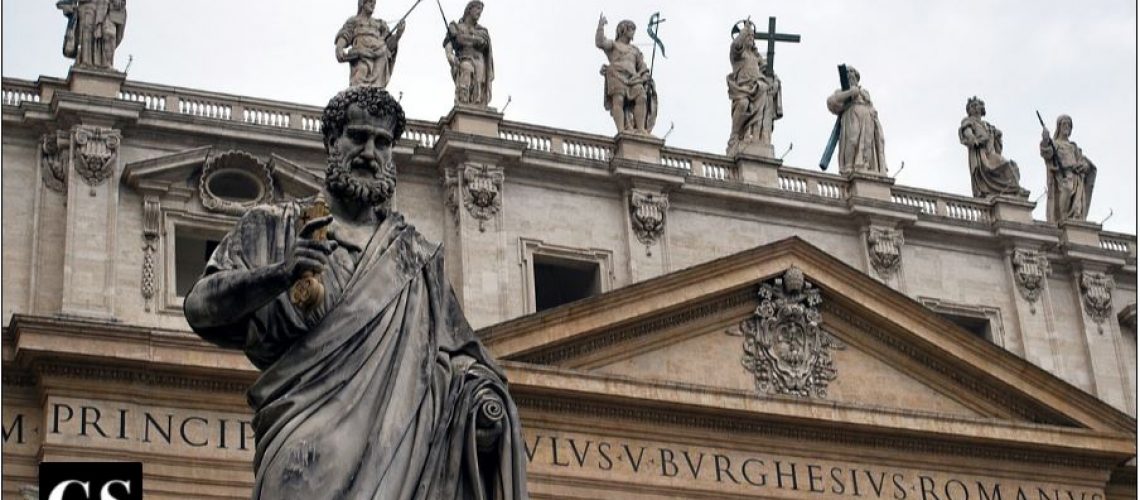
In 1864 Pope Pius IX rejected the view that:
the Church ought to be separated from the State. (Syllabus of Errors 55)
In 1965 Vatican II said:
The Church and the political community… are… independent from each other. (Gaudium et Spes 76)
Comments like that have encouraged some people to claim:
In 1965 the second Vatican Council… affirmed the separation of Church and State. (“What’s the Catholic view on church and state?”)
But is that an accurate reading of Vatican II?
1. The Authority of Pius IX’s View
When there is an apparent doctrinal conflict, it is important to clarify the authority of the different viewpoints.
Vatican II is an Ecumenical Council so it has supreme authority. But what is the status of Pius IX’s rejection of the separation of Church and State?
In 1864 Pius IX said that his view was a formal teaching of his official office. He stated:
By our Apostolic authority, we reprobate, proscribe, and condemn… and command that… [these views] be thoroughly held by all children of the Catholic Church as reprobated, proscribed and condemned. (Quanta Cura 6)
His predecessor, Pope Gregory XVI, also said in 1832 that he was speaking in his official capacity, when he expressed a similar view (Mirari Vos 1 and 20).
Pope Leo XIII also cited and reaffirmed Pius IX’s view in 1885 (Immortale Dei 34). He repeated the point in 1882 (Cum Multa 6) and in 1884 (Humanum Genus 13). He reiterated it in 1892 (Au Milieu des Sollicitudes) and again in 1895 (Longinqua). He also explicitly claimed to be exercising his “Apostolic Office” in making the point (Libertas 47).
Pope Pius X also followed Pius IX’s view. He described the separation of Church and State as an “absolutely false” idea in 1906 (Vehementer Nos 3). It was rejected twice more in 1906 (Gravissimum Apostolici and Gravissimo Officii 2). It was rejected in 1908 (Le Moment) and again in 1911 (Iamdudum 2).
Pope Pius XI repeated Pius IX’s view in 1924 (Maximam Gravissimamque 2) and twice in 1925 (Iam Annus; Quas Primas 17). It was repeated with an appeal to the authority of his “Apostolic office” in 1926 (Iniquis Afflictisque 3). And it was rejected again in 1933 (Dilectissima Nobis 6).
Pope Pius XII rejected the idea in 1953 (Ci Riesce).
Pope John XXIII assumed the rejection of the idea when he called in 1961 for “public authorities… to observe the precepts… of the Church” (Mater et Magistra 253).
The nature and repetition of the claims suggest a high, if not supreme degree of authority for the view rejecting the separation of Church and State.
This means that any alleged conflict between the teachings of Vatican II, and teachings prior to the Council (on this issue) cannot be resolved by dismissing one side.
To move matters forward, it is necessary to clarify the nature of the specifically doctrinal matters which are at issue.
2. What Revelation Says
Christian understanding of the relationship of Church and State is grounded in Scripture. The following three texts have traditionally been cited as relevant:
[Jesus] said to them, … “Repay to Caesar what belongs to Caesar and to God what belongs to God.” (Matthew 22:21)
Let every person be subordinate to the higher authorities, for… those that exist have been established by God. (Romans 13:1)
“We must obey God rather than men.” (Acts 5:29)
These texts acknowledge that there is a difference between the Church and the State (i.e., between God and Caesar). They recognize that members of the Church must obey State authorities, but they also recognize that there can be conflict. When that occurs Christians must obey God (or the Church as the interpreter of God), rather than the State.
3. The Two Powers
The Church has traditionally interpreted Scripture as teaching a doctrine of the two swords, or doctrine of the two powers.
In 494 Pope Gelasius I expressed it in the following words:
There are two, O emperor… by which the world is… ruled: the sacred authority of pontiffs and the royal power…. Although by dignity you preside over the human race, nevertheless you… must be submitted to the order of religion rather than rule over it. (Famuli Vestrae Pietatis 2)
In 1885 Pope Leo XIII restated the doctrine, as follows:
The Almighty, therefore, has given the charge of the human race to two powers, the ecclesiastical and the civil… Each… is supreme, each has fixed limits… But… there must… exist between these two powers a certain orderly connection. Whatever… is referred to the salvation of souls… is subject to the power and judgment of the Church. Whatever is… under the… political order is rightly subject to the civil authority. (Immortale Dei 13–14, emphasis added)
That paragraph outlines the Church’s doctrine in three doctrinal principles:
- The Church and State are each supreme in their own domains.
- The Church’s domain includes everything pertaining to salvation.
- As issues can overlap domains, the Church and State must be connected.
The first principle establishes the autonomy and independence of both Church and State.
The second principle specifies that the Church has the power to determine ethical issues. That is because ethical issues involve matters of sin, and sin has direct implications for salvation.
The third principle insists that there must be a “connection” between Church and State. That connection is an unavoidable (logical) implication of the fact that both Church actions and State actions involve ethics. That means that the Church and State have to work together, in some way, so that there is no confusion for members of the Church about what is ethically permissible and ethically obligatory.
The Church has enacted those three doctrinal principles with policy practices which have varied in different cultures and eras. Sometimes the third principle’s requirement for ethical clarity has involved State legislation. Thus, murder is typically classified ethically as both a (Church) sin and a (State) crime. Sometimes, ethical clarity has been achieved through ethical education, rather than through legislation. Thus, in some contexts prostitution has been a (Church) sin, without being a (State) crime. Similarly, issues like Sunday Mass obligation typically involve (Church) sin, rather than (State) criminality.
Having clarified the specifically doctrinal matters at stake in this issue (i.e., Leo’s three principles), we can now look at their implications for different models of how the Church and State could be related.
4. Caesaropapism
One way in which Church and State could be related is Caesaropapism. That is the view that the Church should be merged into the State, or otherwise subject to it. That view has arisen in many guises over the centuries, including as Absolutism, Caesarism, Erastianism, Febronianism, Gallicanism, Josephinism, Phyletism and Regalism.
Historically, there were sometimes pragmatic advantages for both Church and State when their roles were blurred. (See Constantinianism.) However, it also led to serious confusions. By the Reformation era, individuals like King Henry VIII (d. 1547) considered himself able to define religious doctrine and ethical norms for the Church of England.
Caesaropapism had a particularly negative impact on the Church’s ability to select its own bishops. (See Appointment of Bishops.) It even led to secular rulers thinking they had the right to veto the election of popes (i.e., the Jus Exclusivae), as was attempted in the 1903 papal election of Pope Pius X.
Ultimately, Caesaropapism is unacceptable because it conflicts with the first of Leo’s doctrinal principles. It blurs what should be two powers into one power. As a result, in 1864, Pius IX rejected the claim that:
The ecclesiastical power ought not to exercise its authority without the permission and assent of the civil government. (Syllabus 20)
5. Theocracy
Another way in which Church and State could be related is Theocracy. That is essentially the view that the State should be merged into, or otherwise subject to, the Church.
Medieval history can seem to illustrate examples of this. In the eleventh century, sometimes bishops were involved in the operation of the State. (See Investiture Conflict.) In the twelfth century the Church’s administration of (secular) justice was an issue which contributed to the martyrdom of St. Thomas Becket. In the thirteenth century King John of England even became a political vassal of the pope and the pope annulled aspects of English law (i.e., Magna Carta).
However, these kinds of examples involve considerable confusions of powers and roles, as well as idiosyncrasies of feudalism. They were contextual policies which attempted to interpret and apply the Church’s doctrine in specific circumstances.
Ultimately, theocracy is unacceptable to the Church because (like Caesaropapism) it conflicts with Pope Leo’s doctrinal principles by merging two powers into one power. Pope Leo XIII rejected the view in 1884 when he said:
The Church… is wrongly… believed… to arrogate to herself… the rights of sovereigns. On the contrary, she teaches that what is rightly due to the civil power must be rendered to it with a… consciousness of duty. (Humanum Genus 29)
6. Separationism
A third way in which Church and State could be related is by a total separation. That is essentially a model of (political) Non-Overlapping Magisteria, whereby every human issue has to be assigned to the control of either the Church or the State. Pope Leo XIII described it in 1882 as “completely isolating” the Church from the State, so that they have “nothing in common.” (See Cum Multa 6.)
Advocates of that kind of view sometimes appeal to John Courtney Murray (d. 1967). He claimed that the pope’s rejection of “separation” was actually a rejection of “subjugation” (i.e., Caesaropapism). Therefore, the US constitutional model of separation should be doctrinally acceptable to Catholics. (See his Leo XIII: Separation of Church and State.)
The cogency of Murray’s thinking has been challenged. (See We Hold These Truths and More). Murray’s view was also (pre)rejected by Pope Leo XIII, who said in 1895:
It would be… erroneous to draw the conclusion that… it would be universally lawful… for State and Church to be, as in America, dissevered and divorced. (Longinqua 6)
The reason why the American model was rejected is that it ignores the reality that ethical issues cannot be separated between Church and State. When there is a disagreement about an issue such as abortion, euthanasia (etc.), it can result in the Church and the State contradicting each other about what is (ethically) permissible.
Sometimes people try to resolve matters by appealing to a difference between public and private actions. But that is an irrelevant distinction without a difference when it comes to ethics. Murder does not suddenly become ethical if it is commanded by the State. (That is why in 390 St. Ambrose rebuked an emperor for the Thessalonica Massacre in Epistle 51.) Similarly, if the end does not justify the means for private actions, then it cannot do so for public actions.
The only way of completely separating ethics between Church and State would be to adopt an ideology of Relativism (or Anti-realism or double truth theory) which accepts that contradictions can (somehow) be true. Thus, Church and State could hold contradictory views about the ethics of specific actions, and that would be fine because each view can (somehow) be true in its own independent domain (or in its own language game).
However, it is irrational to believe in contradictions. It is an instance of the Fideism which Vatican I rejected. That is partially why Pope Leo XIII dismissed the idea of separating Church and State as leading to “absurdity” (Libertas 18).
7. Liberalism
A fourth way of relating Church and State is Liberalism. Pope Leo XIII described it in 1888 as follows:
Liberalism… make[s] the State absolute and omnipotent, and proclaim[s] that man should live altogether independently of God. (Libertas 31)
This idea avoids Separationism’s problem of contradictory truths (section 6) by insisting that the Church is irrelevant to determining what is ethical. Liberalism says that people need only think for themselves and consult their own minds (i.e., rationalism) to know what is ethically permissible.
A serious problem with Liberalism was revealed by twentieth-century totalitarianism. Both Fascist and Communist regimes appealed to their own intuitions of rationality, with the result that millions were murdered. The Nuremberg Trials in 1945 made it clear to the world that no politician can determine ethical truths for a State’s citizens, by just stating “what seems rational” to the leader.
That conclusion is reflected in the 1992 Catechism, which says that part of the role of the Church, in the State, is (or should be) to provide an ethical check that should help States to avoid drifting into an (ethical) totalitarianism (CCC 2257).
Nevertheless, Liberalism insists that the Church is irrelevant to the actions of the State. That leads to a problem which is illustrated in a 1960 comment by presidential candidate John F. Kennedy. He said:
I believe in an America that is officially neither Catholic, Protestant nor Jewish; where no public official either requests or accepts instructions on public policy from… any… ecclesiastical source. (“JFK’s Speech on His Religion”)
That comment raises an obvious question. If totalitarianism shows that human rationality (alone) cannot determine ethics, and if the Church is also effectively irrelevant, then where is Mr. Kennedy getting his information from, about the ethics of his political actions?
Or is it the case that Liberalism involves an intellectually muddled acceptance that appeals to rationality alone is not enough to determine ethics, but it just carries on appealing to rationality, regardless?
The problem of rationality within Liberalism was illustrated by a comment from President Ronald Reagan. Although he was a staunch defender of the separation of Church and State, nevertheless in 1984 he found himself having to admit that there is a de facto extent to which Church and State do end up being somewhat inseparable, due to the unavoidable overlap of them sharing the same citizens. (See “Reagan, at Prayer Breakfast, Calls Politics and Religion Inseparable”.)
What this all means is that Liberalism is unacceptable to the Church. Like Separationism, it involves dubious rationality. It also directly conflicts with Leo’s second doctrinal principle (section 3) by denying the Church’s role in determining ethical truths. As a result, in 1906 Pope Pius X rejected the view, saying:
[It] inflicts great injury on society, … when due place is not left for religion, which is the supreme rule… in all questions touching the rights and duties of men. (Vehementer Nos 3)
8. Vatican II
When Vatican II reflected on the issues of Church and State it made it clear that its words were not to be interpreted as changing prior doctrine. It said:
[The Council]… leaves untouched traditional Catholic doctrine on the moral duty of men and societies… (Dignitatis Humanae 1)
When we look at what the Council actually said, we can also see that it followed Leo’s first doctrinal principle. When Vatican II said that the Church and State are “in their own fields… autonomous and independent” (Gaudium et Spes 76), that was a rejection of Caesaropapism (section 4) and Theocracy (section 5). It was an affirmation of precisely Leo’s point that each is “supreme… in its fixed limits” (Immortale Dei 13).
Vatican II also affirmed Leo’s second principle. It rejected Separationism (section 6) and it rejected Liberalism (section 7) by insisting that the Church (not the State) determines the ethics of human actions. The Council said:
In every temporal affair… [Christians] must be guided by a Christian conscience. (Lumen Gentium 36)
Enlightened by Christian wisdom and giving close attention to the teaching authority of the Church, … let the layman take on his own distinctive role. (Gaudium et Spes 43)
The Council also made it clear that the Church’s mission includes helping people to follow divine law, and that includes the “human communities” which constitute States. It said:
Christ… gave His Church no proper mission in the political, economic or social order. The purpose which He set before her is a religious one… [with] a function, a light and an energy which can serve to structure and consolidate the human community according to the divine law. (Gaudium et Spes 42, emphasis added)
In case there was any doubt about what it means to follow the ethics of divine law, Vatican II made the point explicitly clear, stating:
Murder, genocide, abortion, euthanasia or wilful self-destruction, … mutilation, torments inflicted on body or mind, attempts to coerce the will, … subhuman living conditions, arbitrary imprisonment, deportation, slavery, prostitution, the selling of women and children… all these things… are infamies indeed. (Gaudium et Spes 27)
Vatican II had relatively little to say about the third of Leo’s doctrinal principles, (i.e., that there needs to be a relationship between Church and State, so that there is no confusion about what is ethical). But an absence of comment is not a rejection of a doctrine, especially given the text above in which Vatican II insisted it was not to be interpreted as changing doctrine.
When we look at Church policy, prior and post Vatican II, we can also see continuity in the fact that in each context the Church has encouraged Catholics to clarify ethics through both State legislation and ethical education. That is why, to this very day, Catholics campaign around the world for changes to the legislation of States.
What has changed since Vatican II is that there is a different tone and style to communications between the Church and State. Since Vatican II the Church also manages more of its relationships with states at the local level. This involves Episcopal Conferences and lay (Catholic) politicians engaging with governments, rather than the Vatican trying to do everything centrally through Concordats and Encyclicals.
Another change since Vatican II is that there is a greater focus on ethical education, rather than on trying to clarify (all) ethical issues through legislation. This is because over the last century there has been a growth in psychological awareness, which appreciates that legislation is not always the most effective way to promote health and ethical observance. Ethical education and persuasion can be far more effective than the blunt instrument of legal coercion, as even modern States have realized with the positive lessons of Nudge Theory, and the negative lessons of Prohibition.
9. Conclusion
The separation of Church and State has been repeatedly rejected by popes (section 1). It is all too easy to caricature that rejection as Church frustration at losing the expedience of being able to co-opt the State to support its own mission.
However, when we examine the doctrinal content of the Church’s position (section 2), we can see that it consists in three doctrinal principles which Pope Leo XIII clarified (section 3). We can also see that there are logical reasons driving Church statements. Those reasons flow from the ethical content of the Church’s mission to promote salvation. They mean that the Church cannot accept models of Church-State relationship such as Caesaropapism (section 4), Theocracy (section 5), Separationism (section 6) or Liberalism (section 7).
When we look at what Vatican II said (section 8), we can see that there is no reason to think that Vatican II has changed the logic of Leo’s three doctrinal principles, nor has it said anything that conflicts with those principles. That means that there is no reason to think that Vatican II has changed the doctrine which rejects the separation of Church and State.
Ultimately, the Church’s position enshrines an insight that in (healthy) human communities there needs to be a distinction between the State (as Executive, Judicial and Legislative branches) and the determination of what is ethical for the State to do, which is the role of the Church. History shows the dangers which arise when political leaders think that they have the ability to determine for themselves the ethical appropriateness of their own actions, immune to any other considerations. The rejection of the separation of Church and State is the Church’s rejection of precisely that kind of dangerous thinking.


[…] II rejected the separation of Church and State. (See “Did Vatican II Change Doctrine About the Separation of Church and State?”) It also rejected the idea of liberalism. (See “Did Vatican II Accept Liberalism?”) The […]
[…] Network Offers Lifeline to Converts From Islam to the Catholic Faith – Ed Pentin at The RegDid Vatican II Change Doctrine About the Separation of Church & State? – Catholic Stand MagazWell! Biologically They Are Male & Female—a Conundrum – Fr. […]
Yes, undoubtedly theology (and theological politics) might become much simpler if the Church eradicated diversity of views about all the relevant issues. But perhaps that would be a cure worse than the ailment which it attempts to address…?
I don’t see how, because if you take the toll Christianity has engendered in the form of persecution, scandal, untold deaths from war and inquisition, endless division and that
after 2 millennia it represents only a third of theological concept, I’d say it’s not a zero
sum gamble.
One of the difficulties is that it takes time for ideas to mature and minds to settle, so trying to reach doctrinal clarity on some matters, can be pressed too quickly and can lead to infelicitous outcomes. Some of those issues were reflected in an earlier piece – https://catholicstand.com/three-ways-of-knowing-catholicism-orthodoxy-and-protestantism/
In the theological realm, there is a similar divergence that ought to be addressed. When the church asserts it’s right to comingle with the secular on matters of ‘salvation’, it does
so on theory. That we die once, to damnation or bliss, is well disputed by the theological concepts of eastern deism. Since no proof of either, backing a maxim that promulgates one over the other upsets the balance which should exist across the spectrum. How about an integration of doctrinal clarity before dabbling in absolutes. The ‘just war’ theory comes to mind.