

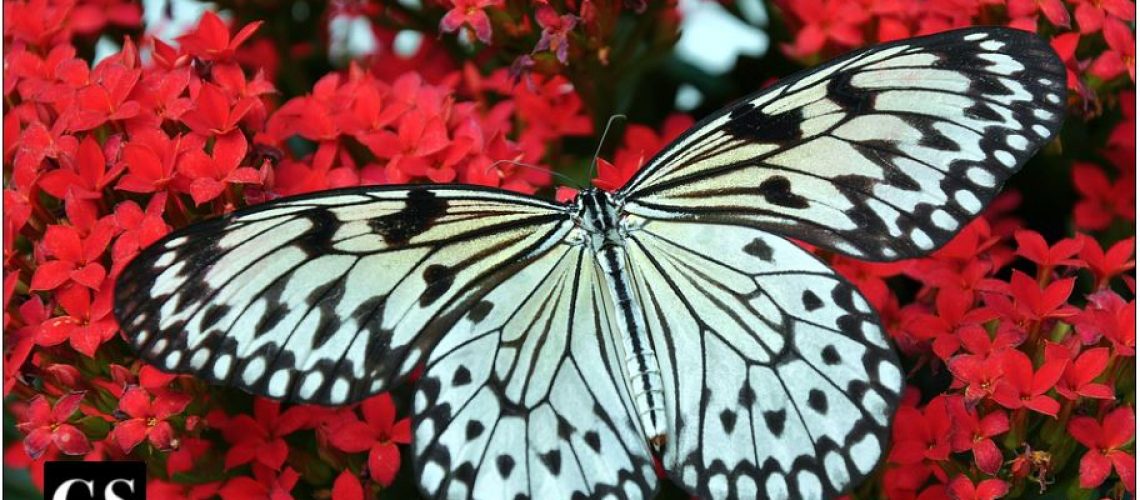
My weekly study group has been reading St. Theresa of Avila’s “The Interior Castle” for several weeks now. It’s a book that has been called “One of the most celebrated works on mystical theology in existence.”
Very recently we encountered a section reflecting on how a silkworm spins a cocoon and then essentially dies to produce a white butterfly. The butterfly and the silk of the cocoon is what remains of the now gone caterpillar.
St. Theresa – and others before and since – intuited what science eventually showed. The caterpillar essentially dissolves into an organic goo that reshapes itself into the form of a butterfly. The language was that the caterpillar dies and the butterfly emerges from that death. The continuity of life at the cellular level was not explicitly expressed or known, but the understanding was present at some level, articulated or not.
The Understanding Of Regeneration
The Church teaches us that regeneration begins with baptism. In Col 2:12, Paul tells us we are “buried with Him [Jesus] in baptism . . . [and] also raised with Him through faith in the power of God, who raised Him [Jesus] from the dead.”
Obviously, this is a mystery that we can only understand “through a glass darkly.” Yet nature illuminates for us some of the underlying mystery. Creation is not an arbitrary construct. Every element reflects God the Creator, and the mind of the Creator is evident everywhere we have the wit to look for and to discern it.
Our death in baptism is not physical because our carnal beings continue to live. But Baptism does mark the beginning of a change. And if we allow God and the Holy Spirit full freedom to perform, that change brings us through a death to our old self and eventually to the fullness of new life in Christ.
Self-Death
When my adult conversion began I was in my early 20s. One of our parish priests at the time often spoke about death to self, a theme he continued to explore for the rest of his life.
We can understand self-death in any number of different ways. But in terms of the metaphor of the caterpillar and the butterfly, we can think of it as a surrender of the current shape of our life to God’s will. This may lead us through a period of what feels like the dissolution of our lives. But dissolution is necessary for rebirth and new life.
Jesus himself said that “Amen, amen, I say to you, unless a grain of wheat falls to the ground and dies, it remains just a grain of wheat; but if it dies, it produces much fruit.” (Jn 12:24). One cannot see the continuity of living cells that produces a wheat plant from the seed, but it is there.
So the life is in the seed, and that life persists and can eventually flourish as it sprouts and grows, even though for a time life is invisible. That change from seed to plant is remarkable! There is no visual connection between the hard kernel and the verdant seedling, yet it undeniably exists.
The Fear Of Discontinuity
What we know in our minds does not necessarily soothe our hearts. We can know about a wheat kernel becoming a productive plant and a caterpillar becoming a butterfly, but that does not make us any less anxious about undergoing self-death, even if it is only psychological/metaphorical.
It seems to me that people do not always fear the results of change as much as they do the period of dislocation, discomfort, and discontinuity that comes between the period before the change and the final state. We may tell ourselves that the path of change is well bounded and safe, but most of us are more comfortable when we are at rest than when we are in transition.
Opening a cocoon would stop the transition from caterpillar to butterfly. And if it were done at the height of the dissolution phase of the transformation, it would be anything but obvious that the organic goo inside would actually have become a butterfly.
Our self-perception during times of intense change and transformation is equally challenged by what we perceive. It is definitely an act of faith to believe that change is indeed leading us to something distinct and desirable.
Growing in Faith Requires a Faith of Its Own
Staying static in our faith is not really an option. If we are not growing our faith, we are in danger of watching it sicken and die. Stasis is not a natural condition for human beings. If we are spiritually healthy, then we are always moving closer to God and growing in the Spirit, just as aging makes us more and more capable of spiritual maturity.
Growth requires us to change, and the periods of instability that accompany growth and transformation are frighteningly uncertain in our perceptions. There is a potential paradox in play here: to grow our faith we must increase it in order to persevere through the process of growth.
But what seems impossible to us is more than possible for God.
It Always Seems To Come Back To Prayer and Trust
In this instance the answer to uncertainty and fear is to be found in prayer. When our trust is insufficient to the challenges of uncertainty and change, we can only resort to prayer.
Sometimes it helps to cast a new eye on phrases that we know so well they have become clichéd and lost their primal power. Consider these words from Psalm 23:3-4:
. . . He guides me along right paths for the sake of His name.
Even though I walk through the valley of the shadow of death I will fear no evil, for You are with me; Your rod and Your staff comfort me.
If we are called to change in order to grow in the Spirit, then surely we can trust God to guide us along the right path to accomplish that change. And beyond that we can also trust Him to accompany us and protect us during those times of perceived danger as we undergo death to self in order to rise to a regenerated life. We learned this as children. But in times of change and growth, we perceive this anew, as the importance of this promise becomes suddenly and vividly real and relevant to our situation.
Forget the Goo, Focus On The Butterfly
Change is scary, messy, and sometimes unsettling and unsightly. But if it comes as a part of our spiritual growth and maturation, it is necessary and healthy. Just remember in times of discomfort, difficulty, and doubt, focus on the butterfly you know is coming, and not on the goo that seems to be filling your life.
The silkworm does not know of the part it plays in creating both beautiful and durable goods. But its role is no less important for its lack of understanding.
Similarly, in the midst of change and tumult we may not see the butterfly we are destined to become, or the utility of our change to the world. But we can trust it is there. God promises us that He will not put us to shame or let our lives go to waste if we surrender our lives to Him.
Prayer
Father, be our rock during times of change, and send the Holy Spirit to guide us through times of uncertainty, difficulty, and doubt. Lend us a sure and certain trust in Your never-failing presence and love for us, no matter how badly we feel tossed around by the tempests of life. Help us remember that our Lord stilled the seas and rescued Peter from the consequences of his failing trust after he stepped out in faith. Strengthen our steps and bolster our faith that we may always focus on your promises and not on our fears and uncertainties. Grant us, we pray, that at the end of the storms of life we may be greeted by Your welcoming embrace and the precious words: “Well done thou good and faithful servant.” Amen.




3 thoughts on “Caterpillar Goo and Butterfly Bodies”
Pingback: MONDAY LATE EVENING EDITION – BigPulpit.com
Dear T,
My mistake. I too commonly use “God” to mean “God the Father”.
The habits of childhood persist…
Mark
The author writes”if we allow God and the Holy Spirit…”
I really dislike this language because it seems to say that the Holy Spirit is not also God. I suspect that the author knows that the Holy Spirit is God, but to a reader who does not know that, the wording could be very misleading.