
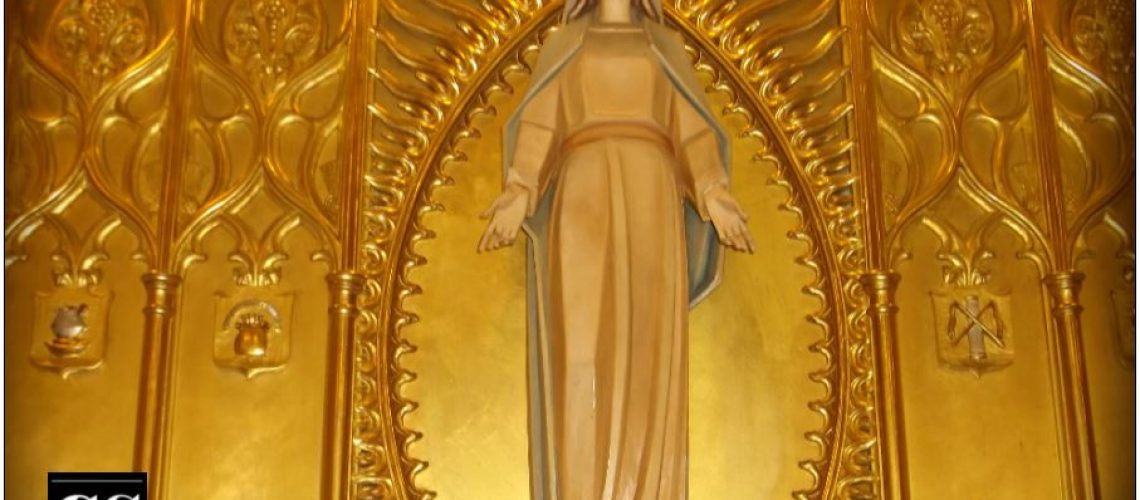
The Feast of the Immaculate Conception (December 8th) is upon us. So, I thought it prudent to take a common sense and biblical look at why God created Mary full of grace from the moment of her conception. You can find the dogma of the Immaculate Conception here.
Mary, Full of Grace
Grace, as it relates to salvation, is God’s unmerited favor. This is why some Bible translations render Gabriel’s greeting to Mary, “Chaire kecharitomene,” as “highly favored one.”
God eternally favored Mary to be the mother of His divine Son incarnate, the only person who ever has or ever will give birth to a divine Person. Because Mary is the only person whom God will ever select and predestine to fulfill this most exalted role and responsibility among creatures, we would better understand “highly favored one” as “most favored.”
Therefore, God most graced Mary for this unique relationship from the moment of her conception, a relationship only she and her Son unceasingly enjoy. Now, when God favors someone, He communicates grace to that person. And when He favors someone above all others, He fills that person with grace.
So, we must have no doubt that God made and preserved Mary full of grace. Since God most highly favored her from eternity, He most fully graced her from conception. She is the spotless Ark of the New Covenant and is the only created being to have such a close, personal connection to God.
Mary, Most Blessed
Additionally, when Mary visited Elizabeth, whom the Holy Spirit had filled (Luke 1:41), Elizabeth said to Mary, “Blessed are you among women, and blessed is the fruit of your womb” (Luke 1:42, RSVCE). Thus, at the Holy Spirit’s inspiration, Elizabeth gave Mary and Jesus the same blessing. By giving them both the same blessing, Elizabeth and the Holy Spirit implied that Mary is the most blessed among all women.
So, Mary is most graced, most blessed, and due to her special relationship with the Son, most exalted among God’s creatures. In fact, God’s favor toward Mary and His blessing of her as the mother of the Most High inspired St. Bonaventure (A.D 1221 to 1274, Bishop, theologian, philosopher, and a Doctor of the Church) to write the following:
It is but fit that the Blessed Virgin should be without any stain, and that she should so entirely conquer Satan, that she was not even for one moment subject to him. If Mary’s soul had been, only for one moment, spotted with original sin, she would have been subject to Satan for that length of time; she would have been a seat, a dwelling of the devil, a slave to him, and a child of divine wrath. Would it have been suitable that the only Son of God should dwell nine months in the womb of a created being, who before, though for ever so short a space of time had been a dwelling of Satan?
Can we think, without trembling, that she, who was chosen from all eternity to become the mother of our Lord, had been a slave to the devil, an object of divine wrath? If this had been the case, Satan could have boasted that, before Christ, he had inhabited the Ark which was destined by the Almighty, not to preserve manna, or the lifeless tables of the law, but to keep, during nine months, the holy Lawgiver Himself. Would this have been worthy of Christ? No one will dare say it. Hence, the honor of Him, whom Mary gave to the world, demands that she should have been conceived immaculate. The high dignity to which Mary was raised allows not the thought that she, even for one moment, was defiled with original sin (Lives of the Saints, Francis Xavier Weninger, 1876).
Chaire Kecharitomene
Many years ago, EWTN posted an examination of the phrase chaire kecharitomene. I saved the quote back then, but I am unable to find it on their website now. Nevertheless, the analysis is excellent for understanding just how much God favored Mary.
‘Hail, full of grace.’ (‘chaire kecharitomene’ – ‘Chaire’ means ‘hail’ or ‘rejoice.’ ‘Charis’ means ‘grace.’ ‘Charitoo’ is a Greek verb ending in omicron omega (‘oo’), which means to put the person or thing into the state indicated by the root. The root being ‘charis’ or ‘grace,’ ‘charitoo’ means to put into a state of grace. ‘Ke’ is a Greek perfect tense prefix that indicates a perfected, completed present state as a result of past action. Thus, a perfected, completed present state of ‘charis,’ or ‘grace,’ as a result of past action. ‘Mene’ is a Greek passive participle suffix that indicates action performed on the subject by another. Thus, a perfected, completed present state of ‘charis,’ or ‘grace,’ as a result of the past action of another. As the speaker is the angel Gabriel, the ‘other’ is God. Therefore, ‘chaire kecharitomene’ means, ‘Hail, who has been perfectly and completely graced by God.’ The common Catholic rendering, ‘full of grace,’ while good, may actually fall short!
One might challenge this argument by saying that if Mary was perfect from conception, then Christ did not save her. However, Mary, under the Holy Spirit’s inspiration, exclaimed, “I rejoice in God, my Savior” (Luke 1:47).
Therefore, God saved Mary, and He did so through His Son’s meritorious work on the Cross (once and for all; Hebrews 7:27-28). Since grace is necessary for salvation, and God graced Mary from the moment of her conception, then God saved her from the moment of her conception.
God Honored Mary, So We Must As Well
The takeaway is clear. God eternally favored Mary alone to be the Mother of God. So, from the moment of her Immaculate Conception, God fully graced her. If God gives Mary this preeminent honor and the grace to go along with it, then those whom He makes in His image and likeness must give Mary the honor she deserves. To believe otherwise is to oppose the clear teaching of Scripture and God Himself (Luke 1:48, 1 Corinthians 12:26).
Mary, our Blessed Mother, please pray for us! Happy Feast of your Immaculate Conception! We love you!


[…] more on Mary’s Immaculate conception, please click here. For an article on how grace works, please click here. Please click here for an article on how we […]
[…] Why Mary is Always Full of Grace – Nate Guyear at Catholic Stand […]
Nate and David:
Thank you for your comments and for helping me to understand my errors!
No problem, Robert.
Happy Feast of the Immaculate Conception everyone!
I’m glad to see your change of heart, Robert.
Nate,
Thank you for presenting Ineffabilis Deus, which was a magnificent encyclical. It is amazing that it is still so poorly known.
Joe
Nate Guyear: not all grace is sanctifying grace. My understanding is that sanctifying grace became available for us at Pentecost because Christ’s Spirit, now that it can be within us, enables it to flow into us. Mary was present with the others on the day of Pentecost.
Your understanding is wrong, Peter. Although there are different types of grace, only sanctifying grace justifies someone, and this is the grace Mary had from conception. Mary was indeed present at Pentecost, but that does not mean she did not already have sanctifying grace. Even the apostles had sanctifying grace before Pentecost. Further, your so-called argument still has not refuted one thing I wrote about.
SOMETHING TO PONDER…
It is never quite spelled out in the Holy Bible…
Was John the Baptist: Born without Original Sin?
https://catholicstrength.com/tag/john-the-baptist-was-sanctified-in-his-mothers-womb/
Sanctified in the womb.
Luke 1:15For he shall be great before the Lord and shall drink no wine nor strong drink: and he shall be filled with the Holy Ghost, even from his mother’s womb. 16And he shall convert many of the children of Israel to the Lord their God. According to Our Lord, in Matt 11:11 Truly I tell you, among those born of women no one has arisen greater than John the Baptist; yet the least in the kingdom of heaven is greater than he.
Unlike Jesus Christ and His mother Mary, John was conceived with Original Sin; but three months before his birth at Mary’s Visitation, he may have been cleansed of Original Sin when Elizabeth heard the salutation of Mary, the infant leaped in her womb, because he was then filled with the Holy Spirit, and thus may have been born without Original Sin.
The Church usually observes the day of a saint’s death as his feast, because that day marks his entrance into heaven. To this rule there are two notable exceptions, the birthdays of the Blessed Virgin Mary and of St. John the Baptist, both born free of original sin.
John’s purpose was to prepare the way for the Redeemer.
In other words, John the Baptist may have been at his birth, in the same state regarding Original Sin that a child is in after he has been baptized.
John was never Baptized in the Bible; He was the Baptist!
Ask yourself: “How else could an unbaptized sinner, Baptize the Lord Jesus Christ, who needed no Baptism?”
Christus Vincit!
Hey David! John the Baptist was certainly born full of grace, but we don’t know if he was full of grace from the moment of his conception. However, a few years ago I read that his being conceived full of grace was being debated in the Church. My opinion is that if he was filled with the Holy Spirit from his mother’s womb, he was full of grace from his conception. We’ll have to wait and see if the Church will definitively teach one way or the other.
Ask yourself: “Would the Son of God be conceived in an unclean vessel, stained with even a hint of sin?”
Precisely. Thanks David!
Think about it. God coming to earth as a human. In order to physically die, He would have to be stained by “original sin”. Therefore, Mary was not conceived without original sin.
I love your articles, Nate. Thank you!
Robert, this is your dumbest comment yet. And I agree with David. So, get behind me Satan!
Thank you, Nate! I now understand that someone can be full of grace from the moment of conception and still physically die. I realize that Jesus was full of grace from the moment of His conception and still died.
No problem at all, Robert! Happy to help you understand.
The short answer – if Mary recognized the need for a Savior, she was not born without original sin. With original sin in her human nature, she died a physical death.
Have to go now, taking wife to mass.
Oh, that’s all you have. I already answered this. Please don’t receive the Eucharist as you are clearly a heretic.
The question of Mary needing a Savior is not a new one, and the debate has long been settled.
The classical formulation is thus: If someone falls into a pit and you pull them out, you have saved them from the pit. However, if you prevent someone from falling into the pit in the first place, you have also saved them from the pit.
All Christians experience both kinds of salvation–both forgiveness of sin, and prevention from sinning. We even pray for both in the Our Father (“forgive us our tresspasses” and “lead us not into temptation”).
Mary is unique in that her salvation was solely of the latter type–God prevented and protected her from ever falling into sin–but it is still salvation, and she still needed to be saved.
This fact is in no way incompatible with the Immaculate Conception.
Exactly, LV. Thank you for your sane words!
My point about physical death for all humans is well documented throughout the Bible. We are all tainted by “original sin” because of our human state.
Mary was not born without it. Doesn’t the Marian dogma of the church contend that Mary was born without original sin, she remained sinless throughout her life, and was a perpetual virgin?
Robert, you stated, “Mary clearly declares that she is in need of a Savior, as well as suffered physical death, consequently I’m not understanding how she was saved from the moment of conception.”
Now, stop dodging my question. Where does Scripture say that a person who is full of grace cannot suffer physical death? Answer this. Show some integrity…if you have any.
Four more questions. Where does the Bible say that everything about Mary is found within its pages? Where does the Bible say that it is the sole or ultimate rule of faith? Where does the Bible define you as the infallible interpreter of its words? Who appointed you as judge over the Catholic Church, which Jesus established? Please answer all four questions clearly and directly.
I wasn’t dodging your question. I was trying to further explain my point, which you apparently missed. I was not suggesting that a person “full of grace cannot suffer physical death”.
Why shouldn’t we go to the primary source of our faith for answers? You attempted to use scripture to bolster your conclusion.
Hasn’t the Catholic Church gotten things wrong over the years?
In the Book of Acts, Peter got it wrong and was corrected by Paul.
I’m not declaring myself as the infallible interpreter of the Bible. I was questioning your interpretation.
You are most certainly dodging my question. This is not about my interpretation. My article defends the Catholic Church’s definitive teaching and explains why it teaches this dogma.
Now, tell me why the Catholic Church is wrong on Mary’s Immaculate conception. Get to it and quit tap dancing.
Be Gone Satan! You are a heretic!
Just wondering how Luke 1:48 and 1 Corinthians 12:26 support the church’s declaration on the Immaculate Conception?
Mary clearly declares that she is in need of a Savior, as well as suffered physical death, consequently I’m not understanding how she was saved from the moment of conception.
Concerned that the church’s Marian dogmas may be the preaching of a different gospel.
Hello Robert! Regarding Luke 1:47, I mentioned this in my article. Mary, like every human, needs God’s grace to enter Heaven. Even Adam and Eve, before and after their Fall from grace, needed God’s grace to enter Heaven.
Regarding 1 Corinthians 12:26, we rejoice together because, among other things, God honored and continues to honor Mary.
Regarding your second statement/question, all rational creatures (angels and humans) need a Savior. In fact, God is Mary’s Savior BECAUSE He created her full of grace. His grace saved her from Hell.
Regarding Mary’s death, I challenge you to show me where Scripture teaches that a person who has or is full of grace can never physically die??? Adam and Eve were created full of grace and chose to walk away from it. John the Baptist, who was filled with the Holy Spirit “even from his mother’s womb” (Luke 1:15), was full of grace from his mother’s womb, and yet he died. Stephen, who was full of grace (Acts 6:8) before he was murdered, clearly died. And Jesus, God the Son, was full of grace (John 1:14) and He clearly died.
So, regarding your last sentence, what is this different gospel you about which you speak? It seems to me that the only “different gospel” is found in Protestantism, where they deny this truth among many others.
Finally, the Bible explicitly states that Mary was full of grace before the angel Gabriel addressed her. It never states that she lost this grace or that she did not have it from conception. Therefore, the Immaculate Conception is not contrary to Scripture.
Being born with original sin doesn’t necessarily mean that the devil resides in us. We are born with a weakened human nature. The capacity to be strengthened from this condition is received when the Holy Spirit resides in us along with the Spirit of Christ. This became available at Pentecost after Christ ascended. It was not possible for anyone to have the Spirit of the ascended Christ within them prior to Pentecost.
First, being born without grace necessarily makes you Satan’s subject. With grace you are God’s subject. There are no other options. Second, sanctifying grace was given way before Pentecost (see Abraham, Enoch, Elijah, Elizabeth, etc.), and Mary only needed sanctifying grace to save her from Satan’s grip. Your argument poses no threat the the dogma of the Immaculate Conception, and really has nothing to do with this article.