
Musicians love harmony. There’s a soothing satisfaction when notes work well together. One would expect this principle to carry over into the way musicians relate to others. Harmony is our comfort zone. Yet musicians find themselves in the midst of conflict as often as any other humans.
The Challenge of Singing in Latin
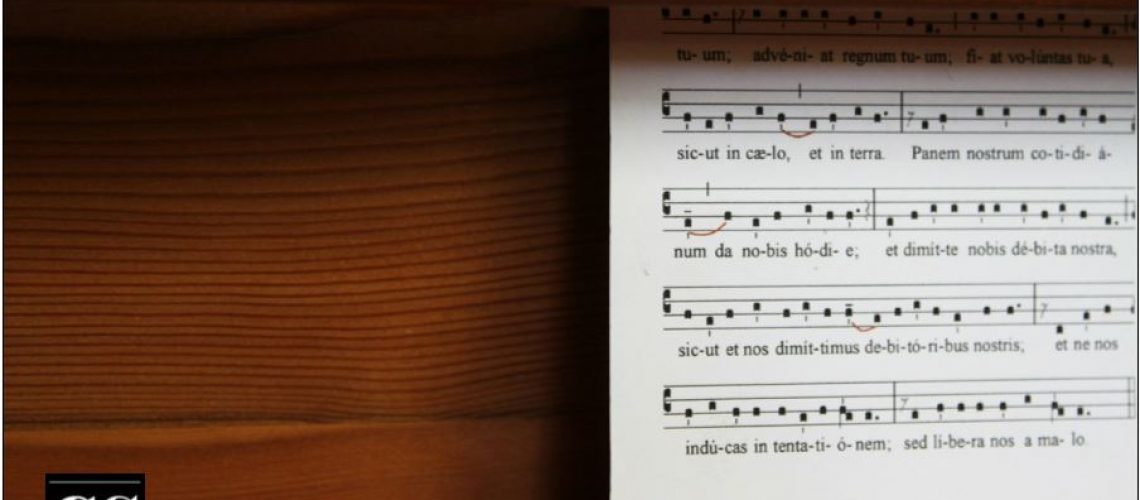
A conflict that members of my parish music ministry encountered happened when we took on the challenge to sing in Latin. For the vigil Mass of the first Sunday in Lent, the choral ensemble I direct on Saturdays chose to sing the Eucharistic Prayer responses in Latin. After obtaining our pastor’s permission, we prepared the Sanctus, Memorial Acclamation, Amen, and Agnus Dei in the Latin Chant as published in our hymnal. We chose to sing a cappella, for simplicity’s sake.
Before Mass, we announced to the congregation that we would be singing these responses in Latin. We invited them to join in, directed them to the pages in the missalette, and sang the Sanctus to give them an idea of the melody. During Mass, as we began the Eucharistic Prayer, I noticed that no one in the congregation was singing the Sanctus with us. As Mass progressed, the congregation’s silence continued. It was not surprising that they did not attempt the Latin Chant version of the Memorial Acclamation, “Mortem tuam annunciamus …”. We ourselves had struggled to learn it. However, when there was still no congregational singing of the “Amen,” which is the exact same word as in English, it was troubling.
After Mass we musicians shared our thoughts about the experience. Everyone was uncomfortable with the lack of participation. It felt as though the silence we had observed was not simply unfamiliarity with Latin. There seemed an inordinate resistance to our efforts.
Our pastor approached the music area and thanked us. He told us in a most tactful manner about the one bit of feedback he had received. Indeed, someone was upset. A parishioner had expressed in no uncertain terms that singing in Latin was wrong.
A Larger Controversy
Naturally, I offered that we would readily give up the Latin if Father wished it. He left the decision up to us but encouraged us to give it another try. We decided to pray on it and went home none too anxious to face the congregation next week.
Giving it some prayer, as Father suggested, I considered the situation. What had I found attractive about Latin Chant? I must admit, some of it was just plain nostalgia. I remembered my mother singing Latin in the Church choir. I learned Latin Chant in college. More importantly, the gentle voices of monks in recordings I had heard expressed a reverence that I wanted to share with my fellow parishioners. That was the key, reverence. I realized that we had been so focused on teaching the congregation these words and melodies that we had sung too loud, too forcefully. It was not reverent, and I had to admit that I didn’t feel it was even pretty.
Aside from the shortcomings of our particular rendition of Latin Chant, I wondered at the silent, seemingly negative response we had received. Our congregation is accustomed to a variety of music. We use guitar, piano, and/or organ at Mass, and include contemporary and traditional hymns. This was the first time, to our knowledge, that we had upset people. It occurred to me rather suddenly one day the next week, that this was about more than just our musical choices for the Mass. This was likely part of a larger controversy in some Catholic circles, the conflict over the celebration of the Traditional Latin Mass. Had some parishioners mistakenly thought that our use of Latin was a step toward bringing the Latin Mass to the parish?
There is a history lesson in this conflict.
Vatican II and Liturgy
The Second Vatican Council, seeing the potential for renewal in the Church, made several changes to the liturgy. To foster a greater understanding of and participation in the liturgy, the Council allowed for the use of the native tongue, frequent reception of Holy Communion, the “lavish” opening of Scripture, the use of a homily to explain sacred mysteries and Christian principles, and the addition of the Prayer of the Faithful (SC 49-55). These measures aimed to make the liturgy more clearly understood, more edifying, more educational, and more accessible. We, members of the post-Vatican II Church, receive Communion more often than Catholics of the past and say the prayers of the Mass in our native language. With these changes in liturgy, the Council helped the Church to accommodate the social changes of the 20th century.
Perhaps spurred by the turmoil of 21st-century cultural conflict with our beliefs, some Catholics now find that celebrating the Eucharist according to the pre-Vatican II Roman Missal is more reverent and meaningful for them. This is what has become known as the Traditional Latin Mass, or “TLM”. In 2007, Pope Benedict XVI acknowledged, in his apostolic letter entitled Summorum Pontificum, the right of all priests to say the TLM.
Some groups that prefer this extraordinary form of the Mass also deny the validity of Vatican II and its reforms. Therefore, in 2021 Pope Francis limited permissions for the TLM. Francis’ motu proprio, Traditionis Custodes, requires bishops to oversee TLM groups within their diocese and restricts the use of parish churches for the celebration of TLM (NCR). Priests ordained after July 16, 2021, must get authorization from their bishop and the Holy See before performing a TLM (Brockhaus). Pope Francis justified these restrictions on the grounds that some who advocate the use of the Traditional Latin Mass do so with an ideology that is not in harmony with Benedict XVI’s pastoral vision. The Pope cited a concerning divisiveness of groups that refuse Vatican II reforms (NCR).
Singing in Latin is Still Allowed!
Thus, the TLM has become controversial. I suspected that my ensemble’s use of Latin responses at Mass appeared to some as an endorsement for the pre-Vatican II form of the Mass. I have no personal objection to the TLM, but convincing our parish to adopt it was the last thing on my mind when I taught Latin Chant to the choir. There is a vast difference between singing some hymns or prayers in Latin and celebrating a Latin Mass. In his Traditionis Custodes, Pope Francis was not voicing an objection to singing in Latin! Surely, the Holy Father has nothing against reverence, organ playing, or the language of Latin.
My fellow music ministers and I came up with additional practical measures to make the Latin Chant more palatable for our congregation. Soft organ accompaniment could help. Minimizing our expectations, we chose to go back to the English Memorial Acclamation and the Amen in the musical setting that the congregation was used to, and to continue Latin Chant for just the Sanctus and Agnus Dei. Most important, we would strive for less volume and a more reverent tone.
Voices Joining Us
At Mass the next Saturday, I explained to the congregation that we would be singing just two responses in Latin, and commented that it was for reverence during the Lenten season. I said we would be delighted if everyone would give it a try. In the following weeks, we implemented the changes we had decided on, singing softly, accompanied by delicate flute settings on the pipe organ, and doing only as much Latin as we reasonably could expect the average person to attempt.
To our great relief, there were no more complaints. By the fourth week in Lent, we heard voices joining us from the congregation on the Latin responses. And after the Vigil Mass for Palm Sunday, a parishioner came to the music area after Mass to say simply, “Hey, thanks! I love the Latin!”
Works Cited
Brockhaus, Hannah. “Pope Francis says traditional Latin Mass was being used in an ideological way.” 9 May 2023. www.catholicnewsagency.com/news/254268/pope-francis-says-traditional-latin-mass-was-being-used-in-an-ideological-way#:~:text=Pope%20Francis%20said%20he%20implemented,used%20in%20an%20ideological%20way.%E2%80%9D. 2 June 2023.
National Catholic Register. “Traditional Latin Mass Restrictions: Here Is What You Need to Know.” 20 December 2021. https://www.ncregister.com/cna/traditional-latin-mass-restrictions-here-is-what-you-need-to-know?amp&gclid=CjwKCAjwyeujBhA5EiwA5WD7_fJgYVlTMDUaKz0vx7NM6dlKuE2YLq-lBgCyT17fnvLxuIzBLNJIVhoC-HIQAvD_BwE. 3 June 2023.
Second Vatican Council. Sacrosanctum Concilium. 4 December 1963. www.vatican.va/archive/hist_councils/ii_vatican_council/documents/vat-ii_const_19631204_sacrosanctum-concilium_en.html. 29 July 2020.


The beauty of Gregorian specifically and the singing of Latin hymns in general is that it helps remind us that we’re not really singing songs, but praying. Prayers set to music. Often that’s lost at mass. But with Latin and Gregorian chant; which was to be given precedence as noted specifically in Vatican 2, we are reminded that we are truly praying to God with our music. There are very good modern hymns that are prayerful as well. Not to diminish that in the least. But sometimes…it’s more music than prayer.
John,
I agree on all counts. Music ministers need to keep in mind the intention of the Vatican II fathers, that Latin is to be given precedence, even while at Mass we pray in the vernacular. It’s also notable that Vatican II recommended the organ as the primary instrument when accompaniment is used.
Thanks for your perspective.
Mary Meo
[…] The Case for Preserving & Exposing the Head Relic of St. Thomas More – Steven Brizek When the Choir Sang in Latin – Mary Ennis Meo at Catholic Stand The Best Minds – Amy Welborn at Charlotte was Both […]
Wonderful article! Mary check out an amazing choir from South America called Harpa Dei. Since 2011 as part of a peace initiative they have been called to evangelization through Sacred Music. Please listen to them on youtube. They would make for a terrific story for you to write about for a future article for Catholic Stand.
Francisco,
Thanks for the tip! I will surely look for Harpa Dei on Youtube.
God bless their efforts.
Mary Meo
This is wonderful! I’m a convert and do not know the Latin Mass. But I was a music major, sang in the choir, and know Gregorian Chant.
Did I like it? No. Sadly I found it boring. Do I like it now, many years later? Yes and no. In an old church with monks, somewhere in Europe, yes. Otherwise, no.
I love the Catholic hymns and responses sung in English. In my church, at times, responses are done in Latin. I don’t try to join in because I have no Latin background and do not know the correct pronunciation. I expect that is true in your church as well. So, we don’t sing.
A truly thoughtful piece; thanks for sharing!
Ida,
Thanks for your kind words. I’m glad you enjoyed reading the article.
Like you, I love our Catholic hymns. As a music minister, I so appreciate when people join in the singing. Usually, we try to select hymns that the congregation will sing, as the goal is full, active, and conscious participation. All for the glory of God.
Thanks again!
Mary Meo