

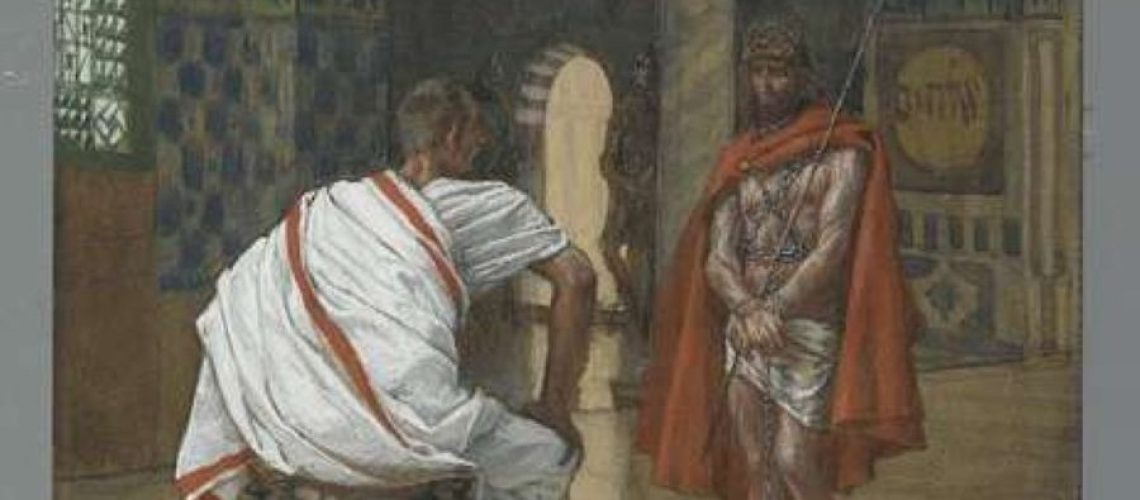
There is a moment in the Gospel where Pontius Pilate looks at Christ and asks a question that feels less like philosophy and more like exhaustion:
“What is truth?”
I used to read that line as a kind of intellectual failure. Now I read it as a man standing at the edge of something he cannot reconcile. And if I’m being honest… lately, I feel closer to Pilate than I ever have.
The deeper I look into history, real history, not the simplified versions we are handed, the harder it becomes to find clean ground.
Nations rise through violence. That’s not controversial. That’s just… reality. The United States, the country I love, was built in part through the displacement and destruction of Native peoples. We dropped atomic bombs. We have fought wars that are debated to this day.
But then I look wider. There is no nation that is innocent and if I keep going…if I’m honest enough…I have to look at the Church too.
The Church I love. The Church I serve. And I see:
The alignment with empire after Constantine the Great. The Crusades, where faith and violence became intertwined. The Spanish Inquisition, where truth was defended in ways that wounded dignity. Moments of silence in the face of great evil. The Sex Abuse Crisis and it’s cover up. Failures that are not ancient history, but recent memory.
And I find myself thinking:
No one is clean.
Not nations. Not leaders. Not even the Church.
This is where the tension begins to break open. Because recently we’ve been hearing a lot of moral declarations, about war, about justice, about human dignity and part of me agrees deeply.
War is terrible. Violence destroys. Human life is sacred and yet, another part of me whispers:
Haven’t we all participated in this, even if indirectly? Haven’t we all benefited from it? Does anyone have the right to stand above it and speak as if they are untouched?
It is a dangerous thought because if no one is clean, then maybe no one can speak truth. This is where many of us deep thinkers quietly go. We don’t say it out loud, but we begin to believe:
“It’s all politics.”
“Everyone is playing a game.”
“There is no real moral authority—only power and control.”
Once that takes hold, something in us begins to die. Not loudly. Not dramatically. Just… slowly. Hope thins out. Conviction softens. Faith becomes uncertain. This is where I cannot go any further into darkness without stopping because standing in front of Pilate is not an argument. It is a person.
Christ does not deny the violence of the world. He does not pretend that Rome is just or that religious leaders are pure. He is condemned by both and yet He says, “For this I was born, and for this I came into the world, to testify to the truth.”
Not a political truth. Not a national truth but something deeper.
Here is where things become difficult again because the Church is not outside of history. She has wounds.Real ones and yet she still dares to speak about, justice, mercy and the dignity of the human person.
Is that hypocrisy? Sometimes… yes. At least in how it appears, and at times in how it has been lived but I am beginning to wonder if something else is also true.
What if the Church does not speak because she is innocent but because the truth she carries does not belong to her?
To be a Christian in this world is to stand in a place that is deeply uncomfortable. We cannot pretend history is clean, baptize our nation uncritically or ignore the failures of the Church but we also cannot, surrender to cynicism, deny that truth exists, walk away from Christ or His Church because His followers have failed.
So where does that leave us? Honestly…in tension.
I am learning that I can love my country without pretending it is innocent, that I can serve the Church without denying her wounds. I can acknowledge the failures of both without losing my faith and maybe most importantly, I can stop looking for a place in history that is untouched by sin. Instead, I must look for the place where sin is confronted, absorbed, and redeemed.
That place is not a nation. It is not an institution. It is the Cross.
If you have ever found yourself wondering:
Who is telling the truth?
Who can I trust?
How do I reconcile all of this?
You are not alone. You are not losing your faith. You may actually be encountering it for the first time in its full weight.
Pilate asked the question and walked away. We don’t get to because for us, the question is not abstract. It is personal.
And it demands an answer not just in what we believe…but in how we live.




1 thought on “What is Truth?”
Thank God for the holiness and the perfection found in the sacraments.