
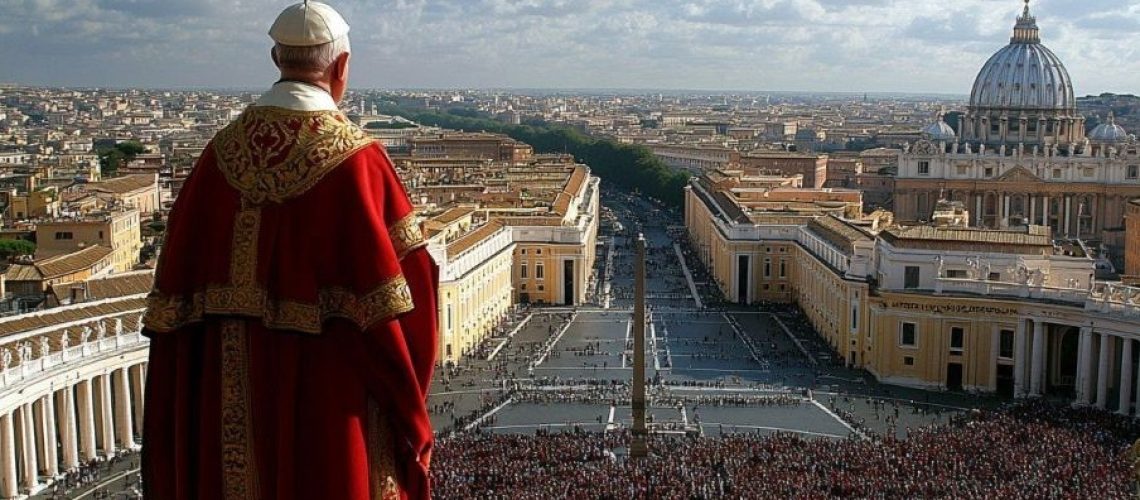
In 1888 Pope Leo XIII wrote an encyclical about Freedom called Libertas. He did so because he considered society to have a “false and absurd” notion of the idea, which he felt that he had a “pressing duty” to correct (Libertas 1–2).
Some people believe that Vatican II rejected Leo XIII’s view. For example, a critic has said:
The Second Vatican Council… declared that “the human person has a right to religious freedom”… However Pope Leo XIII condemned such an idea as being “the great error of our age.” (“Religious Liberty and the Second Vatican Council”)
Comments like that lead to questions about whether Leo XIII had a specific doctrine of freedom, and whether Vatican II’s religious freedom has indeed conflicted with it.
1. Free Will
Leo XIII’s doctrine of freedom begins with an insistence that people have free will, i.e., that they are not subject to determinism or fatalism (Libertas 4).
Leo identified three aspects which are essential to free will.
REASON sees… whatever things… are held to be GOOD upon earth…, and discerning that none of them are of necessity for us, it leaves the WILL free to choose what it pleases. (Libertas 3, emphasis added)
The focus upon the twofold aspects of the intellect (or reason) and the will, means that there are two main ways that free will can fail.
Firstly, intellectual error about what is good can undermine the outcome of free will. For example, people might drink a toxin mistakenly thinking that it is healthy.
Secondly, volitional temptation (weakness of will, Akrasia) can undermine the outcome of free will when people are tempted away from what is good, by anger, lust, etc. For example, people might know that a certain food is healthy but nevertheless they are tempted to eat something that is not healthy.
The reason why free will can fail is that it is fragile. That is partially due to original sin, but it is also due to the nature of embodied cognition, which may be particularly prone to cognitive biases and ego depletion, because its physical nature means that it cannot operate with the logical objectivity of a computer (i.e., like a Homo Economicus).
Human free will is an essential part of what gives humans their dignity as persons. So it is important to ensure that it can operate properly, despite its fragility. Leo XIII identified three types of environments which impact upon its operation.
- Slavery: where humans have too little scope for free will.
- License: where humans have too much scope for free will.
- Freedom: where humans have just the right amount of scope for free will.
2. Slavery
Slavery is a situation where humans have too little scope to exercise their free will.
Slavery can involve physical coercion, which limits the operation of free will. But there are also more subtle economic and political persuasions which can undermine the operation of a fragile free will.
An example of a constraint due to intellectual error is depicted in George Orwell’s novel 1984 (1949). In that story people were unable to exercise their free will properly because truth was hidden beneath a deceptive language of Newspeak.
An example of a constraint due to volitional temptation is depicted in Aldous Huxley’s Brave New World (1932). In that story people were unable to exercise their free will properly because their will was sapped by the drug Soma.
Leo insisted that intellectual errors and volitional temptations (or passions) can constitute types of slavery. He said:
that liberty is truly genuine, and to be sought after, which in regard to the individual does not allow men to be the slaves of error and of passion. (Immortale Dei 37)
In the modern world people often think that having the possibility of sinning (i.e., being able to choose intellectual error or volitional temptation) is part of what it means to be free. Leo completely rejected that idea.
The possibility of sinning is not freedom, but slavery. It will suffice to quote… the words of our Lord: “Whosoever committeth sin is the slave of sin” (John 8:34). (Libertas 6)
3. License
License is a situation where humans have too much scope to exercise free will. It arises when people have insufficient boundaries to support their fragile free will. Thus, Leo XIII stated:
[When]… man is firmly persuaded that he is subject to no one,… every man’s individual reason is his only rule of life (Libertas 15)… Consequently [those people] substitute for true liberty what is sheer and most foolish license. (Libertas 14)
The modern world generally recognizes that children need boundaries (i.e., restrictions to their freedom) in order to properly develop the exercise of their free will. A lack of boundaries can even be child neglect or child abuse.
But modern societies are sometimes less clear about the need for boundaries for adults. It is “sort of” recognized when countries introduce restrictions relating to alcohol, gambling or tobacco. It was “sort of” recognized when countries introduced “Seat Belt Laws,” which coerced people to do what is in their own best interest.
But all too often modern mindsets insist that freedom is achieved by reducing restrictions, even if that means that people can harm and destroy themselves.
Leo XIII utterly disagreed. He said:
…this is not liberty so much as license… [and] the “liberty of self ruin”… is a true slavery. (Immortale Dei 37)
License is wrong because it negligently ignores the fragility of free will. And so it inexcusably fails to implement mitigations to reduce the risk of intellectual error and volitional temptation warping the operation of the fragile free will.
4. Freedom
Freedom, for Leo XIII, is a situation where humans have the ideal balanced environment which protects the operation of their free will. It minimizes the scope for too much or too little exercising of free will.
To achieve freedom people have to be protected so that they can (only) pursue what is genuinely good for them. As Leo XIII put it:
The pursuit of what has a false appearance of good, though a proof of our freedom, just as a disease is a proof of our vitality, implies a defect in human liberty… It abuses… freedom… and corrupts its very essence. (Libertas 6)
The main threat to freedom is intellectual error which confuses what is good, and volitional temptation which creates emotions and feelings which draw people away from what is good.
To achieve freedom, people need clarity about what is good. That is provided by the Gospel. So freedom is essentially defined in terms of doing God’s will:
Any liberty, except that which consists in submission to God… is unintelligible. To… refuse to submit to… [God], means to act, not as a free man, but as one who treasonably abuses his liberty. (Libertas 36)
Without the Gospel to define what counts as freedom, humans are left to follow their own (self-interested) intellectual ideas and volitional desires, and so they are at greater risk of drifting into intellectual errors and volitional temptations. They are also at risk of the tyranny of majority opinion (Libertas 15), when privileged elites determine what is good for the rest of society.
To sum up Leo XIII’s view of freedom:
…every man… follow[ing] the will of God and… obey[ing] His commands. This indeed, is true liberty… which… maintains the dignity of man and is… a liberty which the Church has always desired and held most dear. (Libertas 30)
5. Achieving Freedom
Leo’s DOCTRINE of freedom is relatively simple. It is the idea that society should protect fragile free will by creating an environment of freedom for it to operate in, which avoids slavery and license by implementing the Gospel to reduce the risks of intellectual error and volitional temptation.
That DOCTRINE raises a question. What specific POLICY measures will achieve it?
A POLICY which implements some boundaries is clearly necessary. As Leo put it:
Men have a right freely and prudently to propagate… what things soever are true and honorable,… but lying opinions… and vices which corrupt the heart and moral life should be diligently repressed by public authority. (Libertas 23)
Modern states agree with Leo about a POLICY of banning the propagation of “lying opinions” like “defamation” (and in some places holocaust denial). They also agree on POLICIES banning some aspects of “vices which corrupt the heart,” hence some countries have restrictions on certain kinds of advertising.
But modern states rarely have POLICIES to ban all intellectual errors (like conspiracy theories, vaccine hesitancy, etc.) or all volitional temptations (like pornography, alcohol, etc.).
There are two reasons for their position.
Firstly, since Leo died in 1903, the twentieth-century totalitarianisms of Fascism and Communism have shown that overmighty governments cannot be trusted with powers to ban things. That means that there has been a growing recognition that it may be a better (or a lesser evil) POLICY to live with some intellectual errors and volitional temptations in society, rather than to give governments powers which could eradicate them.
Secondly, developments in twentieth-century psychology have showed that banning is not always the most effective POLICY for managing human behavior. For example, the US Prohibition banned alcohol between 1920 and 1933, but it had mixed results. Studies also show that people often respond better to nudges rather than to laws. But it is not always clear which approach is the best (or least worst) in specific contexts. So different countries often have POLICIES about legalizing drugs which embed conflicting views about banning and nudging.
Sometimes changing circumstances also require changed POLICIES. The Church introduced an Index of forbidden books (Index Librorum Prohibitorum) in 1560 to ban the circulation of intellectual errors. However, over time, publicly banning a book began to give books extra publicity and thus accidentally increased the circulation of their intellectual errors. That meant that the POLICY began to have the opposite effect to what was originally intended. And so in 1966 that POLICY of public banning was discontinued.
What this all means is that an understanding of the DOCTRINE of freedom requires distinguishing between the (unchangeable) DOCTRINE itself, and the (changeable) POLICY measures which are used at different places and in different times, to try and achieve the aims and objectives of the DOCTRINE.
6. Religious Freedom
The DOCTRINE of Religious Freedom is that there must be a “freedom FOR religion.” It insists that there must be an environment which supports fragile free will by eradicating Slavery and License (in religious matters), to try and ensure that each person’s free will is least subject to distortions (in religious matters) caused by intellectual errors (wrong ideas about religion, etc.) and volitional temptations (bad attitudes towards religion, etc.).
For much of the Church’s existence, when societies were largely controlled by monarchies, the Church’s POLICY was to focus on getting states to eradicate intellectual errors by banning the public practice of other faiths.
Banning other religions was a (changeable) POLICY, and not an (unchangeable) DOCTRINE, because it could admit of exceptions. Banning activities such as murder admits of no exceptions, so that is a DOCTRINAL ban. But banning other religions is a POLICY because it could always be subject to the exception of a justified toleration. As Leo XIII put it, explaining the justification of toleration:
God Himself in His providence… permits evil to exist in the world, partly that greater good may not be impeded… In the government of States it is not forbidden to imitate the Ruler of the world. (Libertas 33)
By the twentieth century it was becoming clear that a POLICY of banning religions (i.e., focusing on eradicating intellectual error) only partially addressed the Church’s DOCTRINAL aim to support fragile free will. This is because banning intellectual errors could accidentally contribute to causing volitional temptations of bad attitude and prejudice towards religion. If so, then that meant that the Church’s POLICY was potentially protecting free will from the distortion of intellectual error, at the price of exposing free will to an opposite set of potential distortions of volitional temptation. That, of course, is the very definition of a POLICY which had become counterproductive and ineffective over time.
These issues were clearly recognized by the bishops at Vatican II.
Joseph Ratzinger (the future Pope Benedict XVI) noted that the issue was raised in 1964 when people discussed how:
the attempt to use the State as a protector of faith… thereby became one of the most powerful causes of anticlericalism. (Theological Highlights of Vatican II, Session 3)
The issues were discussed again in 1965 when Cardinal Beran spoke directly to the bishops at Vatican II about how suppression of the Hussites had “inflicted wounds on the Catholic faith that still have not been healed” (Theological Highlights of Vatican II, Session 4).
What it all means is that by 1965 there was a recognition in the Church that the previous POLICY of banning other religions was no longer an effective way of achieving the DOCTRINAL aims of religious freedom (i.e., protecting a fragile free will so that it can freely choose religion). In fact, the changed circumstances of the modern world meant that the best (or least worst) POLICY for achieving the DOCTRINE of religious freedom, might now need to involve reversing the previous POLICY of banning the public expression of other faiths.
7. Vatican II
Vatican II declared that there is a right to religious freedom in Dignitatis Humanae (DH). When we look closely at that document, we can see that it accepts Leo XIII’s DOCTRINE of religious freedom as the basis for its conclusion.
It states:
It is one of the major tenets of Catholic doctrine that man’s response to God in faith must be free: no one therefore is to be forced to embrace the Christian faith against his own will… It is therefore completely in accord with the nature of faith that in matters religious every manner of coercion… should be excluded. In consequence, the principle of religious freedom makes no small contribution to the creation of an environment in which men can without hindrance be invited to the Christian faith, embrace it of their own free will. (DH 10)
That paragraph explains religious freedom as a “freedom FOR religion.” It states that contemporary people need to be free from coercion in order for their free will to operate properly, as that is absolutely necessary for them to be able to embrace religion.
The Council explained further:
It is in accordance with their dignity as persons, that is, beings endowed with reason and free will… that all men… [are]… bound by a moral obligation to seek… religious truth… However, men cannot discharge these obligations in a manner in keeping with their own nature unless they enjoy immunity from external coercion as well as psychological freedom. Therefore the right to religious freedom has its foundation… in [human] nature. (DH 2)
That passage outlines the Council’s view in three main claims:
(1) The first sentence notes that human persons have an obligation to use their free will to seek religious truth (i.e., avoiding what Leo described as intellectual errors and volitional temptations about religion. (See sections 1–4.)
(2) The next sentence notes that contemporary people are obstructed from using their free will properly when they are subject to “coercion” (and so lack “psychological freedom”). This is arguably because coercion may protect a fragile free will by eradicating intellectual errors, but it can do so at the price of introducing new volitional temptations which undermine free will, albeit in a different way. (See sections 5–6.)
(3) The third sentence notes that the civic right to religious freedom (i.e., freedom FOR religion) rests in human nature. This is because that civic right arises from the need to ensure free will operates properly, and free will is one of the most fundamental aspects of human nature.
8. Conclusion
Leo XIII’s DOCTRINE of freedom insists that there must be an appropriate environment for humans to exercise their fragile free will. That environment must mitigate as far as possible, against both excessive freedom (license) and inadequate freedom (slavery), so that people have precisely the right amount of freedom in order to freely embrace religion.
Vatican II said nothing that disagrees with that DOCTRINE.
Where Leo XIII and Vatican II differed was over the prudential judgments of what was the most appropriate POLICY for achieving that DOCTRINAL aim.
In 1888 Leo XIII thought that the most appropriate POLICY was to focus upon avoiding intellectual errors about religion, by banning the practice of other religions.
In 1965 Vatican II thought that the most appropriate POLICY was to focus upon avoiding the volitional temptations of negative attitude towards religion, by rejecting the banning of the practice of other religions.
The fact that Leo XIII and Vatican II had opposite POLICIES does not mean that they did not have the same DOCTRINE of (religious) freedom. Nor does it mean that Vatican II’s different POLICY expresses a judgment on Leo’s POLICY. There is nothing surprising or controversial in the idea that organizations can legitimately have very different POLICIES at different points in time, even though they are pursuing the same (DOCTRINAL) aims and objectives.
For all we know, there may be another Ecumenical Council in five hundred years’ time, which asserts the need for yet a different POLICY on these issues. If that occurs, there will no doubt be members of the Church at that future time, who express concern about whether the faith of the Church has been changed. We can answer that question in advance. Faith is enshrined in DOCTRINE, not POLICY; so changing POLICIES does not change the content of faith, as long as there is an underlying sameness of DOCTRINE, just as there is between Leo XIII and Vatican II on the issue of religious freedom.


Quite a good article, except for the claim in the conclusion that Leo XIII thought the most appropriate policy was to ban other religions. As Leo XIII’s own words in Libertas plainly show, the Church “does not forbid public authority to tolerate what is at variance with truth and justice, for the sake of avoiding some greater evil, or of obtaining or preserving some greater good…”
Indeed, a few year earlier in Immortale Dei, he explicitly stated that it is not universally appropriate to ban other religions.
Essentially, what the Second Vatican Council really did was simply restate everything that Leo XIII had already taught about religious freedom, without adding or subtracting any content related to matters of faith and morals.
[Comment Edited due to length]
Yes Rafael, you make a good point. To keep the piece short, I omitted reference to Leo’s views on tolerance. I covered Leo’s views on those issues in a follow-up piece – https://catholicstand.com/is-vatican-iis-religious-freedom-just-tolerance-by-another-name/
However, there is also a sense in which Leo really did think other faiths should be suppressed. He thought that the ideal scenario was a world in which all states were Catholic and so there would be no need for a policy of toleration. As such, toleration was a temporary expediency suited for the imperfect world which we currently find ourselves in (See Libertas 34).
[…] Some critics say that those words contradict Leo XIII’s claim that religious freedom cannot be a (positive) right conferred by nature. (See section 6.) However Vatican II said that religious freedom is a (negative) right consisting of an immunity from coercion. And the text above does not affirm what Leo XIII rejected, i.e., that human nature confers the right to religious freedom. It says instead that the right has its foundation in human nature, which can be understood as simply stating that the need for religious freedom arises due to other aspects of human nature, such as what is needed for the operation of Free Will. (For further details see “Did Vatican II Reject Pope Leo XIII’s Doctrine of Religious Freedom?”) […]
[…] As there are two different versions of religious freedom, then that means that there is not a contradiction when one version was rejected by Mirari Vos, and a different version was approved by Vatican II. (For further details on the different versions, see “Did Vatican II Reject Pope Leo XIII’s Doctrine of Religious Freedom?”) […]