
The meaning of the Sunday Mass Readings for January 2026 is made clearest by Catholic Doctrine. God communicates most clearly to us through Catholic Doctrine. Doctrines are the essentially unchangeable clarifications of Revelation and Faith that only the pope and bishops have the God-given authority to make, that must be accepted as true knowledge in order to be Catholic, and that not even the pope and bishops may contradict. Catholic Doctrine gives us not opinion, but fact. Catholic Doctrine describes reality. Catholic Doctrine should not be confused with Church discipline (as found in liturgical rubrics and canon law), spirituality, prudential judgments, or theological speculation.
Let’s learn always-true doctrines in the Catechism of the Catholic Church that we can take away from this January’s Readings.[1]
January 1, Mary, the Holy Mother of God
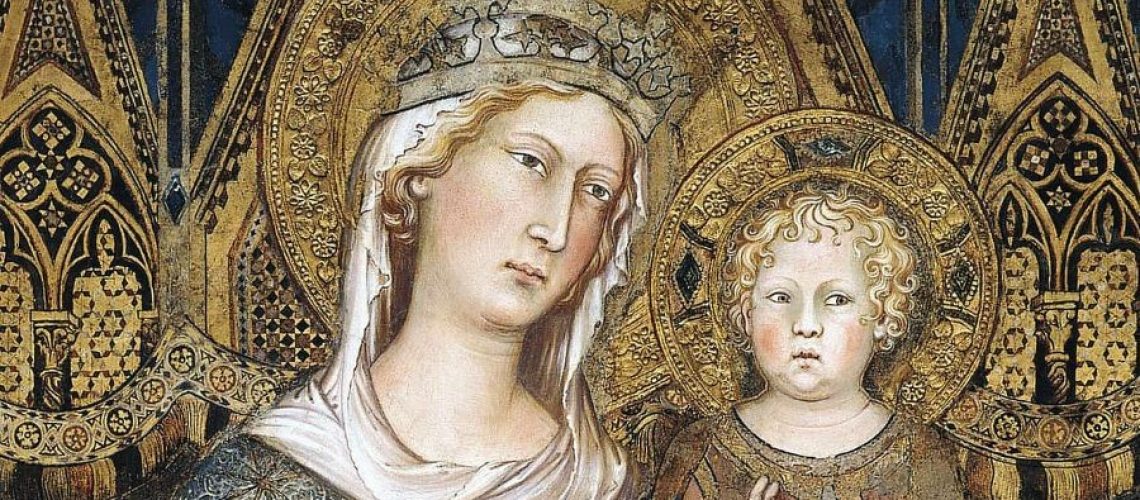
In order to appreciate the doctrine celebrated today, that Mary is the Holy Mother of God, we must, of course, not overlook the doctrine that Jesus is God. Today’s Second Reading should be taken literally when it tells us that “when the fullness of time had come, God sent his Son, born of a woman.” Jesus, the son of Mary, is God (CCC 484[2]). Mary, the mother of Jesus, is the Holy Mother of God (CCC 466, 495). Although not referenced in the Catechism to support this doctrine about Mary, today’s Gospel verse that Jesus “was conceived in the womb [of Mary]” also means that Mary is the Mother of God. CCC 484-511 and 963-972 elaborate on Mary’s unique role in salvation history.
We should also get from the Second Reading the most important Catholic doctrine: “The mystery of the Most Holy Trinity is the central mystery of Christian faith and life . . . It is the most fundamental and essential teaching in the ‘hierarchy of the truths of faith’” (CCC 234). In the words of the Second Reading, “God sent the Spirit of his Son into our hearts, crying out. ‘Abba, Father!’” There is one God in three Divine Persons: The Father, the Son (Jesus), and the Holy Spirit (CCC 689).
Although it is perfectly accurate to recognize that Mary is the Mother of God, let us not be confused. Mary is not the mother of God the Father or the mother of God the Holy Spirit. God the Father is “the first origin of everything and transcendent authority” (CCC 239). He “is Father not only in being Creator; he is eternally Father in relation to his only Son, who is eternally Son in relation to his Father” (CCC 240). The Holy Spirit “proceeds eternally from both [the Father and the Son]” (CCC 246).
There are two heresies to avoid when trying to understand the Trinity. One heresy – Modalism – disregards the distinctiveness of the Persons and does not recognize that the Father is not the Son or the Spirit, the Son is not the Father or the Spirit, and the Spirit is not the Father or the Son. The other heresy – Tritheism, also known as Monophysitism – disregards the unity of the Three Persons in one Divine Being and considers the Father, Son, and Spirit to be three separate beings.
- From Second Reading[3] (Galatians 4:4-7): Gal 4:4-5 is cited in CCC 422; Gal 4:4 in CCC 484, 488, 527, 531, 580, and 702; Gal 4:5-7 in CCC 1265; and Gal 4:6 in CCC, 683, 689, 693, 742, 1695, and 2766.
- From the Alleluia (Hebrews 1:1-2): Heb 1:1-2 is cited in CCC 102.
- From the Gospel (Luke 2:16-21): Lk 2:19 is cited in CCC 2599; and Lk 2:21 in CCC 527.
January 4, The Epiphany of the Lord
The Catechism refers to today’s Alleluia and Gospel (“We saw his star at its rising and have come to do him homage.”) to teach that the magi (“We”) represent all Gentiles (all those who are not Jews). This means that Jesus is not only the Messiah of Israel, but also the one and only Savior of the whole world (CCC 528).
This Sunday’s other Readings should be interpreted in light of this doctrine. “Nations shall walk by your light” (the First Reading), “Lord every nation on earth will adore you” (the Responsorial Psalm), and “the Gentiles are coheirs” (the Second Reading) all mean “that Jesus is the Savior of all men, that all need salvation, and that salvation is offered to all through Christ” (CCC 389).
Mary plays a key role in the epiphany, or manifestation, of Jesus to the world. “Filled with the Holy Spirit [Mary] makes [God the Son] visible in the humility of his flesh. It is to the poor and the first representatives of the gentiles that she makes him known” (CCC 724). Mary cooperated with the Holy Spirit her whole life “to bring [others] . . . into communion with Christ . . . shepherds, magi, Simeon and Anna, the bride and groom at Cana, and the first disciples” (CCC 725).
The best way to have communion with Christ is in the Catholic Church. The fullness of Jesus’ means of salvation is found only in the Catholic Church. We imitate the magi by finding Jesus most fully present in the Catholic Church. We imitate Mary when we bring others to full communion with the Catholic Church.
- From the Gospel (Matthew 2:1-12): Mt 2:1-12 is cited in CCC 486; Mt 2:1 in CCC 528; Mt 2:2 in CCC 439 and 528; Mt 2:4-6 in CCC 528; and Mt 2:11 in CCC 724.
January 11, Baptism of the Lord
Jesus did not need to be baptized. He was without sin, as St. John the Baptist recognized in today’s Gospel; and He would remain sinless throughout His life (CCC 540). Jesus was baptized so that the descent of the Holy Spirit and the voice of the Heavenly Father would manifest that Jesus is the “Messiah of Israel and Son of God” (CCC 535). Jesus’ baptism is also “a manifestation of his self-emptying” (CCC 1224). “Already he is anticipating the ‘baptism’ of his bloody death. Already he is coming to ‘fulfil all righteousness,’ that is, he is submitting himself entirely to his Father’s will: out of love he consents to this baptism of death for the remission of our sins” (CCC 536).
We should take St. Peter literally when he says in today’s Second Reading that “God anointed Jesus with the Holy Spirit” (CCC 438). The word Christ means “the anointed one” (CCC 436). Christ is essentially the Greek translation of the Hebrew Messiah. To say “Jesus Christ” is, in effect, to say “Jesus the Anointed One” or “Jesus the Messiah.”
The Second Reading is also referenced by the Catechism to teach the importance of anointing with oil in the Sacraments (CCC 1289). “The pre-baptismal anointing . . . signifies cleansing and strengthening; the anointing of the sick expresses healing and comfort. The post-baptismal anointing . . . in Confirmation and ordination is a sign of consecration” (CCC 1294).
- From the First Reading (Isaiah 42:1-4, 6-7): Is 42:1-9 is cited in CCC 713; Is 42:1 in CCC 536 and 555; Is 42:3 in CCC 580; and Is 42:6 in CCC 580.
- From the Responsorial Psalm (Psalms 29:1-2, 3-4, 9-10): Ps 29:2 is cited in CCC 2143.
- From the Second Reading (Acts 10:34-38): Acts 10:35 is cited in CCC 761; and Acts 10:38 in CCC 438, 453, 486, and 1289.
- From the Alleluia (Mark 9:7): Mk 9:7 is cited in CCC 151 and 459.
- From the Gospel (Matthew 3:13-17): Mt 3:13-17 is cited in CCC 535 and 1286; Mt 3:13 in CCC 1223; Mt 3:14-15 in CCC 608; Mt 3:15 in CCC 536 and 1224; Mt 3:16-17 in CCC 1224; Mt 3:16 in CCC 536 and 701; and Mt 3:17 in CCC 444 and 713.
January 18, 2nd Sunday in Ordinary Time
One important doctrine we should take away from today is: Jesus is fully human as well as fully divine (CCC 461). This doctrine makes clear the meaning of “The Word of God became flesh and dwelt among us,” said in today’s Alleluia. How Jesus can be both God and human is more fully presented in CCC 464-478.
A verse from the Gospel, “Behold, the Lamb of God, who takes away the sin of the world,” is cited four times in the Catechism to support another crucial doctrine: without the atonement of Jesus for the sins of humanity, no human being could experience eternal salvation (CCC 536, 608, 713, 1137). This means that both the Original Sin of humanity’s first parents and each person’s own sins make it impossible for any person to be in the eternal direct presence of the All-Holy God without God the Son paying the price for everyone’s sins by His sacrificial death on the cross. CCC 598-618 and 1503-1505 elaborate on how Jesus “takes away the sin of the world.”
- From the First Reading (Isaiah 49:3, 5-6): Is 49:1-6 is cited in CCC 713; and Is 49:5-6 in CCC 64.
- From the Responsorial Psalm (Psalms 40:2, 4, 7-8, 8-9, 10): Ps 40:2 is cited in CCC 2657; Ps 40:7-9 in CCC 462; and Ps 40:7 in CCC 2824.
- From the Second Reading (1 Corinthians 1:1-3): 1 Cor 1:2 is cited in CCC 752 and 1695.
- From the Alleluia (John 1:14a, 12a): Jn 1:12-18 is cited in CCC 1996; Jn 1:12-13 in CCC 706; Jn 1:12 in CCC 526 and 1692; and Jn 1:14 in CCC 423, 454, 461, 594, 705, and 2466.
- From the Gospel (John 1:29-34): Jn 1:29 is cited in CCC 408, 523, 536, 608, 613, 1137, and 1505; Jn 1:31-34 in CCC 486; Jn 1:31 in CCC 438; Jn 1:32-34 in CCC 713; Jn 1:32-33 in CCC 536; Jn 1:33-36 in CCC 719; and Jn 1:33-34 in CCC 1286.
January 25, 3rd Sunday in Ordinary Time
Today’s Gospel Reading gives us the gospel (good news or message) that Jesus Himself preached: “From that time on, Jesus began to preach and say, ‘Repent, for the kingdom of heaven is at hand.’” What we should take away from this verse is that the Kingdom is the ultimate beatitude or happiness to which God invites humanity (CCC 1720).
By “Kingdom of Heaven” Matthew means what other New Testament writers mean by “Kingdom of God.” (Matthew uses “Heaven” instead of “God” due to Jewish piety.) To summarize CCC 541-556, 645-655, 668-679, and 1042-1050, the Kingdom is the theme of Jesus’ preaching and actions. It is what Jesus says to “seek first” (Matthew 6:33). It is our salvation. If we do not understand the Kingdom, we do not fully understand Jesus. The Kingdom is not Heaven, if by “Heaven” we mean the state after death when the soul, separated its body, is with God. The Kingdom inaugurated by Jesus will only be fully established when He comes again in glory on the Last Day to judge the living and the dead. Those who enter the Kingdom will have souls united with transformed bodies for all eternity in perfect relationship with God, each other, and all of God’s creation – free from all physical and moral evil. The greatest Revelation of what the Kingdom will be like is Christ’s Resurrection.
- From the Gospel (Matthew 4:12-23 or 4:12-17): Mt 4:17 is cited in CCC 1720 and 1989; and Mt 4:19 in CCC 878.
[1] There are too many citations, or references, in the Catechism to the verses in a month of Sunday Mass readings to identify all the pertinent doctrines, so I will use my best judgment to select which verses and doctrines to cover in a column that may not exceed 2,000 words. The bullet points allow you to explore further the Biblical basis of Catholic Doctrine.
[2] CCC abbreviates Catechism of the Catholic Church. Any number after it is the number of a paragraph in the Catechism. For example, “CCC 484” means paragraph 484 of the Catechism.
[3] If a Reading is not listed, then none of its verses is cited by the CCC.

