
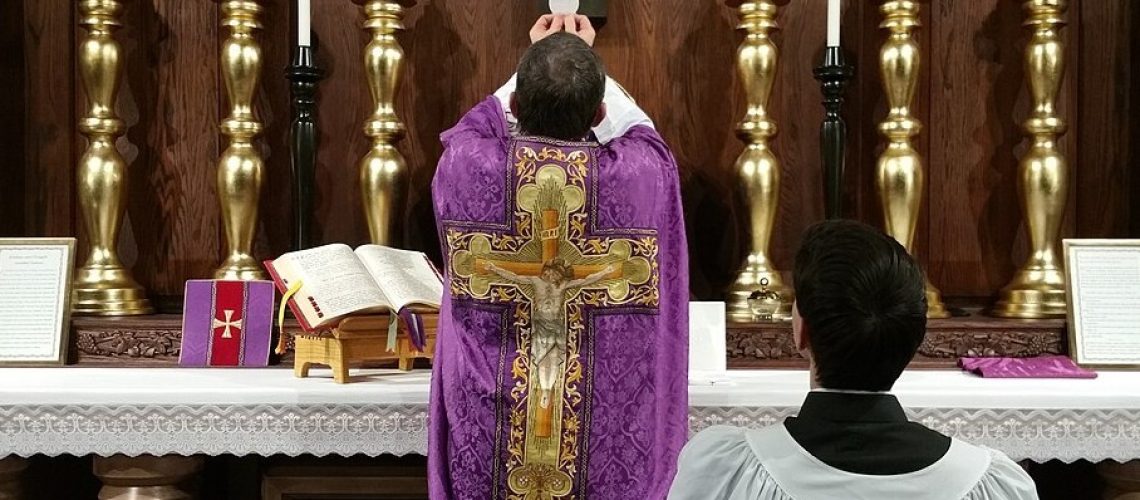
At Mt. St. John’s Academy in 1965, my Kindergarten classmates and I sang, “Sanctus, sanctus, sanctus.” Our teacher, Sr. Luigia, had taught us the Latin chant that expresses the meaning, “Holy, holy, holy.” Even the more rambunctious children in our class became settled and reverent when we sang the mysterious words the good nun had taught us.
An Evolution in Liturgical Music
Shortly after my First Holy Communion, the “Sanctus, sanctus, sanctus” that we had learned was replaced by a ditty with the lyrics, “Sons of God, hear his holy word. Gather round the table of the Lord” (James Thiem). In middle school, a nice nun taught me how to play the guitar, and I soon strummed folk and soft rock music written for Catholic liturgy. Eventually, hymns with contemporary piano accompaniments appeared in the hymnals.
Latin seemed to be needed only by those who were going into medicine or the seminary. Teachers called it a “dead” language, useful for deciphering anatomical terms or Summa Theologica, but not much else.
Liturgical music evolved into pieces mimicking secular entertainment, as music ministers sought to facilitate the full and active congregational participation promoted in Vatican II. Directors of music believed that, to appeal to the faithful, hymns needed to be of a style similar to the culture’s popular music. Composers complied, and produced a regular hit parade of contemporary Catholic liturgical songs and Mass settings.
A Longing for Depth
Twenty-first century Catholics are displaying a renewed sense of reverence for the liturgy. It’s not so much that sacred music in the last sixty years has been irreverent. There seems now to be a longing for depth in our worship, for hymns that embody the rich heritage of our Catholic faith.
Latin is part of that heritage. Many Catholics have an ardent desire for the Latin Mass, so much so that it has become a point of contention. Apart from this, some music ministers are using Latin during the Novus Ordo Mass. A parish near my hometown sings the Latin Chant Mass responses on a regular basis. The congregation sings the “Sanctus” and “Agnus Dei” with confidence and devotion. More local churches are holding adoration of the Blessed Sacrament, and participants sing the traditional Benediction hymns, “Tantum Ergo” and “O Salutaris Hostia”.
Vatican II on Latin at Mass
Shelving Latin for more than a generation may have been an understandable reaction to Vatican II’s call to modernize. However, the Vatican II fathers did not intend for Latin to disappear. Sacrosanctum Concilium, the Vatican II document also known as the Constitution on the Sacred Liturgy, addresses this. While Sacrosanctum Concilium allows for Mass to be said in the vernacular, or “mother tongue”, it also maintains that “steps should be taken so that the faithful may also be able to say or to sing together in Latin those parts of the Ordinary of the Mass which pertain to them” (Article 54).
The Value of Latin Hymns and Prayers
What value might there be in teaching a congregation to sing Latin hymns or Mass responses? First, Latin is the language of the Church. Papal encyclicals are written in Latin. Prayers and hymns in Latin serve to unite the faithful, reminding us that we are part of a universal Church whose members join us in prayer. Singing and praying in Latin, we echo the prayers of our fellow Catholics throughout the world, and of our forefathers in the faith from past generations.
Second, the use of Latin fosters a sense of the mysticism that is part of sacred worship. Like incense, candles, and the vestments of the clergy and altar servers, Latin intimates the transcendental nature of liturgy. Liturgy, providing a window between heaven and earth, connects us with our Lord and his angels and saints, beyond our fallen world. Latin is part of this other-worldliness that is essential to a life in the faith.
Thirdly, from a technical perspective, Latin is a beautiful language for vocal music. Its pure vowels allow singers to produce clear tones. Latin is free of awkward, guttural sounds and complex consonant blends. Singing in Latin brings out the best in a soloist or choir.
Lessons from a Latin Translation
Finally, the Latin root words helpful to physicians also convey meaning beyond the lyrics of a hymn in the vernacular. So many of our English words are derived from Latin that we can sometimes comprehend a phrase better when we’ve learned its translation in Latin. For example, the Marian hymn, “O Sanctissima”, enriches our understanding of Mary, as described below:
Text:
O Sanctissima! O Piissima!
Dulcis virgo Maria,
Mater amata,
Intemerata,
Ora, ora pro nobis.
Notice the many lessons to be learned with a study of the root words in the Latin text of this hymn:
O Sanctissima – “Sanctus”, meaning “holy”, is the root in English words like “sanitize”. Thus, holiness involves being free from stain of sin. The suffix “issima” enhances the word; Mary is not just holy, but holy to the greatest degree.
O Piissima – Again, the suffix “issima” shows that Mary is pious to a superlative degree.
Dulcis virgo Maria – Literally, “sweet virgin Mary”. When I taught this hymn to a children’s choir, we noted that “dulcis” sounds a little like “delicious”. It made Mary’s sweetness something they could relate to, even though it sounded silly. The similarity of “virgo Maria” to the English “virgin Mary” illustrates that Latin is at the root of our speech patterns, just as the ancient Church is at the root of our faith.
Mater amata – The similarity of “Mater” to “Mother” is more evidence of Latin as our root language. “Amata” translates to “beloved”, but also shares nuances of other words with this same root: amiable, amicable, enamored.
Intemerata – Meaning “chaste” and “pure”, this word translates literally to “untamed”. Thus, being chaste and pure is Mary’s untamed, or natural, condition. As Mary has not inherited original sin, she remains in her natural state as created by God, pure and chaste. The term also refers to Mary’s perpetual virginity.
Ora pro nobis – Here, we ask Mary to “pray for us”. “Ora” relates to “pray”, as we often pray aloud, orally. Other words with the root “ora”, such as adore and adoration, suggest a link between prayer and adoration. When we lift our minds and hearts to God, we adore him. Even a prayer of petition is adoration. Turning to God in our need shows how highly we hold Him in our hearts and minds.
Latin Makes a Comeback
As often happens with cultural trends, Latin is making a comeback in Catholic liturgical music. Curtis Stephan’s “Bread of Angels”, written in 2002, includes Latin phrases from the 19th century classic, “Panis Angelicus”, by Cesar Franck. “Ubi Caritas”, by Bob Hurd, contains English verses with the Latin refrain, “Ubi caritas et amor, Deus ibi est.” (“Where charity and love are, there is God.”) Stephan and Hurd are just two of many composers who recognize the value of using the language of the Church, ever ancient and ever new, in our worship.
May the return of Latin in liturgical music accompany a renewed devotion to our Catholic faith and to the Lord who reveals himself to us through it.


The deep spiritual value of Latin is as plane as day.
Latin has serious enemies within the aging V2 Woodstock boomer clergy.
Pope Leo seems not to be one if them. TBTG.
[…] Vatican to Announce Decision on Female Deacons Soon – Jorge Enrique Mújica at Zenit3. The Return of Latin & Why It Matters – Mary Ennis Meo at Catholic Stand Magazine4. The Pope Speaks & With Pope Leo XIV, It Is […]
[…] Analysis, Punditry, and News:The Return of Latin & Why It Matters – Mary Ennis Meo at Catholic Stand MagazineThe Strange Path of Fr. Joe – Kevin Wells at […]