
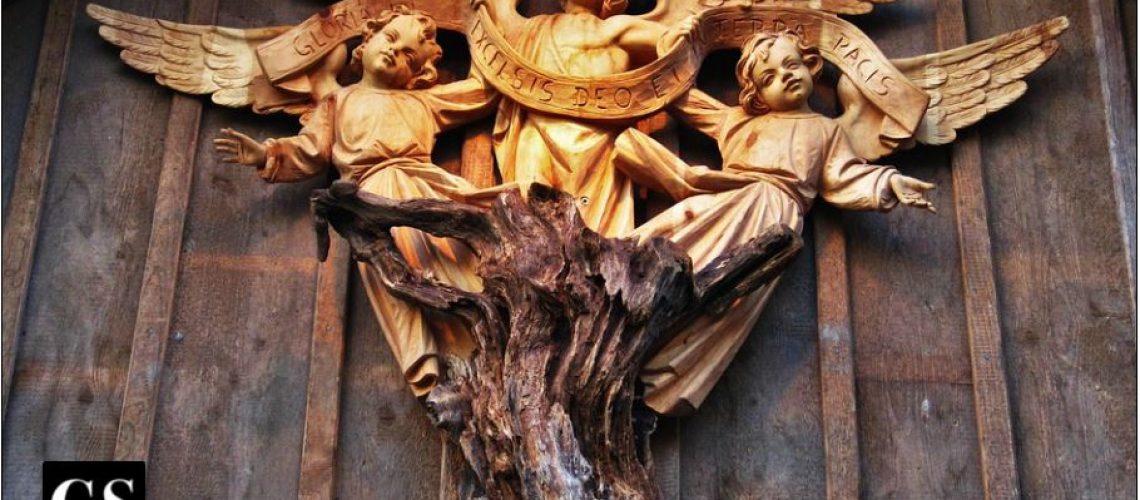
And suddenly there was a multitude of the heavenly host with the angel, praising God and saying: ‘Glory to God in the highest and on earth peace to those on whom his favor rests’ (Luke 2:13-14).
These are among the most glorious and consoling words in Scripture. Who does not feel uplifted at the thought of wondrous spirits, the herald angels appearing in the night sky, praising the unseen Creator and offering a message of peace to humankind? These verses have found their way into Christmas carols, holiday cards, and even Yuletide television specials. After a lifetime of hearing Charles M. Schultz’s Linus recite the Christmas story, we are still moved each year as that innocent voice delivers the King James translation, “Glory to God in the highest and on earth peace, goodwill toward men.
Beyond Festivities, a Rightful Focus
With all the worldly distractions we encounter in our holiday festivities, these words in St. Luke’s Gospel bring our perception of Christmas to its rightful focus. The Word of God came to dwell among humans to reconcile us to the Father, establishing peace between God and men.
While peace is a familiar concept to most adults, the last phrase of the angels in Luke’s account of the Nativity is less clear. First, there are different translations. The New American Bible refers to “those on whom his favor rests,” while the King James uses the phrase, “goodwill”. Actually, these two translations do not conflict. God’s favor surely rests on people of goodwill. And the concept of goodwill is surprisingly linked to the concept of peace.
What is Good Will?
What exactly is goodwill? In accounting class, goodwill relates to the value of a corporation’s reputation. Among individuals, goodwill means a positive attitude or benevolent disposition towards others.
A prayer after Communion, attributed to St. Thomas Aquinas, asks, “May [this Communion] be unto me the armor of faith and the shield of goodwill” (Aquinas). Isn’t that a novel concept, that faith is like armor, and that goodwill can act as a shield? Certainly, kindness and thoughtfulness can be disarming toward contentious, would-be adversaries in social situations. But Aquinas most likely had a more spiritual intent in using that metaphor. In what spiritual way might good will serve as a shield?
A most relevant definition of goodwill for a Christian is one I ran across in a life-changing book that was gifted to me earlier this year. In his short treatise, Searching for and Maintaining Peace, Fr. Jacques Philippe explains goodwill as a person’s devotion to the will of God. We have good will when our greatest desire is to love God as much as he wishes us to love him, and to fulfill his sacred will. Genuine goodwill toward our neighbors develops as a fruit of our devotion to God’s will.
An Astounding Statement
Fr. Philippe goes so far as to call goodwill a “necessary condition for peace” (Philippe 15). Imagine that, an actual pre-requisite. Without conforming our will to God’s will, we cannot have true peace. Moreover, he reasons that goodwill is not just a condition for peace, but that it is sufficient for peace. In other words, desiring the will of God above all things is the only thing necessary for peace in one’s heart.
That is rather an astounding statement. Desiring God’s will does not ensure that my life will be free from distress. It will not protect my loved ones from disasters. Moreover, desiring God’s will does not even ensure that I will be as virtuous as I would like to be! Humans make mistakes, even serious mistakes, despite our devotion to the Lord. Fr. Philippe recounts a story of Saint Gertrude, who expressed a desire to be more virtuous. The Lord responded, “In all things and above all else, have goodwill; only this disposition will give your soul the light and the special merit of all the virtues” (Philippe 19).
Saint Therese of the Child Jesus claimed that goodwill “will save you from all perils,” and would lead one to paradise, even though one might struggle in the attempt to acquire virtue (Philippe 19-20). She quoted a 17th-century priest named Father Surin. Fr. Surin wrote that evil spirits, who were able to surmount all sorts of difficulty in disturbing people, nevertheless could not succeed against goodwill. Perhaps it was this kind of spiritual enemy that St. Thomas Aquinas had in mind when he referred to goodwill as a shield.
Good Will, the Key
Of course, this does not mean that we should abandon the pursuit of virtue. It does, however, show the importance of being single-minded in our devotion to the will of God. This, reasons Fr. Philippe, is the way to peace in our soul. After all, working towards the will of God, one knows one is on the winning side! If despite faults and failures one continues to strive toward what God wants, this yields peace of heart.
In the Christmas season, as in any season of life, peace is a great blessing. As Fr. Philippe explained, goodwill is the key, necessary for peace and sufficient for peace. Even in times of distress, in fact especially in times of distress, seeking the will of God offers the only hope. May we truly be people of goodwill, and thus people of peace.
Works Cited
Aquinas, Thomas. Prayer After Communion. http://www.scborromeo.org/prayers/aquinas.pdf. 10 December 2023.
Philippe Jacques. Searching for and Maintaining Peace. Tr. George and Jannic Driscoll. Society of St. Paul, 2002.


[…] for Plaid: The Influence of St. Margaret on Fashion – Meghan Ashley Styling, Catholic Stylist The Only Thing Necessary for Peace & Goodwill – Mary Ennis Meo at Catholic Stand Join a New Political Movement for Catholics! – Catholics […]
How can leaders, whether on a local or global scale, embody and promote the values encapsulated in “The Only Thing Necessary for Peace and Goodwill”? Greeting : Telkom University
This is an excellent question, one that I imagine would be suitable to a class of university social studies/humanities students. That being said, I wonder if you actually wish me to write a reply. The question is best put to students who have a working knowledge of public policy, including government and international diplomacy.
However, I will say this much: The call to holiness is universal. Thus, the call toward seeking the will of God should compel all people, individuals as well as governing bodies. Leaders can embody and promote the value of devotion to God’s will. How can this be when not everyone believes in God? How can it be when some governing bodies create a separation of Church and state? God is goodness itself; God is love itself. Atheists and politicians who do not acknowledge God in public can still believe in goodness and love. All leaders can embody and promote goodness and love. Imagine, if they did, how peaceful the world would be.
The problem is, of course, that not everyone intends goodness and love toward others. Even popular leaders may lack integrity. Bias and selfishness of those in leadership positions may be looked upon as virtuous, because it means the leader will get his constituents what they want, despite the consequences to those on the other side.
Not being a political science student, I can only propose that the answer is for those in leadership positions to seek the will of God so completely that they open themselves up to him, trusting him to make them “wise as serpents and gentle as doves” (Mt 10:16). This will yield the leader and those he governs peace of heart and soul. If strife persists because of outside/opposing forces, at least the leader has not escalated the problem with undue force or unjust actions on his constituents’ part.
” If despite faults and failures one continues to strive toward what God wants, this yields peace of heart.”
And there it is. So true. Every single day I ask God what He wants of me. And the answer, well I believe it’s His answer, comes into my mind. “Do as you are doing.”
Which is trying to be the best I can be, and helping where I can. Loving all, praying, oh how I pray! I’m a warrior in prayer.
This is a wonderful piece. Thank you, Mary. And a Blessed Christmas to you and yours.
Thank you so much, Ida! You surely have the armor of faith that St. Thomas Aquinas mentioned.
A Blessed Christmas to you and yours as well!
~Mary