
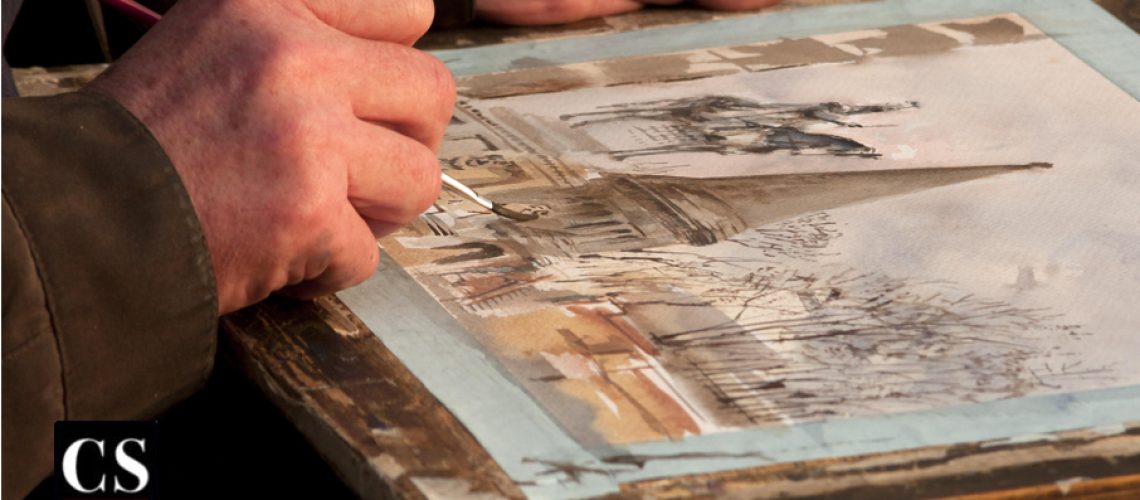
A history text in my Catholic grammar school described a Medieval artist painting an ornate mural on the ceiling of a large cathedral. The chapter was set up as an interview with a modern reporter going back in time and asking the artist questions as he worked.
The interviewer noted to the artist that no one would be able to see a particularly beautiful detail which the artist had painted in an obscure corner of the ceiling. “Why did you even bother to draw that?” the interviewer asked.
“No man may see it,” replied the faithful artist. “But God sees everything. I am painting for the glory of God.”
Decades later, I recalled my history lesson as I admired the many gorgeous churches in Bologna and Palermo, Italy. Images of angels, saints, and the holy Trinity tell the story of salvation. Even illiterate peasants of centuries past could learn the faith through the intricate, colorful artwork of inspired craftsmen. The work of the Spirit is clearly in these spaces, just as it is in the sounds of a cathedral choir singing the liturgical works of the master composers.
The Calling of the Artist
It is easy to see how creators of religious art, music, literature and even architecture processed the stirrings of the Holy Spirit and their own understanding of the faith. God’s calling to these artists is obvious, and we marvel at their works as they reveal sacred truths.
The call to create inspiring art is not limited to Medieval times nor to religious artists. God’s call to create extends beyond these. In his Letter to Artists, John Paul II writes, “Every genuine art form in its own way is a path to the inmost reality of man and of the world” (JPII 6). Christians understand this “inmost reality of man and the world” as the Gospel truths of redemption and salvation. According to John Paul II, then, every genuine work of art leads in some way to Gospel truth.
This statement seems incredible in light of some artwork produced in secular cultures. Nevertheless, the Pontiff remarks that even outside of religious expression, art has such a close affinity to faith that, “even where culture and the Church are far apart, art remains a kind of bridge to religious experience” (JPII 10). The artist’s imagination rises above everyday experiences, much as the saint views the vicissitudes of life from a unique perspective. Artists react to beauty that other people, preoccupied with daily activities, may overlook. Similarly, saints perceive joy and sorrow in terms of grace rather than worldly practicality.
The deeply spiritual perspective of both artists and saints enriches the world with an appreciation for a reality that exists beyond appearances. Even the contribution of atheist artists can serve as a preparation for individuals within a culture to become more aware of inner realities and in this way more spiritual.
Art Reflects Culture
Art reflects the culture that created it. It follows that the virtues of a culture emerge in the work of that culture’s artists. Christian content abounds in the frescoes and icons of Medieval artwork. In ancient Greece, Homer expressed values such as courage, strength, and loyalty to home and family. Shakespearean plays reveal the importance of conscience, justice, humility, and love.
Twenty-first-century writing, music, and film steer away from religious themes and seek largely to entertain the consumer and thus profit financially. Still, contemporary art displays society’s desire for empathy. If contemporary artists can be pinned down to a particular agenda, it is promoting esteem for one’s self and compassion for society’s marginalized individuals.
Conversely, art also reflects the evils of a culture. Whether these evils are the callous shortsightedness of Victorian nobility or the abject cruelty of racism, they are bound to influence artistic expression in some way. When the artist exposes society’s shortcomings, he raises awareness and helps to bring about change. Dickens models Mr. Scrooge’s epiphany, and the world reacts to Anne Frank’s heartbreaking, poignant diary. John Paul II notes that, even in exploring dark themes and unsettling aspects of evil, “artists give voice in a way to the universal desire for redemption” (JPII 10).
The Power of Truth
The power that Christian artists have to move people is reflected in John Paul II’s request of them. The Pontiff exhorts artists to make the world of the spirit perceptible to others. Even more, he asks them to make this world attractive, in order to bring people to God (JP II 12).
In a series of reflections on modern literature and entertainment, Bishop Robert Barron finds evidence of sacred truths which he calls “Seeds of the Word”. The idea is that values such as love, sacrifice, and compassion, found in movies and novels, attest to God’s presence, and give examples of Gospel values. Thus, even in spite of an author’s lack of faith, a work can prepare readers for further understanding and grace. In his Foreword to Barron’s book, Cardinal Timothy Dolan remarks that sharing these reflections enables Christians “to engage with the culture in a way that allows us to evangelize” (Dolan, vii).
This perspective on contemporary art and entertainment is not really new. In the third century, Saint Clement of Alexandria explained how philosophers, playwrights, and poets who lived before the time of Christ nonetheless expressed some portion of the Christian message. They thus showed that, in Clement’s words, “The force of truth is not hidden” (Dolan, vii). For modern consumers of literary and theatrical works, the force of truth need not be hidden in our lives either.
Anecdotes from an Unlikely Calling
John Paul II’s Letter to Artists and Robert Barron’s Seeds of the Word have been vividly alive in my mind this summer. My community theater, a secular troupe of amateur artists, has produced a contemporary musical and performed it for our friends and neighbors. Our goal is to provide amateur artists an opportunity to practice their craft, and to offer quality, uplifting theatrical entertainment to our community. Thus, we respond in a concrete way to John Paul II’s Letter to Artists.
What has come of this response?
Amateur actors from age 16 to about 80 had the opportunity to work together, to sing, to dance, to overcome stage fright, to support one another, and to serve their community.
Before performances, Christians within the troupe offered to pray with the troupe for the show’s success. Some who had not professed themselves to be of any faith voluntarily joined in the prayers. When we prayed that we might bring joy to our audiences, some who seemed at first to be non-believers professed, “Amen!”
At one rehearsal, an actress in her later 70s had difficulty with dance steps. During a short break, the actress approached a college-age actor and asked for help. Although the young man needed the break as much as anyone else, he remained on stage modeling the steps for the older actress, with a friendly air and a generous spirit.
One young actress, beset with a medical issue, performed her role from a wheelchair. During this process we learned that one Broadway actress who uses a wheelchair has recently won an Emmy for her performance. This knowledge brought hope and encouragement to our actress.
While the plot centered around a group of 20th-century NYC gamblers, the storyline of the show promoted marriage. Two gamblers gave up their illegal livelihoods in order to marry their sweethearts. In addition to being heart-warming, the ending attested to Gospel values of commitment, sacrifice, virtuous living, and spousal love.
It seems at first unlikely that one will have true spiritual experiences in an activity that involves the likes of Broadway. Even in contemporary theater, the force of truth will not be hidden. In the Creator’s image, we ourselves receive a creative spirit. Armed with this creativity, Christian artists have the power to bring light to sacred truth in ways that will reach some who are otherwise unreachable. This is indeed a unique calling.
Works Cited
Barron, Robert. Seeds of the Word: Finding God in the Culture. Word on Fire, 2017.
Dolan, Timothy. Foreword. Seeds of the Word: Finding God in the Culture. Word on Fire, 2017.
John Paul II. Letter to Artists. 10 August 2022.


This beautiful reflection touches the very heart of why I chose to become an iconographer. Every time I prepare a board or apply gold leaf, I am reminded of that Medieval artist you mentioned—painting not for human applause, but for the glory of God. Currently, I am working on an icon of Our Lady of Guadalupe, and I feel that ‘unique calling’ to make the spiritual world perceptible through color and form. Thank you for reminding us that our creativity is a gift meant to lead others back to the Creator.
Elizabeth, thank you so much for these encouraging words! It is gratifying to read your affirmation that the call to artists is a call to bear witness to the truths of salvation in unique ways. Thank you.
[…] Francis de Sales Shares His Secret to Fundraising – Brice Sokolowski/CatholicFundraiser.net The Artist’s Unique Calling – Mary Ennis at Catholic Stand St. John Vianney’s Pastoral Plan for Eucharistic Revival […]
For every action there is a reaction, every evil of Satan is balanced with goodness from God. The war we battle on earth has already been won by God. So there are Christians called by God to electronic media, music, painting, writing, dance, theater, to every art form there is. If God calls you to a lifestyle of redeeming others, you must answer the call, hopefully with a resounding “yes.” Do not let anyone tell you this is not a call of a lifetime. Do not let anyone persuade you that your call is less than, just because they cannot see the importance of answering this call by God. People, now more than ever, respond to the arts, understand the message when put to music, creative verse, dance, and acted out. It is sad that the conservative world cannot understand the world of art as a means of delivering the most important message of all, the message of salvation. You can’t hit someone over the head and say “obey.” The result is the opposite. I commend you for following this call on your life. God calls, and you have responded with a resounding “yes.” In the end God looks at our hearts, our responses to His Will over our lives. Keep answering “Yes!”