
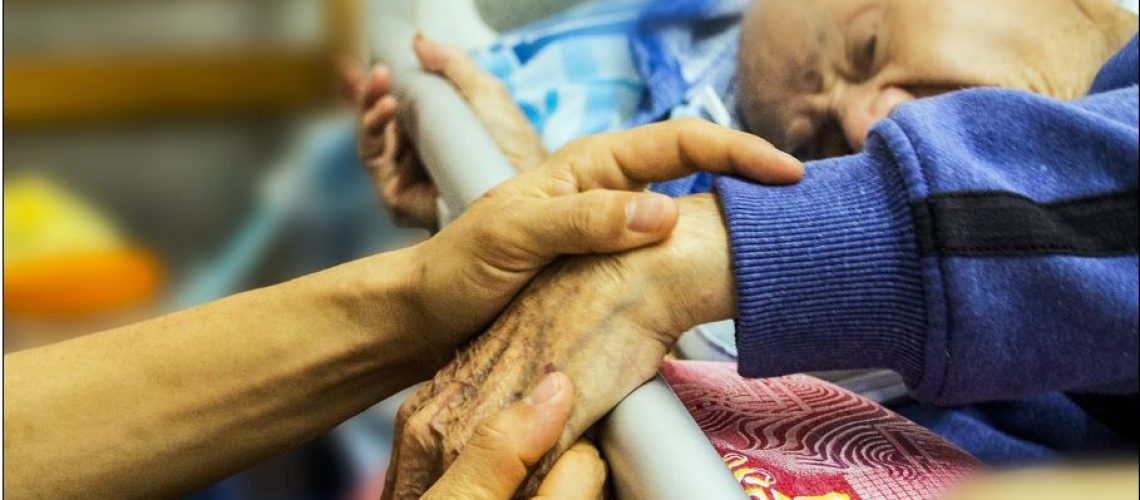
Recently I was called to visit a sick person to give them The Anointing of the Sick. It was a strange visit. (More on this later.)
I recalled, however, that it was not the strangest sick call I had been on. That prize was won years ago, at my first parish. And I do not think the accolade will be taken away soon.
A mysterious note
The sick visit, some years ago, started with a note, left in my mailbox. It read, simply, “Anointing of the sick.” The name of a local funeral home down the street was on the note. Given the urgency, typically the secretary would call for an anointing, so it was odd that she had left a written message.
Stranger still was the indication of the funeral home. Fortunately, the secretary was at her desk, and so I inquired: “The anointing … is at the funeral home?”
“Yes,” was her short reply, with a sense of calm and normalcy that baffled me.
“Is it … for someone who works there?” I asked.
“I have no idea,” she said. “They just called and said they needed a priest for an anointing of the sick.”
In light of this somewhat cryptic information, I called the funeral home. I knew that the owners were Catholic, but many of the employees were not. Hence, I expected that the staff would simply say, “Anointing? What’s that?” and leave it be. I was not expecting the reply I received.
“Oh yes, that’s for Mr. Johnson. I’ll tell his daughter you’re on your way,” was the response. Again, this was presented as the most natural occurrence in the world. So, I made my way to the funeral home, with my oil stock, stole, and book.
Anointing of the “sick”
As I entered the funeral home, the staff were, as usual, quite welcoming (a fact which has always somewhat disturbed me). I mentioned the anointing, and, again, the agent replied matter-of-factly, “Oh yes, Mr. Johnson. He’s in the back room. His daughter is on her way.”
I then tried to tactfully ask the obvious, and exceedingly untactful, question: “And Mr. Johnson … is … deceased?”
“Oh yes, he’s been dead for some time,’ the agent said. “Once you’ve finished, our staff will finish their work, and the funeral will be in the next few days.”
“And the daughter … knows he’s dead?” I asked. “Of course,” was the reply .
I was led to the back room, where Mr. Johnson lay, covered waist-down with a sheet. He was clearly and utterly dead.
“I’ll leave you two,” the agent said over her shoulder, as if Mr. Johnson and I were to have a private conversation. Of course, any conversation would have to be more like a monologue.
The daughter’s thoughtfulness
So, I did what a priest should do. I prayed, and thought about what to say to the daughter. But something just didn’t make sense. She knew her father was dead, and yet she called asking for the anointing.
When the daughter finally showed up, she was very excited and happy to see me. “I’m so glad you came!” she said.
“Well, I’m glad to be here … I mean … I’m glad to help,” I replied. “So you wanted the anointing of the sick for your dad?”
“Yes!” she said. “Years ago, when I was about to have a very serious operation, my dad insisted that I go to the priest and get anointed. I don’t go to church, but I wanted to make sure my dad got the same anointing, because it made me feel better.”
A difficult situation
Now the situation became much clearer. The daughter was being thoughtful and loving, but she had no idea that the sacrament is precisely the anointing “of the sick,” and not “of the dead.” It might have been poor catechesis, lack of interest, lack of faith, or any number of causes.
The fact remained, however, that I had a dead person, and a daughter wanting an anointing. Fortunately, the ritual book, entitled “Pastoral Care of the Sick,” contains much more than just the formula for the sacrament. It contains the rite for giving communion to the sick, the commendation of the dying, prayers for the dead, and prayers after death.
The solution
Indeed, the text also gives clear instructions for cases such as these.
“223. This chapter contains prayers for use by a minister who has been called to attend a person who is already dead. A priest is not to administer the sacraments of penance or anointing. Instead, he should pray for the dead person using these or similar prayers.
“224. It may be necessary to explain to the family of the person who is dead that sacraments are celebrated for the living, not for the dead, and that the dead are effectively helped by the prayers of the living.
“225. To comfort those present the minister may conclude these prayers with a simple blessing or with a symbolic gesture, for example, making the sign of the cross on the forehead. A priest or deacon may sprinkle the body with holy water.”
I explained, very simply, that of course we could pray for her dad, and it would certainly help him. I have always also found that people derive a great deal of comfort from the “symbolic gestures” – the sign of the cross, sprinkling of holy water, and the like. Indeed, the daughter was very comforted and appreciative, much more at peace with her father’s passing.
I was happy that the daughter was consoled, but I couldn’t help but feel saddened for her father. After all, he made sure his daughter was anointed, and yet it seems he could not receive the same gift.
My recent visit
That whole episode came to mind with the latest, strange, sick call visit.
The pastor was told that I could visit after the morning Mass, since the person would be in the apartment waiting. Unbeknownst to me, the pastor asked the family member who called four times if she really thought that the sick man would be okay waiting. The woman insisted he would be fine.
I went to the “sick” person’s apartment after Mass and there was a very somber welcoming committee outside the door. That is highly unusual for a sick visit, but, as it dawned on me, it’s very common when someone dies. Indeed, as I entered the tiny apartment, the rooms were filled with mourning family members.
Once again, instead of giving the anointing I was praying for the deceased.
The motive for these missed anointings
Why is it that these people missed their anointings? Perhaps it’s because, here in Italy at least, many people think that the anointing is a definite prelude to death. Indeed, when the priest offers the anointing, it is not uncommon for the sick person to reply, “No! I’m not really that sick! I’ll get better soon!”
On occasion, such persons will even show up at church after they’ve recovered, simply to make the point that they weren’t really that sick after all!
However, ultimately the problem is to be found in a lack of understanding of the sacrament.
The Code of Canon Law
The “Code of Canon Law,” the rules that govern many aspects of Church life, tells us who can receive the sacrament.
“Can. 1004 §1. The anointing of the sick can be administered to a member of the faithful who, having reached the use of reason, begins to be in danger due to sickness or old age.”
In other words, anointing is not for someone who is necessarily on the doorstep of death, with one foot in the grave. A person who is elderly and in danger (and sometimes just being elderly is a danger), or a young person who is sick, can receive the sacrament. There is no minimum age requirement, except that a person has reached the age of reason.
Indeed, this is precisely what the “Catechism of the Catholic Church” says.
1514 The Anointing of the Sick “is not a sacrament for those only who are at the point of death. Hence, as soon as anyone of the faithful begins to be in danger of death from sickness or old age, the fitting time for him to receive this sacrament has certainly already arrived.”
The Effects of the Sacrament
Likewise, many people think that anointing of the sick simply brings physical healing or “makes them feel better.” However, the Catechism gives four amazing effects of the sacrament:
1520 A particular gift of the Holy Spirit. The first grace of this sacrament is one of strengthening, peace and courage to overcome the difficulties that go with the condition of serious illness or the frailty of old age. This grace is a gift of the Holy Spirit, who renews trust and faith in God and strengthens against the temptations of the evil one, the temptation to discouragement and anguish in the face of death. This assistance from the Lord by the power of his Spirit is meant to lead the sick person to healing of the soul, but also of the body if such is God’s will. Furthermore, “if he has committed sins, he will be forgiven.”
1521 Union with the passion of Christ. By the grace of this sacrament the sick person receives the strength and the gift of uniting himself more closely to Christ’s Passion: in a certain way he is consecrated to bear fruit by configuration to the Savior’s redemptive Passion. Suffering, a consequence of original sin, acquires a new meaning; it becomes a participation in the saving work of Jesus.
Two more effects
1522 An ecclesial grace. The sick who receive this sacrament, “by freely uniting themselves to the passion and death of Christ,” “contribute to the good of the People of God.” By celebrating this sacrament the Church, in the communion of saints, intercedes for the benefit of the sick person, and he, for his part, through the grace of this sacrament, contributes to the sanctification of the Church and to the good of all men for whom the Church suffers and offers herself through Christ to God the Father.
1523 A preparation for the final journey. If the sacrament of anointing of the sick is given to all who suffer from serious illness and infirmity, even more rightly is it given to those at the point of departing this life; so it is also called sacramentum exeuntium (the sacrament of those departing). The Anointing of the Sick completes our conformity to the death and Resurrection of Christ, just as Baptism began it. It completes the holy anointings that mark the whole Christian life: that of Baptism which sealed the new life in us, and that of Confirmation which strengthened us for the combat of this life. This last anointing fortifies the end of our earthly life like a solid rampart for the final struggles before entering the Father’s house.
Conclusion
Hence, we see that the anointing of the sick isn’t just for the dying, and not even just for the person who receives it. It is for all those who are seriously sick, and benefits the entire Church when it is received! What’s more, it is not a one-time sacrament. As the Catechism states:
1515 If a sick person who received this anointing recovers his health, he can in the case of another grave illness receive this sacrament again. If during the same illness the person’s condition becomes more serious, the sacrament may be repeated.
Please make sure to request the sacrament for yourself and for your loved ones.


Your varied experiences ministering this last sacrament reminded me of my own five year commitment as a Hospice volunteer and the many faiths and lack thereof encountered; also, ecumenism, the forgotten term that started the multi effort outreach to other faiths. Not that I would commission more duties for you and your brother priests, but it would be be a mitzvah if that distinct prayer book, particular to one sacrament included prayers and anointing with oil to those of any faith who wanted an intercession. I’m thinking of the Samaritan who treated the man waylaid by robbers and passed by those who did not see the need. Great post, Fr. Nate.
Thanks for the comment, and God bless you for your work as a hospice volunteer! That’s a good idea; I guess as Catholics we have our rites and sacraments, but I’m not aware of anything that set for Protestants, Jews, or other faiths. That being said, though, I know a priest who serves as a full-time hospital chaplain in my home town. It’s tough work, but he tells me that he spends a lot of time with non-Catholics, just sitting and talking. In fact, he’ll take the calls when he’s off if someone just needs to talk. It’s a good example for me as a priest, and a beautiful work of ecumenism or inter-religious dialogue when a sick person (and their families) need a word of comfort. I think that is precisely what Our Lord would have done. Thanks again, and God bless!
Fr. Nate
As always, I see Father Nathaniel’s name, and I read. And I learn. As I now understand, I don’t need to be sick, just having reached an advanced age and knowing my life is nearing its natural end – I could ask for this sacrament.
Am I right?
Hi Ida,
You’re right! The Code of Canon Law says that the sacrament is for anyone who is in danger to due “sickness or old age”: you don’t have to be mortally sick or actively dying to receive the sacrament (although it would be a good time to!). It’s enough to just be older and to know that we don’t live forever on this earth.
God bless, and thanks, as always, for the comment!
Fr. Nate