
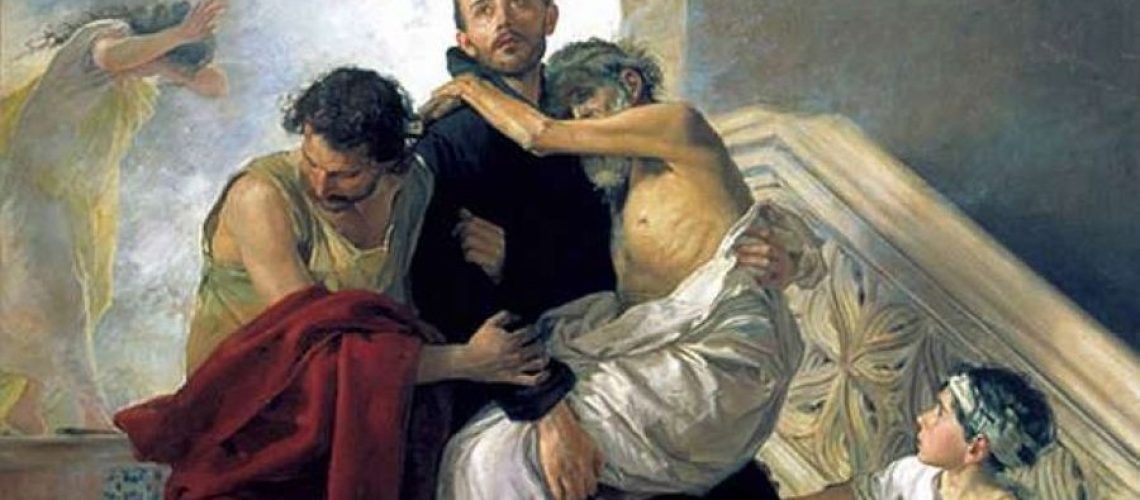
In an age that worships comfort, security, and the curated perfection of social media, the life of St. John of God crashes into our consciousness like a holy wildfire. He was not a serene theologian in a gilded library, nor a cautious bureaucrat building institutions. He was a Portuguese soldier with a reckless past, a man whose encounter with God transformed his impulses from vice to heroic virtue.
For the modern Christian navigating a secular world that often reduces faith to a private, comfortable sentiment, St. John of God stands as a prophetic witness. He is the patron saint of the “impulsive” baptized in the fire of the Holy Spirit. As we investigate his life, we uncover a radical blueprint for a Church that doesn’t just manage charity but embodies the dangerous, uncalculated love of Christ.
To understand the depth of his conversion, one must first sit with the chaos of his early life. Born João Duarte Cidade on March 8, 1495, in Montemor-o-Novo, Portugal, his life was marked by displacement from the age of eight. The provided account suggests he “left his home to join a priest,” but historical records from his first biographer indicate a more traumatic rupture: he was likely abducted or seduced away from his family, leaving his mother to die of grief and his father to enter a monastery.
Young John found himself a homeless orphan on the streets of Oropesa, Spain. He was taken in by a shepherd, Francisco Mayoral, and settled into the quiet life of tending flocks. Yet the restlessness was already embedded in his soul. To escape his master’s persistent offer of marriage to his daughter, John fled into the cauldron of 16th-century European warfare.
For nearly two decades, he was a mercenary and soldier, fighting for Charles V against the French and the Turks. This was his “sinful life”, a period marked by the brutality of camp life, looting, and a near-execution for dereliction of duty when the war spoils he guarded were stolen . He was a man lost to himself, drifting through violence and moral ambiguity.
At 40, he attempted to find meaning through a quixotic quest: he sailed to Ceuta in Africa, hoping to ransom captive Christians and possibly achieve martyrdom. But in Africa, he found not glory, but suffering. He encountered a destitute Portuguese noble family, exiled and ill. Instead of chasing martyrdom, John stayed to nurse them, working menial jobs to keep them alive. It was his first act of redemptive service, a seed of the saint he would become, planted in the soil of humiliation and hidden charity. Disillusioned by the cruelty of colonial rulers, he returned to Spain and settled in Granada, working as a humble bookseller, peddling religious tracts and books of chivalry.
The turning point is as dramatic as it is psychologically profound. On January 20, 1537, the 42-year-old bookseller attended a sermon by the great preacher John of Avila. The text struck him with the force of a cavalry charge. Moved by a grace that shattered his composure, John of God began to cry out, publicly beating his breast, tearing his hair, and throwing himself in the mud. He ran through the streets of Granada, a man undone by the realization of his sin and the vastness of God’s mercy.
His behavior was so extreme that the townspeople, deeming him dangerously insane, had him committed to the Royal Hospital, the very place where the mentally ill were housed. There, he received the brutal “therapy” of the day: chains, flogging, and starvation.
This is a critical moment that speaks powerfully to our own time. St. John of God is not just the patron of the sick; he is a saint who was the patient. He experienced the stigma, the isolation, and the misunderstanding of mental suffering . In the asylum, he was stripped of his dignity, but not of his humanity. When John of Avila visited him, he delivered a revelation that would change the course of healthcare history. He told the distraught penitent that God was not pleased by self-destruction, but by service to others. This counsel redirected John’s fervor from internal torment to external love.
Upon his release, John of God emerged not as a broken man, but as a man on fire with a singular purpose. He made a pilgrimage to the Shrine of Our Lady of Guadalupe in Extremadura, where tradition holds the Virgin Mary revealed his mission: to care for the poor, the sick, and the marginalized.
Returning to Granada, he rented a house and began searching the streets. He carried on his own shoulders the crippled, the homeless, the prostitutes, the insane, and the incurable discarded by the society. This was the “House of God” (Casa de Dios), the first of its kind, a radical departure from the impersonal, overcrowded institutions of the era. He did not just treat diseases; he offered a
home. His hospital was open to everyone:
the crippled, the disabled, lepers, mutes, the insane, paralytics, those suffering from scurvy and those bearing the afflictions of old age, many children, and countless pilgrims.
He funded this operation through sheer begging and faith, often incurring massive debts. In a letter brimming with evangelical wisdom, he wrote, “If we share with the poor, out of love for God, whatever he has given to us, we shall receive according to his promise a hundredfold in eternal happiness. What a fine profit, what a blessed reward!”. He called himself “a prisoner for the sake of Jesus Christ,” unable to leave his house for fear of creditors, yet utterly trusting in Divine Providence.
Perhaps the most spectacular validation of his mission occurred during a catastrophic fire at the Royal Hospital in Granada. While onlookers stood paralyzed, watching patients trapped inside, John of God rushed into the inferno. According to eyewitness accounts, he passed through the flames unscathed, carrying patients to safety on his back. When authorities planned to use a cannon to demolish the burning wing that would have killed the remaining patients. John climbed to the roof with an axe, tore away the burning beams himself, and fell into the flames. When the crowd rushed forward, certain he was dead, he walked out of the fire completely unharmed. This event, captured in the Office of his feast day, solidified his patronage of firefighters and hospitals, demonstrating that the one who serves God’s poor is under God’s divine protection.
His charity was not abstract. Burns in the heart. It was embodied. The Bishop of Tuy, Sebastian Ramirez, once had a religious habit made for John to stop him from giving away his own cloak to every beggar he met. He served not only the bodies but the souls of his patients, converting two of Granada’s most notorious sinners, Antonio Martin and Pedro Velasco, who became his first disciples and the nucleus of what would become the Brothers Hospitallers.
John of God died on March 8, 1550, his 55th birthday. His death was as selfless as his life. Hearing that a young man was drowning in the Genil River during a flood, he plunged into the freezing water to save him. He succeeded in rescuing the boy, but the exposure led to pneumonia. As he lay dying, attended by the Bishop and nobility of Granada, he revealed the three fears that weighed on his heart beaming his profound humility:
- That he had received so many graces from God and repaid them with so little.
- That after his death, the poor women he had rescued and the sinners he had reclaimed might be treated badly.
- That those who had trusted him with money might suffer loss because he hadn’t fully repaid them
He died as he lived: thinking of the poor. His body was buried with the honors usually reserved for princes, a testament to a city that realized it had housed a living saint. His works were his identity. He was the nurse, the bookseller spreading the faith, the hospital founder, and the compassionate caregiver to the mentally ill. His life was a living Gospel.
At his death, John was already venerated as a saint by the people of Granada. The Church formalized this, beatifying him in 1630 and canonizing him in 1690 .
After His Death
His patronage expanded to reflect the breadth of his life. In 1886, Pope Leo XIII declared him the patron of hospitals and the sick. In 1930, Pius XI named him patron of nurses and their associations . Because of the fire miracle, he is the patron of firefighters . His early life as a shepherd and soldier, and his brief career selling books, also made him patron of booksellers and
printers . The Hospitaller Order he founded now operates in over 300 hospitals in 53 countries, and they are entrusted with the medical care of the Pope himself as a perpetual honour to their founder.
Why does St. John of God matter to Christians in 2024? He is profoundly relatable because he was profoundly broken and profoundly human.
For Those with Mental Illness
As one modern writer poignantly noted, “I’m looking for a saint whose experience was closer to mine… who not only maintained their faith through the ordeal but experienced a level of recovery”. John of God was incarcerated, chained, and beaten for his “madness.” He understood the darkness of despair. His recovery through meaningful service offers hope to millions suffering from depression and anxiety. He is a patron for those who feel the Church might not understand their psychological pain .
For the Impulsive
In a world that over-analyzes, John of God acted. He ran into fires, he picked up strangers, he spent money he didn’t have. His was a “eager readiness” to do good, guided by the Spirit’s “love and immediacy.” He challenges our bureaucratic, risk-averse charity.
For Healthcare Workers
In an era of secularized, corporate healthcare, St. John of God reminds us that true healing is personal and spiritual. As Archbishop Eamon Martin stated, Catholic healthcare places “at the centre, the life and inherent dignity and respect for each individual human person, created by God… it aims to bring healing to the whole person by modelling the tender, one to one, attention and compassion of Christ”.
For the Sinner
His life is the ultimate testament that it is never too late. He spent 40 years wandering in sin and violence, and then spent 15 years building a legacy that has lasted 500 years. He proves that conversion is not a moment, but a lifelong mission.
To pray with St. John of God is to ask for a heart that serves, not a heart that calculates. For those suffering, the traditional Novena to St. John of God is a powerful tool, asking for his intercession as the “heavenly Patron of the Sick”.
St. John of God’s Intercessory Prayer
Lord Jesus, you gave St. John of God a heart that burned with reckless love for the poor. Free me from the chains of prudence that bind my generosity.
Give me the holy impulse to see your face in the sick, the outcast, and the mentally anguished. Where I see a problem, give me the faith to see an opportunity for grace. Where I feel fear, give me the courage of John, who walked through fire to save a soul. May I, like him, trade my crown of thorns for the roses of your mercy, and find my paradise in serving you alone. St. John of God, prisoner for Christ, pray for us. Amen.
Final Thoughts
St. John of God’s lifestyle was one of total self-expenditure. He did not build a walled garden of piety; he built a bridge from the Cross to the street corner. His final words to us are not spoken, but lived. He stands at the edge of our comfort zones and beckons us forward. He whispers to the modern Christian paralyzed by fear:
Do not be afraid to look foolish for love. The flames of this world cannot harm the one held in the hand of God. Throw yourself into the flood. Pick up the suffering. Give away your cloak. Your debts will be paid in Heaven.
St. John of God, pray for us, that we may serve with a heart as ready and as willing as yours. Amen.


[…] Precise details of all miracles attributed to St. John of God beyond canonical accounts (Catholic Stand – devotional article) […]
[…] of Catholic Masculinity – Fr. Raymond J. de Souza, M.P.A., M.Phil., S.T.L., at Lepanto InstSt. John of God: Impulsive Lover of the Poor – Vincent Obiajulu at Catholic Stand MagazineVideo: Pope Leo XIV Appoints a Fringe Activist […]