
The word diversity is used a lot these days. In some ways, too much diversity (meaning variety) can be problematic, but more often than not, some diversity can be a good thing.
For instance, imagine a parking lot full of 100 cars. Each car is a different make and model, from 1922 to 2022. Some of the cars are sporty, like the 1986 Toyota Celica. Others are built for capacity, like the 1957 Chevy Station Wagon. Some cars are electric, like the 1922 Electroca, the 1980 Comutra (one of my daughter’s favorite Classic cars), and the Tesla Model X.
Unusual designs fill many of the spaces such as the 1979 Volkswagen Thing. Some of these cars were designed to save lives, like the 1953 Henney-Packard ambulance. Others are grim, like the 1969 Lincoln hearse.
Such a collection of cars offers immense variety, and the cars serve many functions. Some are for racing, some are for off-roading, some are for families, and one is for burying the dead. Some are new and reliable, others not so much.
Every vehicle in this lot is a car, but each is unique. This is a very diverse collection, suitable for a museum. Yet each vehicle saw service at some time because each vehicle fit someone’s needs.
Diversity in Modern Society
Now imagine half of the cars are blue and half are red. Is this diversity? Of course not. Diversity lies in the variety of the 100 vehicles themselves, not their color.
However, the loudest voices in modern society seem to claim that color, skin color to be more precise, is the primary form of diversity when it comes to people. If one thinks this premise through, saying skin color makes a unique race is like saying a black 2020 Toyota Corolla is different car than a white 2020 Toyota Corolla.
Moreover, how does a blind person identify this form of diversity?
Ponder another question. Does our Blessed Mother care?
Real Diversity
Returning to the parking lot full of cars, why is the lot diverse? The diversity is in the ages of the cars, their functions, their features, their abilities, and many other factors as well.
All are cars, but none are equal in age, capability, function, and so forth. Each car has its strengths and weaknesses. A Dodge Viper may be great for racing, but it’s a poor choice for a family of six to take on a road trip. Even if every car was a black (the color Henry Ford selected for the Model T because it dried the fastest to support production), the lot would still be extremely diverse.
Real diversity in humans is shown by our skills, talents, interests, experience, and age, just to name a few factors. But all of us, regardless of our differences, are of the human race. What’s more we are all made in the image and likeness of God.
Diversity in the Communion of Saints
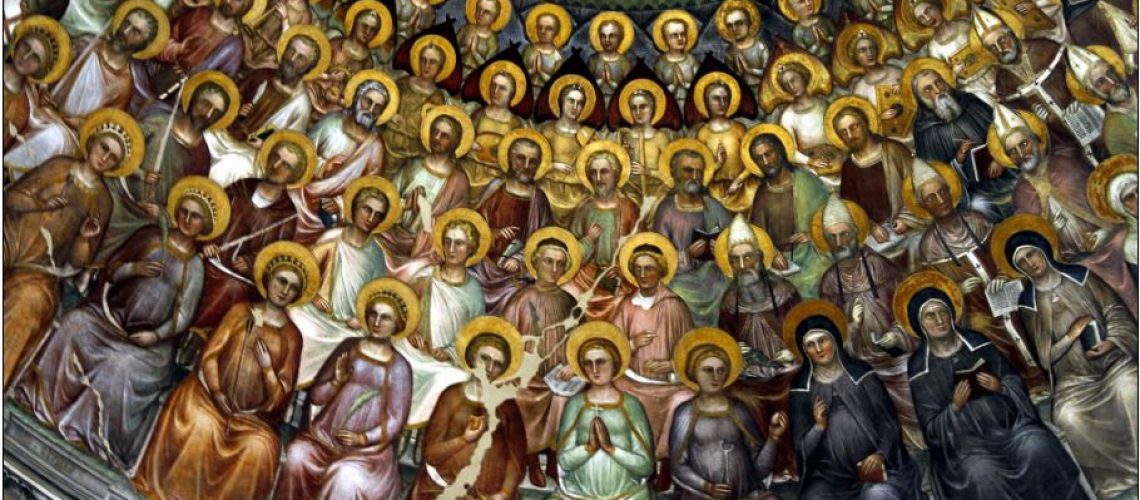
When looking to the role models in the Church, the diversity is amazing. Some saints were soldiers, like St. Ignatius of Loyola, while others reached out to children, like Mother Xavier Cabrini. Some found their way to Christ in the simplest ways, like the Little Flower, and others were amazing Scholars like St. Thomas Aquinas. Some lived in poverty, like Mother Theresa, yet others were kings like St. Edward the Confessor. Some came from the Far East, like St. Joachim Sakachibara, and others from the Far West, like St. Kateri Tekakwitha.
Yet each saint is unique. Each has a story and path to Christ. And each Saint was made in the image and likeness of God.
Diversity in Paths to Christ
This same diversity applies to us. Each of us is unique in many, many ways. One way we are unique is in what inspires us.
Take retreats for example. Some people are greatly inspired by retreats with loud music, vibrant speakers, and group prayer. Others find such retreat ostentatious and nothing more than a quick hit for a spiritual high.
Some people are stirred with a quite retreat immersed in sacred silence muting the sounds of a deafening world to listen to the voice of Christ. Others find silent retreats dull and mind-numbing.
Is one form of retreat better than another? No, and that is okay. Each of us is inspired in different ways and needs very different types of inspiration depending on the unique burdens and challenges each is facing.
Diversity of Worship in the Catholic Church
The same is true for our forms of Worship and the Mass in particular.
Throughout my career, I have been blessed to travel to many different places. I have attended Mass on 5 continents and have heard Mass in several languages. I’ve been to Mass in massive Cathedrals and in humble chapels, in secrecy in someone’s home, and even in an open field and on a canoe. I have attended Mass in Roman, Coptic, and Byzantine parishes.
The Byzantine Divine Liturgy of St. John Chrysostom dates back to the 5th century. This mass includes “bells and smells” that may seem foreign to someone who has only experienced the Novus Ordo mass established in 1969. One can still attend a Tridentine Mass, codified in 1570, which in the overall life the church, is still modern.
Each of these forms of Mass is unique, and each is equally Catholic. Every Mass focused on the Eucharist.
Tolerance of Other Catholics
Conflict has always riddled the Church. This is evident when reading the Acts of the Apostles. And conflicts continue. Among the conflicts that can be observed in the Church today is the question of how we should worship.
I personally witnessed this conflict during my Parish Synod. One woman at my table voiced scorn for another local parish because they said some prayers in Latin after Mass. After listening to her, I realized she wanted our parish, all other parishes, and all of the Catholic Church to follow the path that inspired her and only that path. She did not seem willing to tolerate any diversity in worship or tradition that others might find inspiring.
Is one form of worship better than another? No, and that is okay. Is one form of Mass better than another? No, and that is okay. Each form of the mass is Catholic, focusing on the Eucharist.
Each of us is unique needing different types of inspiration depending on the specific burdens and challenges each of us are facing. Our paths, worship, and customs will be diverse, and that is okay. Moreover, each of us must be willing to tolerate the path others are taking to holiness.


[…] recent CS article asked the question, “Is one form of Mass better than another?” It also answered the […]
[…] Sorry Your Holiness, Diversity in Catholic Worship is Just Fine – Genesius at Catholic Stand […]
As one who switched from the NO to the Latin Mass last year, I can say that I was amazed at what was left out of the NO. I am happy to have switched (I do remember it from when I was a small child, and perhaps I love returning to my childhood as well), because I truly feel that I am participating more and getting much more out of the Mass now.
I think that the Latin prayers, as well as the “smells and bells” serve to set the Mass apart as something clearly not mundane, but as a special spiritual joining of Heaven to Earth.
I think we would have kept more Catholics if it had not been changed.
[…] Every Catholic Should Read: Diary of a Country Priest by Georges Bernanos – Missio Dei Sorry Your Holiness, Diversity in Catholic Worship is Just Fine – Genesius at Catholic Stand The Matter of Life: A Valuable, If Uneven, Primer on Abortion […]
Let’s try this again. The TLM was changed because the CC saw the handwriting on the wall -that unless it did something radical the number of future practicing members would be not much more than the total number of Latin Mass devotees today. As it is, the CC knew the NO was only a finger in the hull of a leaking ship since in reality it was theological concepts that was driving 7 of 10 to move on. ergo: Francis, who came to wake everyone. We live in a global village now and it will take no less than a global understanding of theology to right Peters barque. Let the Spirit blow where it will, and fear not.
“Saw the writing on the wall”? Nonsense, mass attendance is much lower today than in the past when the TLM was in full force and effect. Moreover, moving to the vernacular wherein some theological concepts were made less clear in the Mass also caused problems.
An important reminder for all from Vatican II (See Sacrosanctum Concilium) is that the Latin rite was to be maintained, and that the introduction of the vernacular was limited to certain parts of the Mass, but not to the primary parts of the Mass. Only in 1969, with the promulgation of the Novus Ordo that is not in alignment with Vatican II did we see the change to the full Mass in the vernacular.
So Mike, are you saying that if the TLM were reinstalled the pews would swell with faithful ?
OP, the TLM was changed because a very small handful of progressives wanted it thrown out. The charge to do this was led and controlled by one man — Annibale Bugnini. He hoodwinked Pope Pauls VI and the entire Second Vatican Council. See “A Perfect Storm – How the New Mass was created after Vatican II – Mass of the Ages Episode 2” on YouTube — https://www.youtube.com/watch?v=1XctfSR7SS4
Thanks, Gene, however, beyond the CC’s clerically sordid politics the question remains :
had it not changed, if it was reinstated, what outcomes could you perceive ?
Only God knows the answer to your “had it not changed” question. Mass attendance may or may not have fallen off. We’ll never know. As for your “if it was reinstated” question, Archbishop Roche is wrong – Pope Saint Paul VI did not abrogate the Traditional Latin Mass. Sacrosanctum Concilium itself makes this clear and Summorum Pontificum reasserts this. Personally, as I have written here at CS, I would like to see both the NO and TLM offered in all parishes. Some Catholics do prefer the NO, and that’s fine, as this article points out. But the ongoing, and even increasing popularity of the TLM especially among young people, is strong evidence that some Catholics prefer the TLM as well. The NO and the TLM are both legitimate and approved forms of the Liturgy along with the other rites mentioned in this article.
Gene, I agree with you 100 %. All things equal though, the fall off had nothing to do with
form or order. The deposit of faith, though undermined by language and omission in the
NO, requires a lot more by way of ‘deposits’ if the CC is to hold the higher facilities of first
world Christians accountable.
This site’s embrace of diversity when it comes to things Catholic is . . . selective.
As the year comes to a close, I was reviewing posts on several previous articles. As the article was about diversity, I found your comment confusing. Can you explain what you meant by Catholic Stand’s embrace of diversity when it comes to things Catholic is selective?
I’ve never understood the reason for replacing the Tridentine Mass. Is the Novus Ordo better somehow? It seems that we lost a lot by replacing what had been acceptable for many hundreds of years.
We would have lost a lot more if you hadn’t.
Thank you for the comment. Please consider how you would respond if someone said the following.
I’ve never understood the reason for replacing the Divine Liturgy Mass. Is the Tridentine better somehow? It seems that we lost a lot by replacing what had been acceptable for many hundreds of years.