
Every year, Americans gather on July 4 to celebrate the founding of the United States. But how many Americans really understand the full gravity of what took place 250 years ago?
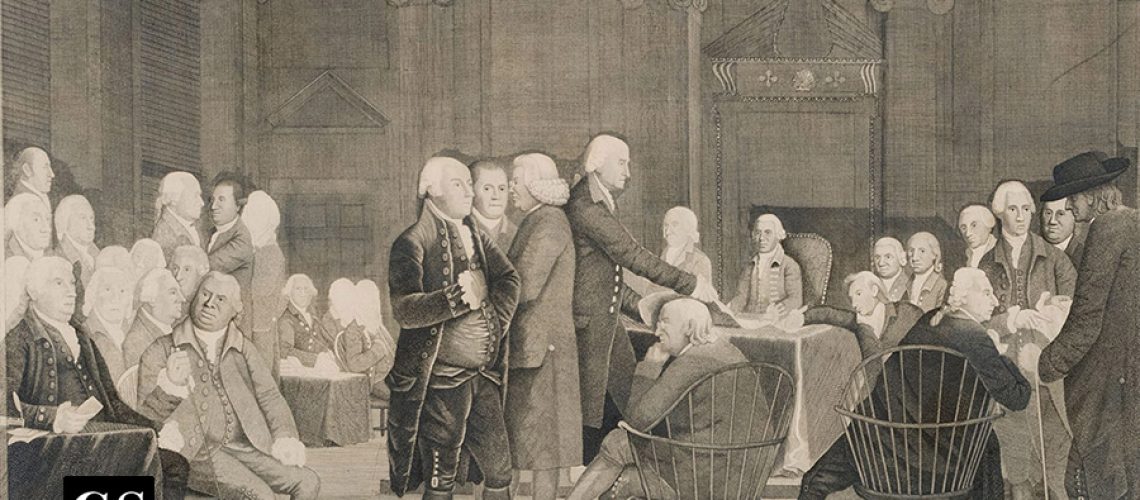
In 1776, the colonies had already been at war for a year. (The Battles of Lexington and Concord took place on April 19, 1775.) July 4 marks the day the Continental Congress signed the Declaration of Independence. After this act, the Continental Congress effectively became the first Congress of the United States of America.
July 4 marks a turning point in human history. It marks the moment when a people declared that their rights came not from kings, parliaments, or armies, but from God Himself. It marked the birth of a nation that sought, as the Constitution later states, “to form a more perfect Union…” to build something better than what came before.
Like all aspects of this fallen world, the United States is not perfect. However, the nation has strived – and continues to strive – to improve.
Over the last 250 years, new laws have corrected many injustices. This striving reflects the Christian understanding that humanity must continually grow, reform, and repent.
Divine Influence
Thomas Jefferson did not write the Declaration of Independence in isolation. He wrote it as a man shaped by Scripture, philosophy, and the intellectual currents of his age.
Jefferson even owned multiple Bibles and was familiar with passages such as Genesis 1:27. This truth forms the foundation of the Declaration’s claim that all men “…are endowed by their Creator with certain unalienable Rights, …”
Jefferson also drew heavily from John Locke’s Second Treatise of Government. Locke argued that natural rights come from God, not from monarchs. He wrote that legitimate government exists only with the consent of the governed. Jefferson echoed Locke’s language almost verbatim when he described the Laws of Nature and of Nature’s God.
Another influence was Algernon Sidney. Sidney’s Discourses Concerning Government insisted that kings are not divine beings but servants of the people. Sidney paid for this belief with his life when King Charles II executed him for treason. Jefferson admired Sidney’s courage and incorporated his ideas into the Declaration’s structure.
For the first time in history, a government began forming that sought to give people the same freedom God has given His people. The states’ representatives in Philadelphia sought to respect human dignity, human choice, and human responsibility. They sought to build a nation where liberty was not granted by kings, but recognized as a gift from the Creator.
Many people talk about the Declaration of Independence, but few actually read it. Now might be a good time to read it. Just click on the link.
Fifty six delegates signed the Declaration of Independence knowing that it was treason, punishable by death. It is a legal argument. It is a moral argument. It is a theological argument. And it is a document that demands to be read, studied, and understood.
Missing Elements
When I began courting my wife, her family got together that July 4 to watch the musical 1776. As a young man more interested in action movies and science fiction than musicals, I tried to decline. My wife, however, countered with, “Come on; you might learn something.”
Of course, with that gauntlet thrown down, I could no longer protest. And she was right. In particular, I learned that Jefferson’s original draft was different than the final draft.
Jefferson’s original draft contained several passages that Congress removed. These deletions reveal the political tensions of the time. They also reveal the compromises necessary to achieve unanimity among the colonies.
One significant deletion addressed slavery. Jefferson accused King George III of waging “cruel war against human nature itself, …” by perpetuating the slave trade. He condemned the king for violating the sacred rights of Africans. But several of the representatives objected to these statements. The removal of these words remains one of the most, if not the most, painful compromises in American history.
Jefferson also included a passage criticizing the king for encouraging Native American tribes to attack frontier settlements. Congress softened this language to avoid overly inflammatory rhetoric.
The Declaration we know today is thus both a compromise and a masterpiece. It is a document shaped by ideals and by politics reflecting the human imperfection of the founders.
The Hand of Providence
George Washington believed firmly that the United States won its independence through the hand of Providence. In his Letter to the States (1783), Washington wrote that the American victory was due to the interposing Hand of Heaven. He repeated this conviction throughout his life.
Washington also believed that God guided the nation through the adversity of the War for Independence. Human strength alone could not explain the improbable triumph of the Continental army.
The founding generation often spoke of Providence not as vague spirituality, but as the active guidance of the Creator. Their faith sustained them. Their faith shaped their decisions. Their faith helped them endure hardship.
As Americans celebrate the Fourth of July, let us remember not only the courage of the founders, but the divine hand that shaped the nation’s birth.


[…] Bless America – Donald R. McClarey, J.D., The American CatholicSome Thoughts on the Declaration of Independence – Genesius at Catholic Stand MagazineHow Benjamin Franklin Picked America’s First Catholic […]