
A Convert’s Response to Allie Beth Stuckey
The first Catholic claim I took seriously as a protestant centered heavily on the intercession of the Saints. Throughout my swimming of the Tiber, it was this doctrine that at face value seemed the simplest and most logical. I appreciated simple and logical; they seem useful to a man who is attempting to convert to a branch of Christian faith radically different than his upbringing. That’s why Ms. Stuckey’s argument against “Heavenly Intercession” is so perplexing. As a convert to the Catholic faith, I find it troubling when protestants like Ms. Stuckey offer objections to a topic in ways that communicate a lack of thought and or study. Should we all be theologians of St. Jerome’s caliber, of course not, but neither should we offer arguments as if we were theme park caricaturists.
That said, is it worth sifting through the thoughts of a convert on a topic that is such a commonplace practice of our faith. In short, yes, because that which becomes familiar becomes forgotten. George Farmer for his many virtuous defenses of the faith in the debate, missed a key opportunity to undermine a presupposition of the opponent’s argument. We refuse, at least I certainly hope
we refuse, to allow secularists to define terms like man and woman, why allow a protestant to define what our Catholic doctrines teach? When wrong terms are wrong they should be identified and illuminated for the continued growth of Christ’s body. Therefore, let’s look afresh at Ms. Stuckey’s argument and remind ourselves of the teachings we hold dear to our hearts.
“I don’t see any biblical support for this idea that we can pray to dead people…”. I would most certainly hope that Ms. Stuckey is not praying to dead people because those who are in Christ are alive; how odd it would be to imagine a faithful Christian asking those who are not in Christ to pray on their behalf. I personally have no desire to ask a deceased post-modern atheist to carry my prayers to, well, no one. Contrary to Ms. Stuckey’s cartoonistic understanding of Mary and the Saints, they are quite alive. I profess clearly that I am biased, as I am Catholic, and I love Mary and my patron Saint Patrick. Ms. Stuckey might object at that point and say it is wrong to love Mary, which would be an
unfortunate objection to make considering that I bet she loves her best friend, or her dog were she to have one.
This issue, which Trent Horn often points out, is common among protestants; they object to a doctrine because it doesn’t meet certain criteria, yet embrace protestant doctrines that don’t meet the criteria they just stated as necessary. Let us as Catholics not be guilty of the same. Our admiration and respect are not above Christ of course, despite our Calvinist debator’s misguided conceptualization of Catholics. When objections are offered in this regard, we must respond by rejecting the underlying idea being presented. Respecting, and venerating, Mary is not a sin, no more than it is a sin to respect your parents. Heavenly intercession is possible because Christ was victorious in his death and resurrection and through His victory we can cry out to those who are now near to Him and can intercede on our behalf.
As a former protestant, I’ll tell you, Sola Scriptura is the lens by which all discussions are viewed when discussing doctrine and dogma. If a protestant doesn’t recognize the fallacy of that teaching, then moving on to topics such as Heavenly Intercession is much harder. However, in this case, we can supply scriptural evidence for this teaching, which also helps in providing evidence for the necessity of a teaching office, and a hierarchical leader who can lead the church to solid ground when the answers to these topics seem shaky.
In exploring the former half of Ms. Stuckey’s statement, my first question to her would be the same as Christ asked the pharisee, “Have you not read…”. Because the existence of biblical evidence for heavenly intercession is ample and available. Mr. Farmer, in his rebuttal, admirably points to the parable of Abraham’s bosom. A fine first volley in countering this unfortunate statement of Ms. Stuckey. In a follow-up video, Trent Horn points to additional examples in the book of Revelations. Here, St. John paints the luminous picture of Heaven where elders proffer bowls of incense “which are the prayers of God’s people.” Now, surely, our debating Calvinist isn’t imagining these as some heavenly zombie creatures.
Nevertheless, how she responds to this scriptural evidence unveils her particular adherence to Sola Scriptura. She might argue that this letter is metaphorical, it is a pictorial example of something happening but is most certainly not literal. Fair enough, but to what degree is it not literal? Obviously, the Lord is giving St. John insight into something. Regardless of whether 24 actual elders are holding 24 actual bowls of actual incense may be beside the point; perhaps God’s point is to demonstrate the existence of someone in Heaven bringing prayers to God. This, like termites in the framing, eats away at the protestant argument for Sola Scriptura. If she claims metaphor, then the question must be asked “What else is a metaphor,” followed immediately by “And on whose authority was it decided that this and that scripture are a metaphor.” If she responds in the affirmative, then she has agreed to the existence of biblical evidence for Heavenly Intercession. Either she affirms the argument she’s trying to disprove, or she requires an external source that can define what exactly is happening in the Heavenly portrayal and thereby undermines sola scriptura.
Scriptural evidence being established, unless Ms. Stuckey intends to argue like an atheist that one verse lacks sufficiency, we need to expand on the latter half of her statement “…praying to dead people.” The statement itself doesn’t pass the logic test. Does Ms. Stuckey believe that Heaven is populated by dead people, and St. John, like a young actor in a 90s film, received the ability to peek into Heaven and see the deceased? No, I don’t think she’s making that claim. Rather she is making a far worse one. To be charitable, I’m not certain she intended to say that those in Heaven are dead. But what if she believes that those in Heaven are incapacitated; they’re unable to partake of the beatific vision until a later time such as the renewal of all things as depicted in Revelation? That would seem to indicate that Christ’s victory on the cross and out of the tomb lacks a degree of potency. How can death be defeated if everyone is still dead or incapacitated?
There exists an abundance of protestant worship music that claims (rightly) that death was defeated, yet according to Ms. Stuckey, it is only the “dead” who are in Heaven. She might, however, rebut and say “No, those in Heaven are not dead or incapacitated,” but I follow that statement with “Then who is in Heaven,” and “What do you believe existence in Heaven is like currently?” The answer is so
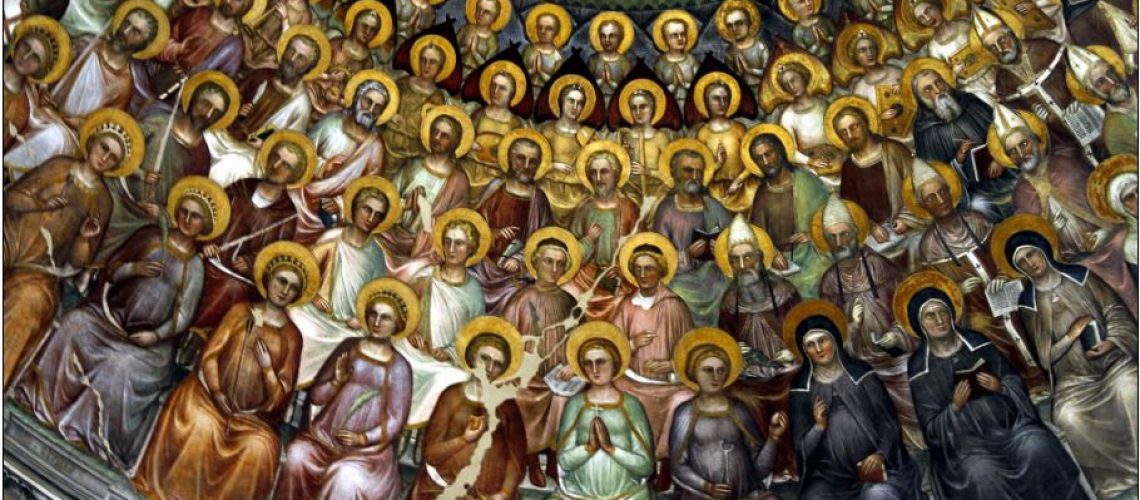
important to our Christian faith because it points to Christ’s victory and to who God is. Was it not Christ in Mathew 22 who said “God is the God of the living not the dead.” The great cloud of witnesses is not a zombie crowd running and drooling their cheers on our behalf. No, they are the great ones who in perseverance are welcomed into the beatific vision and now cheer us onward in our own attempt to live victoriously. I’ll grant that there is a discussion to be had about “to what degree are they alive” since those in Heaven have not yet received the new bodies promised in Revelation, but that doesn’t negate their “alive-ness.” As Catholics, the first question when responding to protestant
protests about Heavenly intercession must be “Is Heaven a land of the living or the dead.”
Every protestant, must, if they believe in the victory of Christ and the Holiness of scripture, believe that Heaven is the land of the living. Our follow-up question then should come as no surprise, “If Heaven is the land of the living, would you also agree then that some in Heaven have access to our prayers?” If they answer no, they‘re in disagreement with scriptural evidence of Revelation 5. If they agree that those in Heaven have access to our prayers, then they take a step closer to the beauty of Heavenly Intercession and thereby making the Catholic doctrine of Heavenly Intercession two for two. The last falsity offered by Ms. Stuckey in relation to our dialogue on “Heavenly Intercession” does not come directly from her statement on the dead in Heaven, but warrants attention and drives home the remaining point on this topic.
In her refutation, Ms. Stuckey takes hold of St. James words that “the prayers of the righteous avail much.” And on this, we stand shoulder to shoulder in agreement. The righteous say powerful prayers, and for that I am most grateful. But I would ask her “do you and I, pilgrims on the journey home, often mired in the muck of the world’s brokenness, stand on equal footing when it comes to righteousness with those who stand in the presence of Christ in Heaven?” As with the inquiries offered previously, her answers will enlighten us as to what she actually believes. Ms. Stuckey might argue with the words of St. Paul who states that we are all righteous because of Christ. A valid point for sure, and worth contemplating. But, and it’s a rather large one, those who have stepped through
the veil and now stand, living mind you, in the presence of Christ are no longer grappling with sin. Their righteousness in Christ is whole and complete as they no longer grapple with sin. If the prayers of the righteous availeth much, then why not ask those who are whole in their righteousness, who (as we demonstrated earlier) have access to our prayers, to pray alongside us as we seek to bring the
Kingdom of God to those around us? Personally, I will gladly receive as much intercession as possible, as this journey toward the Celestial City is quite arduous, and I need all the help offered.
Maybe this was a simple slip of the tongue, an unintended blurb that in hindsight Ms. Stuckey regrets offering as an argument against “Heavenly Intercession”. The final question I would place on the table of this discussion is simply “Is it possible you’re not against the intercession of Mary and the Saints, but more likely, you’re against what the Catholic Church teaches?” Her answer to that question would
be most intriguing.
i. Here I use the term Heavenly intercession to mean asking Mary and the Saints to pray on our behalf.
ii. This is of course after dealing with the issue of sola scriptura. If the protestant you are talking with lands firmly on sola scriptura without budging even a little, the rest of this is snowballs at a campfire.
iii. It’s worth noting that in the translation of 2nd Corinthians, St. Pauls states that we ”might” become the righteousness of Christ.


[…] of Francis’ Motives in Appointing Tucho to the Doctrine of the Faith – Rorate Cæli She Sees Dead People – Garrett Hines at Catholic Stand Movie Review: Sound of Freedom – Steven […]
Fantastic response.
I’ll grant that there is a discussion to be had about “to what degree are they alive” since those in Heaven have not yet received the new bodies promised in Revelation,
Such a fine repartee to Ms Stuckey’s dive into the shallow waters of Solo Scripture.
However, the notion that there will be live bodies milling about, bodies with livers, spleens and reproductive organs in a space where ‘relations’ are not going to happen is no less uncompelling as her arid views on intercession.
As a convert to Catholicism, I read this with great interest. I avoid getting into discussions about my faith as I do not have the knowledge to back up why I converted and why I follow the teaching of our faith.
I just know that I’ve come home. That I’m supremely happy and content. And that I’m grateful I have all those in heaven to whom I pray for intercession.
Thank you for sharing your thoughts.