

By John Vrdolyak
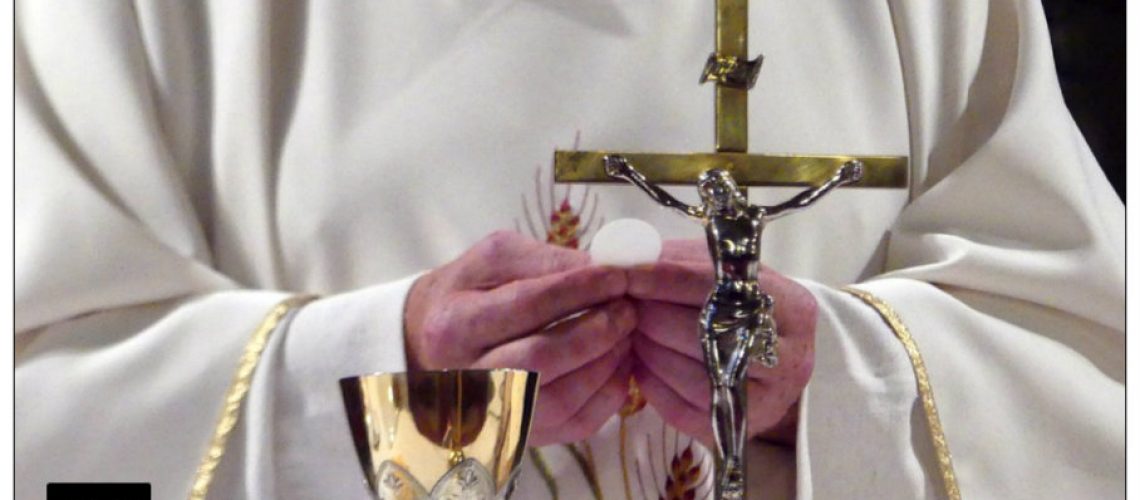
Many well-informed Catholics can quote the sobering statistics concerning belief in the real presence of Christ in the Eucharist – with 69% of all Catholics and 37% of Catholics who regularly attend Mass believing that the Eucharist is simply symbolic. Many point to the lack of catechesis or the lack of reverence or piety in celebrating the Holy Sacrifice of the Mass as reasons for this rather recent break from Church teaching and practice. While I agree that the failure to preach and teach that the Eucharist is the Body, Blood, Soul, and Divinity of Jesus coupled with widespread unreprimanded liturgical laxity, innovations and improvisations, disrespectful distribution and routine receptions have been disastrous on many levels, including on Eucharistic piety, belief and devotion, it’s not the only, or largest hurdle needed to overcome.
True, if the National Eucharistic Revival addresses some of these all-too-common issues and egregious abuses, it may move the needle a few percentage points, and more Catholics will believe the Eucharist is Who Jesus said it is. But many more will not be convinced just because they are taught what the Church believes, as we have seen with other contemporary issues including contraception, fornication, abortion, and homosexuality, where the vast majority of Catholics simply disagree with Church teaching. And many others will not be convinced because the Mass is better understood and celebrated more reverently, and the Body and Blood of Christ is confected, distributed, and received more solemnly, fervently, and humbly. This is not to say that these verbal and non-verbal corrective measures must not be implemented immediately, for they clearly bend toward right worship and should have been addressed years ago.
However, the biggest impediment to not only belief but transformation is our post-Christian, post-modern, narcissistic, materialistic worldview. Until we reclaim our Christian heritage faithfully passed down for hundreds of generations since the time of the apostles, which includes an unshakable belief in the supernatural, a sense of the sacred, a sabbath mentality, well-formed, unclouded consciences, right reason, traditional morality, a grasp of salvation history, and an other-centerd orientation, not much will really change or be sustained. If we as a Church could address only two areas which would not only cement belief in the Eucharist but transform hearts, the Church, and the culture, it would be: 1. Restore belief in the supernatural, and 2. Reorient Catholics on the real rubrics of right worship.
Belief in the Supernatural
Though there may not be any statistics on lay and clerical Catholics’ belief in the supernatural realm beyond that which can be observed and measured, I would guess it is not appreciably different from belief in the Eucharistic presence of Jesus. For those who do not believe in an unseen, spiritual realm will not believe that the visible substance of bread and wine they see and taste can be anything other than visible matter. Modernity and materialism have blinded mankind to the fact that we are corporeal spirits with an eternal destiny with God, yet an eternity in hell is a real possibility for all of us. Lost to our “enlightened” civilizational awareness is that we are surrounded by myriads of unseen, powerful, angelic beings, some good who work for our ultimate good, and some evil who prowl around unceasingly working for our destruction and damnation, the latter of whom, according to St. Padre Pio, if could be seen, were the size of a grain of sand, would blot out the sun. How few know that at every Mass during the consecration, many angels, including our guardian angels, kneel in anticipation of the Parousia, the Eucharistic coming of Christ, made present through the words and actions of the priest and the power of the Holy Spirit? If we could see or believe this clear and once-widely accepted supernatural reality, who could refuse to believe that the re-presentation of the once-for-all sacrifice of Christ on Calvary was being made present in an unbloody manner in our midst? Would such a radical reorientation cause more Catholics to receive Jesus in a state of grace with greater understanding, obedience, and humility than merely eliminating the dizzying, unconsecrated conga line of Eucharistic ministers or encouraging reception of the Eucharist kneeling and on the tongue, both of which I strongly favor?
Would the majority of self-professed Catholics who don’t believe that the Eucharist is Christ’s Body and Blood, somehow instantly do so because they are told that the Church teaches it, or see that the priest and some of the parishioners act as if this is the case? Or would many more come to believe in the miracle of transubstantiation if their incomplete, materialistic mindset was opened to the supernatural realities that surround them and are within them, especially ancient and recent Eucharistic miracles which even the false gods of science have admitted to be human heart tissue of one suffering greatly and human blood type AB? Add to this the countless miracles which have no explanation in modern science, such as incorruptible saints whose lifeless bodies have been preserved from corruption without embalming or mummification for hundreds or well over a thousand years. For the super-secular-skeptics, there is the uncanny similarity of near-death experiences, saints who bilocate, read souls, live for years on nothing but the Eucharist, or bear the stigmata. Then there are demonic possessions, encounters with angels, miraculous cures and even people rising from the dead. Until we can help our Catholic brothers and sisters break the prevailing, pervasive, empty, self-centred, one-dimensional worldview, not much will change, and if we fail to even try to do so, we are without love. And if we ourselves believe in the supernatural, and in the power and providence of God, how can all our efforts not begin with, and end with, prayer – for if any hoped-for revival is based solely upon human ideas and actions, it will inevitably fail.
Return to Right Worship
Even among a small number of daily communicants who believe in the Real Presence are men and women who fail to live courageous, counter-cultural, Christian lives of sacrificial love. I can say this with complete confidence based upon my own lack of love of God and neighbor. Perhaps the focus on Mass attendance rates and Eucharistic belief misses the mark and utilizes the wrong metrics. Maybe there are other things we can do which are more closely correlated with conversion, transformation, and God-willing, salvation, which should be the ultimate goal. In our lack of belief in supernatural realities, far too much of our liturgical worship has been reduced to attendance, passive listening, synchronized actions, memorized recitations, reception, and departure without an extra word to anyone else present. In our myopic materialism, even our worship of the Most High has become somewhat self-referential and self-directed, without much of a trace of awe, wonder, praise, thanksgiving and fear of the Lord. Having been emptied of its sacrificial nature and supernatural significance, at least in the minds of many parishioners, it becomes a banal box that people must check if they want to be considered “good Catholics”. Unless and until Catholics understand that at Holy Mass, the infinite merits of the Cross and the inexhaustible graces of the Blessed Sacrament are made available to us and can be applied not only to ourselves but to the whole world in our time, our lives and the world will continue down its present path to perdition.
On the flip side, unless we approach and undergird our worship with a spirit of repentance, an openness to conversion, and a desire to love God and others, it can be an empty exercise. Both the Old and New Testaments illustrate how such disintegrated, hypocritical worship is not desired by and can be detestable to God. Israel, when it engaged in idolatry and immorality, believed that merely offering the prescribed sacrifices and attending the established feasts were sufficient to appease God. But God told His people that He desires a clean heart and a broken spirit, not sacrifice (Psalm 51:16,17; Jeremiah 7:21-23, Isaiah 1:12-19). In the New Testament, the message is the same, particularly against pharisaical acts of public righteousness, with Jesus even telling us that He wants us to make peace with our brother before coming to the altar (Matthew 5:24).
This by no means indicates that we should not participate at Mass every Sunday, at a bare minimum, but it does instruct us that, we must also love God and love neighbor, otherwise our offering may be ineffectual and the graces and blessings we receive may be severely limited. In addition, unless and until we participate in the Holy Sacrifice by making an offering of ourselves to the Father, uniting it with the salvific sacrifice of Christ, we are pitiable spectators and not active participants, no matter how loudly we sing, how quickly we respond, and how often we sit, kneel and stand on cue.
If at the end of the three-year revival, say 35% of all Catholics and 68% of regular Mass-goers believe that the Eucharist is, in fact, the Body and Blood of Christ, yet remain unrepentant, unconverted, and untransformed, where we continue to treat the parish church as a mere public place where we go for an hour a week and our fellow parishioners as strangers to be avoided, did it really make a difference in the here and now or in the hereafter? Maybe our advanced, enlightened, elite society can take a lesson from the unsophisticated, superstitious Early Christians who risked and sacrificed their lives for their belief in the supernatural and changed the world through their curious but attractive lives of selfless, sacrificial love in imitation of the God who took on Flesh and continues to take on Flesh out of love for us. But no matter what we do on a personal, parish, or national level, let us never underestimate the ability of the Holy Spirit and our Eucharistic Lord to accomplish an organic, spirit-led, supernatural revival in addition to, or despite, our human efforts to plan, predict and program.




18 thoughts on “Reorientation Before Revival”
There is an eerie parallel between what the Protestant Reformers, i.e. Cramner, Bucer, Zwingli and others perpetrated on the church under Henry 8th and what the “reformers” of the Latin Mass did. Keep in mind that the changes made by the Protestants were intended to reduce the Priest to a presider over a common meal and gut the Priesthood itself of any perceived power to confect Transubstantiation – the doctrine of Christ’s REAL PRESENCE in the Eucharist. So, what changes are common to both the Protestant Reformation and V2?
– Removal of the High Altar and introduction of a “Cramner” table, a “Lord’s Board”
– Ad Populum orientation – the presider now faces the people and has his back to the
tabernacle.
– Introduction of the vernacular which eliminated Gregorian Chant
– Introduction of “common clothing” reducing the ornate decorum of the presider
– Elimination of the communion rail which is, in reality, the people’s altar.
– Elimination of incense, bells for use in high-lighting important parts of Mass.
– Elimination of receiving while kneeling.
– Elimination of receiving on the tongue.
– Elimination of the use of a paten.
– Introduction of communion under both species.
– Elimination of most genuflections and signs of respect for the Host.
And, something that even goes beyond what the Protestant Reformers did to the Mass that the V2 “reformers” added:
Introduction of eucharistic ministers and lay readers.
When liturgists instill behaviors and actions that seem to undermine the Real Presence, the people attending such a service will eventually begin to think that there is no Real Presence. Was the Protestant Reformation successful? Yes. Currently, there is no Protestant Denomination that believes their “eucharistic service” offers the Real Presence of Jesus Christ. Were the “reforms” to the Mass of V2 successful or fruitful? Sadly, there is symmetry between the lack of belief of many Catholics today in the Real Presence. By that measure the NO Mass has been an utter failure. A Mass that purports to make present the Body, Blood, Soul and Divinity of Christ; but, in its inherent actions suggests otherwise leads to a church that requires a “eucharistic revival”. This information has been distilled from the three-part series of author Michael Davies: “Cramner’s Godly Order”, “Pope John’s Council” and “Pope Paul’s New Mass”.
I won’t be surprised at all if a poll is taken after the “revival” (which in my area, I’ve heard no mention of at all) showing statistically significant improvement. Hey, handshakes and novenas all around, right?
Well, not really, since the original survey was so faulty and dishonest. It was designed exactly for that purpose. Do you really believe that 70% do not believe? No, they merely failed the Catholic vocabulary and trivia test that the survey was. That’s what “many well-informed Catholics” know from their experience and good old common sense.
I would also add, unless I missed it, this idolatry of SCIENCE as ‘all-knowing, always right’ attitude. The supernatural has no chance when people ONLY rely on their physical senses for all of their beliefs in anything. Sometimes, people don’t believe actual, provable physical worldly things simply because they have never seen or heard or tasted, etc….as Christ told the Pharisee….if I tell you of earthly things and you don’t believe me, how will you believe me if I tell you of Heavenly things.
Let’s face it, much of this is lack of faith and a closed heart and mind and these people wouldn’t believe Jesus Christ if He were standing in front of them performing a miracle right before their eyes. They would make some excuse or try to search for a rational explanation before ever humbling themselves.
The only question you need to answer (for your own enlightenment) is why, prior to Vat 2, untold generations believed – and not believed due to incredulity or theological apathy – in the Real Presence. If I tried to convince you that the moon is made of green cheese you would dismiss me out of hand at no cost to myself or thee. If someone walks in off the street and receives Jesus’ body and blood into their body, the second Person of the Trinity is not going to gag or react to their unbelief while being ingested into the very fabric of their being. It’s not what goes into the body that make one unclean. In fact, only good could come of this: why, because God is bigger than tepid faith or lack thereof. From St Thomas to modern day skeptics, conversions happen to people who take roads to avoid such a fate and the 30K plus Christian denominations are still chugging along as they pass down a plate garnished with symbolism. Not unlike Jesus’ rebuke to the Pharisees about His dining with sinners and again the disciples efforts to keep even children from receiving him, the CC’s ‘club’ mentality has caused its own winnowing. In the end there is nothing here to ‘revive’ – though, like the loaves and fishes, there is more than enough to share.
Papist,
I’m not exactly sure what your point/critique/argument is. If your conclusion is that the supernatural reality of the Eucharist being the Body, Blood, Soul, and Divinity, isn’t true, or it doesn’t really matter if it is, or that anyone should freely receive it, whether they are Catholic, in a state of mortal sin, or understand Whom they are receiving or not, then I couldn’t disagree more, even more than the proposition about a moldy cheese moon. If none of these are your points, then I apologize and ask for clarification. And if you do, please try to use small words so that I can understand.
Let’s see; small words. I believe in the Real Presence, even a small mind should have figured that out in the way I used caps. It does matter ‘if it is’. The point being ie: if you don’t believe in penicillin when the doc Rx it for an infection the substance will most likely work anyway. Unless you have a reaction or a condition that requires much more than an antibiotic. To think that Jesus present in the body of a natural agnostic has no effect is to doubt His many miracles performed on ‘sinners’. Mortal sin is a relative term. Miss mass or commit mass murder; all the same, or should I say, insane. Surely the other points you can deduce: CC ‘club’ , winnowing, premise for writing this essay Disagree all you want but don’t think it implausible that you’re the one not getting it.
Ordinary Papist,
I agree with the author that your first comment was confusing. I too was unable to understand the point you were attempting to make. Further, in his comment, the author was simply trying to better understand your point not attack you. So there was no need to call him a “small mind.”
Now, as to your actual point. Your analogy to penicillin is lacking, to say the least. Assuming arguendo (and ignoring the mind/body/soul connection in healing) that a physical remedy would cure a disease even if the patient did not believe it would, the Eucharist does not work in this way. We only need to look to Scripture to know that if one consumes the Eucharist unworthily, he hurts rather than heals himself. St. Paul makes that abundantly clear in 1 Corinthians 11: 27-30 (“27 Whoever, therefore, eats the bread or drinks the cup of the Lord in an unworthy manner will be answerable for the body and blood of the Lord. 28 Examine yourselves, and only then eat of the bread and drink of the cup. 29 For all who eat and drink[h] without discerning the body,[i] eat and drink judgment against themselves. 30 For this reason many of you are weak and ill, and some have died.”). St. Thomas Aquinas echoes this teaching in his Summa Theologica, Third Part, Question 80, Article 4 (“Therefore, if anyone, while in mortal sin, receives this sacrament, he purchases damnation, by sinning mortally…it is manifest that whoever receives this sacrament while in mortal sin, is guilty of lying to this sacrament, and consequently of sacrilege, because he profanes the sacrament: and therefore he sins mortally.”). In fact, Aquinas directly addresses your point about medicine here and makes a correct analogy: “Every medicine does not suit every stage of sickness; because the tonic given to those who are recovering from fever would be hurtful to them if given while yet in their feverish condition. So likewise Baptism and Penance are as purgative medicines, given to take away the fever of sin; whereas this sacrament (Eucharist) is a medicine given to strengthen, and it ought not to be given except to them who are quit of sin.”
So not only does it hurt Our Lord, but unworthy reception brings death and damnation to the receiver. I think you should reexamine your own beliefs in light of Scripture and Tradition, especially on a doctrine so essential to the Faith and our own salvation.
Apology for the ‘small mind’ innuendo – the rest stands.
I agree that God is not bound by our laws, doctrines, and sacraments, and that the Eucharist could be beneficial to some regardless of their understanding, being in communion, etc. Whether and to what extent are matters known only to God (not to you or me), but we both likely agree that God can and does accomplish great, even miraculous things, from evil, indifferent, or innocuous intent. I can think of no better example than my current pastor, a great priest who received his first holy communion when he was a seventeen-year-old protestant and attributes his priesthood to the Eucharist.
But that’s a different question than should the Church change its disciplines to allow everyone to receive Jesus and profane the Blessed Sacrament, and cause potentially untold harm and hardship, 9just so that it’s not viewed as a closed club. And I still wonder if you agree with St. Paul (as cited by the obviously large-minded Sursum Corda) who warned that people who receive Him unworthily or without discerning the Body and Blood can become sick, die and bring judgement upon themselves (1 Corinthians 11:27-30). Or, hypothetically, say you’re at Mass and a known satanist, who commits egregious sins and engages in detestable idolatrous worship of demons, goes up to receive the Eucharist (whether he may in some way believes the Eucharist is Jesus, but does so out of spite, rebellion, or an overt act of profanation) would you try to stop him?
Cigarettes are sold everywhere, still, people are going to smoke, some, all their lives and have no ill affects. You can’t profane God who is above human endeavors, any harm done by way of personal disrespect will be handled by God I’m sure. The Eucharist is food for everyone. Paul’s overbearing hard ministry is the result of the murders he condoned or took part in.. The enormous guilt he carried to his grave colored his theology in a way that resonates today – the end is near. He was certainly more taciturn shepherd than theologian though his letter on, Love is … is the most profound essay ever written. We’re talking about holding hostage anyone who is not Catholic. It would be up to the priest to handle such an egregious move – or God, who supposedly killed a bearer of the ark for merely trying to stabilize it.
Thanks for the undeserved compliments and thoughtful comments. Sadly, because our unbelief in the Eucharist (and other supernatural realities) is a multifactorial problem a few centuries in the making, there is no easy fix. And yes, one could add any number of other reasons or excuses for the current great apostasy, and as many corrective measures to counter them, but in the interest of brevity, and potential implementation, I tried to focus on the ones I perceived as most problematic and necessary to address. Undoubtedly, post-Christian, post-modern man is less predisposed to accept this “hard teaching” of the Eucharist than Jesus’ original hearers in John 6, the vast majority who abandoned Him precisely because of this teaching. This is not only because of our collective skepticism on spiritual realities, but because of our utter lack of human and spiritual formation, including without limitation our civilizational amnesia on what most people in Christian history, even those of the so-called “Dark Ages” understood. How few of the treasures of our Christian tradition and heritage (academic, cultural, liturgical, etc.) have been faithfully handed down, widely accepted, and eagerly internalized by most people of the modern, materialistic West? The good news is, there is no shortage of things we can do to help.
And thank you for the civil discourse. It’s not that I can’t appreciate your sincere POV, just disconnected from the rubrics – it’s more than ironic that just prior to receiving Jesus at mass we echo the words of a Roman centurion whose understood worthiness, and declined, unlike those in line who partake anyway.
Amen.
Love that centurion. We used to recite his prayer three times before reception of the Eucharist before the Novus Ordo.
Of all the good points made, the most important one is that the great majority of Catholics do not know how they can conscientiously participate in the sacrifice of the Mass. The bread and wine placed on the altar represent their lives. They need to understand that and enter into the mystery of joining their lives with that of Jesus.
Pingback: VVEDNESDAY AFTERNOON EDITION – Big Pulpit
It wouldn’t hurt to hear something from the pulpit that addresses the infrequent genuflecting that I see as well as the frequent conversations in front of the Blessed Sacrament that don’t need to be done inside of the church.
It sounds like a belief in magic, or idolatry.
It’s a legal fiction (because it’s still the same old gluey flour wafer).
The Church spent centuries torturing and burning people who disagreed with this point.
Why should they believe something literally which Jesus himself only meant metaphorically?
It doesn’t seem to matter, unless you really believe that non-Catholics go to Hell.
These are my guesses as to why most Catholics today don’t believe in the “real presence”.
From the bottom of my heart, thank you for sharing this. I’m a convert. I believe wholeheartedly in transubstantiation. It’s my lifeline that keeps me going, something I hug very close when the going gets rough.
And I’ve learned to shut out the outside world and closely follow the words of the priest. For someone with a monkey mind, that’s quite a feat but oh, so worth it.
Thank you again.