
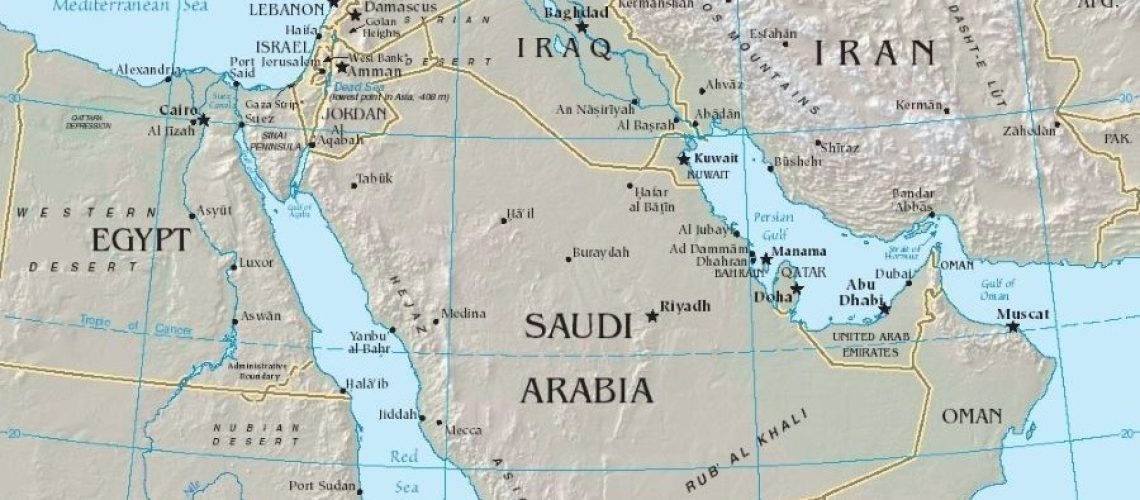
As frequent readers of CS may know, I regularly travel to the Middle East. And that’s where I was for this year’s Advent and Christmas seasons.
And this year I was privileged to assist with the Simbang Gabi novena during my stay. With so many Filipinos in the Middle East, these Masses are now quite widespread and well-attended.
Simbang Gabi is Tagalog and translates to “Night Masses.” This tradition, from the Philippines, consists of nine masses celebrated over the nine days prior to Christmas, held either very early in the morning before the sun rises or in the evening.
The practice dates to the 17th century and has several interesting features. Although the celebration takes place in Advent, the liturgy is celebrated with white vestments (instead of purple). The Gloria is also sung at every Mass.
These privileges are in honor of the joy of Christ’s birth. As Filipinos left their country for work or study, they brought the tradition with them. Today, this Mass tradition is quite widespread and well-attended.
This past Christmas, Cardinal Luis Antonio Tagle, Pro-Prefect of the Dicastery for Evangelization, celebrated two Simbang Gabi masses in Dubai. The Cardinal was on an apostolic visit to the region, thousands of Catholics attended the Masses. Over 30,000 Catholics even attended the second evening Mass!
A Different Situation
There were not 30,000 Catholics at my masses, but at each Mass I celebrated (sometimes twice in one evening), there were always around 100 people. Nevertheless, this number filled the chapels and house churches, regardless of their location. And the liturgy was always the same: the readings were particular to the novena, the vestments were white, and the Gloria was sung.
There was something else that all the Masses had in common. That something was in the intercessions, and it grabbed my attention. Every night, the people gathered and prayed by name for the country’s leaders. They invoked God’s prudence and blessings upon them, asking that those invested with authority might be able to govern the country well and direct it towards the common good.
Such a petition is perhaps more common in the United States or in Europe. However, in this country, where the leaders are indifferent, at best, and sometimes even hostile to Christianity, the idea of praying for the leaders and their governance is quite striking. Yet, praying for those in authority is nothing new. It is even Biblical.
In his first letter to Timothy, Saint Paul writes, “First of all, then, I ask that supplications, prayers, petitions, and thanksgivings be offered for everyone, for kings and for all in authority, that we may lead a quiet and tranquil life in all devotion and dignity. This is good and pleasing to God our savior, who wills everyone to be saved and to come to knowledge of the truth” (1 Tm 2:1-4).
Where is Timothy located? In 1 Tm 1:3, we’re told that Paul instructed his disciple to “stay in Ephesus to instruct certain people not to teach false doctrines.” Some experts say Paul wrote the letter between his first imprisonment in Rome and his execution. This means Pail wrote the letter between 63 and 67 AD.
Who, then, were the leaders for whom Paul is asking prayers? Nero, the emperor known for his violent and vicious persecution of Christians, ruled from 54 to 68 AD. This means Paul was asking Timothy to pray for an emperor who not only despised their prayers but was also actively working to end their work and even their very lives!
A Difficult Situation
What, then, are the citizens’ obligations to their government and government leaders? Clearly, we must pray for our leaders. However, the “Catechism of the Catholic Church” explains our duties as citizens of heaven, as well as of an earthly kingdom.
Paragraph 2238 of the Catechism explains our duties as citizens.
“Those subject to authority should regard those in authority as representatives of God, who has made them stewards of his gifts: “Be subject for the Lord’s sake to every human institution…. Live as free men, yet without using your freedom as a pretext for evil; but live as servants of God.” Their loyal collaboration includes the right, and at times the duty, to voice their just criticisms of that which seems harmful to the dignity of persons and to the good of the community.”
Note that being a good citizen includes the duty to criticize the government when that government hurts the dignity of people and the common good. This makes sense if we consider that the government’s role is precisely to promote the common good. If, however, the government goes against that good, then it is no longer fulfilling its purpose.
Likewise, if the government injures or attacks the dignity of its citizens, it is no longer seeking the common good. As such, to “justly criticize” the government when its policies violate human dignity or go against the common good is not to be a disloyal citizen. Rather, such action is a right and even a duty of the citizen who loves their earthly home.
What’s a citizen to do?
However, criticism of the government when criticism is called for is not the only duty of the citizen. The paragraphs that follow, namely, 2239 and 2240, give a longer list of obligations:
“It is the duty of citizens to contribute along with the civil authorities to the good of society in a spirit of truth, justice, solidarity, and freedom. The love and service of one’s country follow from the duty of gratitude and belong to the order of charity. Submission to legitimate authorities and service of the common good require citizens to fulfill their roles in the life of the political community.”
Submission to authority and co-responsibility for the common good make it morally obligatory to pay taxes, to exercise the right to vote, and to defend one’s country.”
Love and service follow from gratitude. When Thomas Aquinas writes about the virtue of piety (Summa Theologiae ST II-II, q. 101 a. 1) he notes the following.
“Man becomes a debtor to other men in various ways, according to their various excellence and the various benefits received from them. On both counts God holds first place, for He is supremely excellent, and is for us the first principle of being and government. On the second place, the principles of our being and government are our parents and our country, that have given us birth and nourishment. Consequently man is debtor chiefly to his parents and his country, after God. Wherefore just as it belongs to religion to give worship to God, so does it belong to piety, in the second place, to give worship to one’s parents and one’s country.”
Worship (exhibere cultum in Latin) in this sense means “honor” or “respect.” Of course, God should hold primacy of place in everything that we do, but just as we honor our parents, because they gave life to us and raised us, likewise we should honor our country.
Note that Aquinas doesn’t place conditions on the parents or the country. So even if our parents were not morally upright or good people, we still owe them the minimum of honor. This means we must pray for their conversion and salvation. Likewise, even if our country seems to be in a bad situation or passing through difficult moments, we still need to pray for it and respect it, since it gave us life and provided for us.
Since God is the one to whom we owe our first allegiance, the Catechism reminds us that God’s law comes first, before the laws of a particular society. At 2242 we read:
“The citizen is obliged in conscience not to follow the directives of civil authorities when they are contrary to the demands of the moral order, to the fundamental rights of persons or the teachings of the Gospel. Refusing obedience to civil authorities, when their demands are contrary to those of an upright conscience, finds its justification in the distinction between serving God and serving the political community.”
However, even in these cases, the Catholic citizen is not exempt from following all of society’ rules, as the same paragraph concludes:
“When citizens are under the oppression of a public authority which oversteps its competence, they should still not refuse to give or to do what is objectively demanded of them by the common good; but it is legitimate for them to defend their own rights and those of their fellow citizens against the abuse of this authority within the limits of the natural law and the Law of the Gospel”.
So citizens are still obligated to support the common good and work for it, even in a society where there is injustice and difficulty.
Conclusion
So even in Dubai Catholics continue to pray for the leaders of the country where they live. In this way, they fulfill their duty as Catholic citizens, even in a country that does not cherish their beliefs. Likewise, our Catholic faith should shape our citizenship, no matter where we find ourselves.


[…] parish in Italy now, after spending most of December in Dubai. (I wrote a little bit about that here.) After Dubai I was sent to Macau. I spent part of January and February at the diocesan […]
[…] Ph.D.What Does It Mean to Pray About a Decision? – Kerri Christopher at The Catholic HeraldPraying for Politicians . . . Regardless of How They Govern – Fr. Nathaniel Dreyer at CSMA Glimpse at the Obscure Life of a Medieval English […]
Thank you, Fr. Dreyer, for this enlightening article. Years ago, in my Catholic elementary school, we ended our daily prayers with the petition, “God bless our President and our country.” It is ironic that we tend to say, “God bless the President,” more when we like him than when we dislike him. Really, the more problematic his policies are, the more we ought to pray for him! Thank you again.
Hi Mary, and thanks for your comment.
Exactly – I think you’ve said it very well! We need to pray for our leaders, even (and especially) when their policies are disturbing!
God bless,
Fr. Nate