
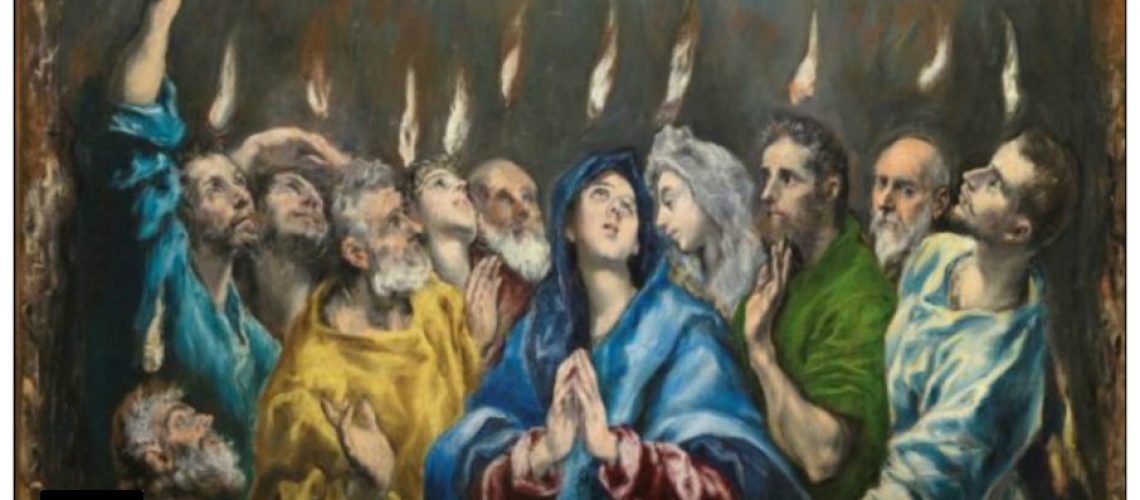
Our Lady’s Immaculate Conception meant that there was no sin in her. This meant that there was no impediment within her to prevent the continual and ongoing inflow of the Holy Spirit who immediately filled her on the first Pentecost Day and drew her up and into her loving son. Here she shared and enjoyed with him the sublime contemplation of God the Father where together they experienced the joy in contemplating his Glory. In what happened to the Mother Jesus gave them, the first Christians saw what would happen to them also, once they were purified by daily practising repentance, the repentance that is first learnt in the school for divine loving, which is prayer.
The Sin Against the Holy Spirit
When the first Christians looked at Our Lady and saw what she did each day, and how she did it, they were looking at what the Holy Spirit would do for them if they kept repenting. In those early days, there was only one outstanding and unforgivable sin, and that was the sin of omission, the sin that Our Lady has said in modern times is the worst and sadly the most commonplace of all sins. In short, it is what Jesus himself called the sin against the Holy Spirit.
It is committed today more than any other sin. It is the father and the mother of all other sins for the ‘faithful’. For if, despite all God has done, and all his son has suffered, to ensure that the Holy Spirit would be poured out on the first Pentecost Day, and on every subsequent day, we fail and continually fail to keep turning to receive it, then disaster will follow. Disaster will follow because we commit the sin against the Holy Spirit, for which, as Christ himself insisted, there is no forgiveness. This point is of such importance that I must explain it a little further.
The Most Pernicious Sin of All
In recent years Our Lady, in her appearances, has made it quite clear that the sin of omission, which prevents the Holy Spirit from entering our lives to change them, is the most pernicious sin of all. At the Last Judgement, or when, or if, there is an ‘illumination of Conscience’, we will see our sins, not as others see them, or even as we think we see them ourselves, but as God does. When this happens, we will see that our greatest sin of all has been the sin of omission or the sin against the Holy Spirit for which there is no forgiveness, for forgiveness, like all the other gifts of God come through his love, as it is being received into an open and willing human heart. Close your mind and heart to God and his love, stop daily repenting, and you close it to all else he wants to give you, that only comes through his divine love. This of course includes the forgiveness that we all need, and for which we all crave. The longer we commit the sin against the Holy Spirit by refusing to open ourselves to his love in prayer then the quicker we begin to go backwards in the spiritual life and further away from God, and the only love that can save us from disaster.
Our Lady, the Apostles and the other first followers of Jesus continued to turn and open themselves to receive God’s love, his Holy Spirit through daily and ongoing prayer, through Jesus Christ, their Risen Lord and Saviour. This would not only multiply infinitely the power of their prayer to God but multiply what he could give them in return. If they wanted to know where this prayer was leading them, they only needed to look at the new Mother that Jesus had, not only given to St John on the Cross but the new mother that he had given to the infant Church too.
Wisdom from St John of the Cross
St John of the Cross gives us an extremely helpful example to explain the inner nature of the repentance that is learnt in prayer. He gives us the example of Moses. When Moses and his family, and all the other families watched with ever-increasing horror to see their young men being cut down in the terrible carnage of battle against the Amalekites they all but gave up hope. Despite the temptation to gaze upon the awful bloodshed of his beloved people that he could do nothing to prevent, he kept trying to turn to the only One he knew who could help him. Time and time again he repented, by turning to God by raising his arms aloft to him in prayer to beg his intervention, but time and time again, as if by some malign magnetic force, he was drawn back to witness the evil that was being perpetrated on the battlefield before him. Seeing how God was beginning to act through him, to bring about victory when he prayed and remained in prayer, his bodyguard used props to keep his arms raised to God in prayer. Victory came quicker than expected, lives were saved, evil was prevented, and peace prevailed.
Inner Repentance
The same happens when we drag ourselves away from the evils of the world that are daily set before us through the all-enveloping power of the mass media. When, like Moses, we turn to the only One who can prevent it, and turn time and time again to him, as we wrestle with the pernicious powers of evil, we are practising repentance in our daily prayer. This is the inner repentance practised in our minds and hearts that repeatedly opens us to the only love that can change us. Only this love can bring us to the peace for which we yearn making us into channels of peace for others. The props used to help Moses to keep his heart and mind fixed on God symbolise the spiritual props or prayers that we use to help us keep repenting. Keep turning our hearts and minds to God, until they remain sufficiently open to receive his love and all the infused gifts contained within that love. The selflessness that is practised, and the love that is received in this prayerful action can alone facilitate the selflessness that is practised outside of prayer, as we keep trying to love God in the neighbour in need beginning with our own families.
Wisdom from Garabandal
This is the inner nature of the repentance that Our Lady told the children to practise at Garabandal and all the other places where she has appeared in recent years. That is why she told them to pray so that their repentance could be practised and brought to perfection. Then the sacrifices made in order to practise this repentance should be offered at Mass so that they can be united with the Sacrifice of Christ to receive in return the hundredfold that Jesus promised. The whole of the spiritual life then can be summed up in the four words used by Our Lady at Garabandal: Repent, Pray, Sacrifice, and the Mass. When this spiritual dynamic of what has been called ‘sacrificial repentance’ is practised day after day ’week after week’ year after year’ we are taken up into and fitted ever more fully into Christ’s sacrificial action’ that we celebrate every time we go to Mass. No matter what we believe in our minds if this daily ‘sacrificial repentance’ is not practised with our hearts then we will soon be committing the ‘sin against the Holy Spirit’ and we will inevitably be travelling downward bound on the ladder of perfection. It is the last minute of extra time, start again, beginning now, to turn again daily to the only One who can change you, and the world that Christ has chosen to redeem through you.


Dear David ,
Thank you for your inspiring message .
I am Jewish and also believe in the importance of prayer and repentance. Your reference to Moses and Amalekites had a particular resonance for me.
Its interesting, as well, that you mentioned Pentecost .By coincidence we have just celebrated the festival of Shavuot (” Weeks ” in Hebrew ,that is seven weeks from the second day of Passover ) .This is a double celebration as it was the end of the grain harvest in the days of the Temple in Jerusalem ,and the giving of the Ten Commandments to Moses on Mt. Sinai.Of course , Pentecost has a different meaning for Christians.