

Asperges me, Dómine, hyssópo, et mundábor; lavábis me et super nivem dealbábor.
(Thou shalt sprinkle me, O Lord, with hyssop, and I shall be cleansed; Thou shalt wash me, and I shall become whiter than snow.)
It is time. A bell rings, and all in the congregation stand.
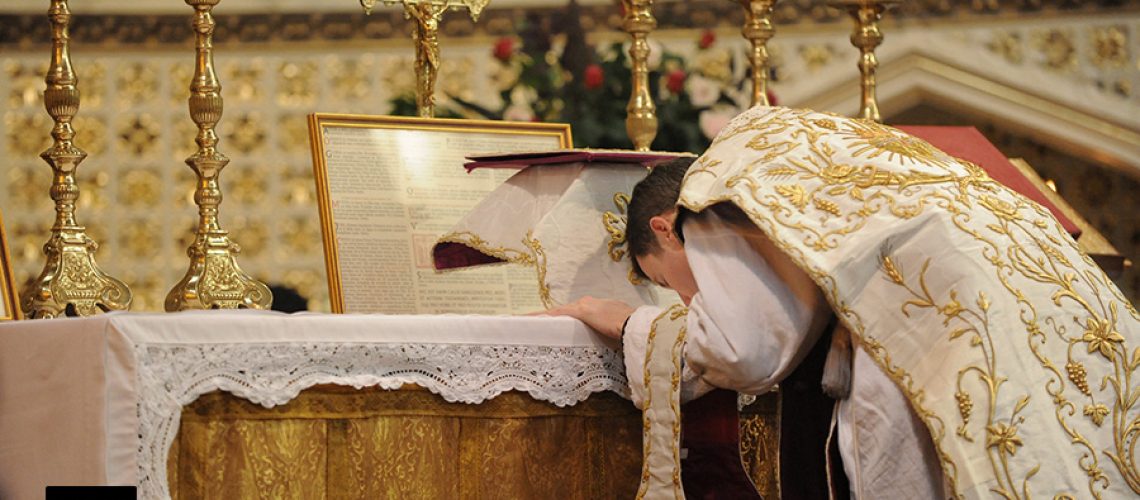
The altar servers and the priest walk out into the sanctuary, either from a side entrance or (as is in my church) from behind the altar wall. There is no music, and all are silent. You notice that the priest is not clothed in his vestments, which are lying off to the side on his chair. Instead, he is wearing a cope over his alb and a biretta on his head. Here, he must first seek forgiveness before he can clothe himself in the garb of a priest.
Seeking to be Cleansed
He does not yet climb the altar steps, but, upon removing his biretta, kneels down facing it. The cantor leads the Asperges, taken from the ninth verse of Psalm 51(50), the great lament composed by King David after the prophet Nathan confronted him with his sins against Uriah and his wife Bathsheba (2 Samuel 12:1-15). Have mercy on me, O God, according to your steadfast love; according to your abundant mercy blot out my transgressions. Wash me thoroughly from my iniquity, and cleanse me from my sin.
The reference to hyssop goes back to Passover, when the Lord commanded Moses to daub the lamb’s blood over the doors of the Israelites (Exodus 12:21-27). The ancient Jews commonly used hyssop for ritual sprinkling with water for purification. (Ironically, the Romans gave a hyssop branch dipped in vinegar to Jesus upon the cross.)
The priest now turns toward the congregation, and, using a container of holy water held by one of the servers, walks down the center aisle blessing the congregation.
Miserére mei, Deus, secúndam magnam misericórdiam tuam.
(Have mercy upon me, O God, according to Thy great mercy.)
Once back in the sanctuary, the priest leads the congregation in David’s ancient chant to ask for God’s mercy.
Osténde nobis, Domine, misericórdiam tuam
(Show us, O Lord, Thy mercy.)
Et salutáre tuum da nobis.
(And grant us Thy salvation.)
Dómine, exáudi oratiónem meam.
(O Lord, hear my prayer.)
Et clamor meus ad te véniat.
(And let my cry come unto Thee.)
Then the priest asks the Lord to be among the congregation, and to “send Thy holy Angel from heaven, to guard, cherish, protect, visit, and defend all that are assembled in this place.”
Going to the Holy Mountain
Next, the priest and the altar servers step to the side of the altar to remove his cope and only now don his stole, cincture, chasuble, and maniple. He does not yet climb the steps of the altar but returns to its base, and longingly looks up at it, using these well-known words:
Priest: Introíbo ad altáre Dei.
(I will go in to the altar of God.)
Server: Ad Deum qui laetificat juventútem meam.
(To God who giveth joy to my youth.)
He is seeking to be worthy to go to the altar—our holy mountain—just as did the author of Psalms 43:
Send your light and your fidelity, that they may be my guide;
Let them bring me to your holy mountain, to the place of your dwelling.
That I may come to the altar of God, to God, my joy, my delight.
Then I will praise you, O God, my God. (vv. 3-4)
This happens before the priest steps up to the altar before the Mass begins. It is a beautiful reminder that a contrite heart pleases the Lord and that before we can participate in His holy sacrifice, we must seek His forgiveness and blessing. The priest and we must be cleansed first.





7 thoughts on “Love Letters to the Latin Mass 3: First We Must Be Cleansed”
Hi Cynthia!! It’s been great to reach each installment of these love letters, and I look forward to the rest!
As with the previous two, this article speaks to the very core of why the TLM draws me into the Lord in such a special way.
The Asperges along with the prayers at the foot of the altar have long been some of my favorite features of the TLM, especially as they relate to Christ’s time in the Garden of Gethsemane as we too prepare ourselves through self-denial as we await the Sacrifice.
Thank you as always for putting your thoughts to words so well, and looking forward to the rest of this series.
Connor
Thank you for your kind words.
This also is my favorite part of the Mass, not only because it reminds me of my sinfulness and self-absorption, as Nathan reminded King David, but it celebrates our total dependence upon God and His overflowing mercy. It truly prepares and centers me for what comes next, and for the rest of the week!
C
Pingback: Extra, Extra! News and views for March 22, 2023 – Catholic Mass Online Search
Pingback: MONDAY EDITION – Big Pulpit
With all the ritual cleansing, atonement, guilt, from a priest and a congregation that is most likely squeaky clean by ordinary standards, I imagine them confessing sins that are so paltry as to be ingratiating – and makes everyone else who atones in other ways seem unforgiven for their efforts. Of course, for those who partake of this ancient rite I have all due respect and cannot understand why Rome or anyone would want to cancel the practice. It’s not for everyone but neither is the NO. Orthodox. Reform. Conservative. Something for everyone.
Beautifully put! I teach a Religious Ed class on Traditions and we spent one whole year on the Mass, going back through the Old Testament and relating all the parts of the TLM to the Temple worship. God showed us very clearly how He wished to be worshipped. Prayer services are not sacrifice. Yes, I believe transubstantiation occurs in the NO, but my belief is based on my understanding of Jesus’ Passion and you can’t hurt Someone who is not there. I firmly believe the Church is now mirroring His Passion.
Ceremony in Latin, led by specialized, trained man putting on ceremonial vestments, careful to say prayers exactly the right way, word for word, prayers of supplication and repentance, incense, focus on a place apart from them, in the distance.
Jesus breaking bread and drinking wine at the same table as the apostles, speaking in their vernacular language, and if he raised up the bread ceremonially, it was in their midst.
Cynthia’s post, of course, is about externals. But based on what she tells us, in the first century she would be more at home at a Roman pagan ceremony than at the Last Supper. Apollo is my guess as to the god being worshipped.