
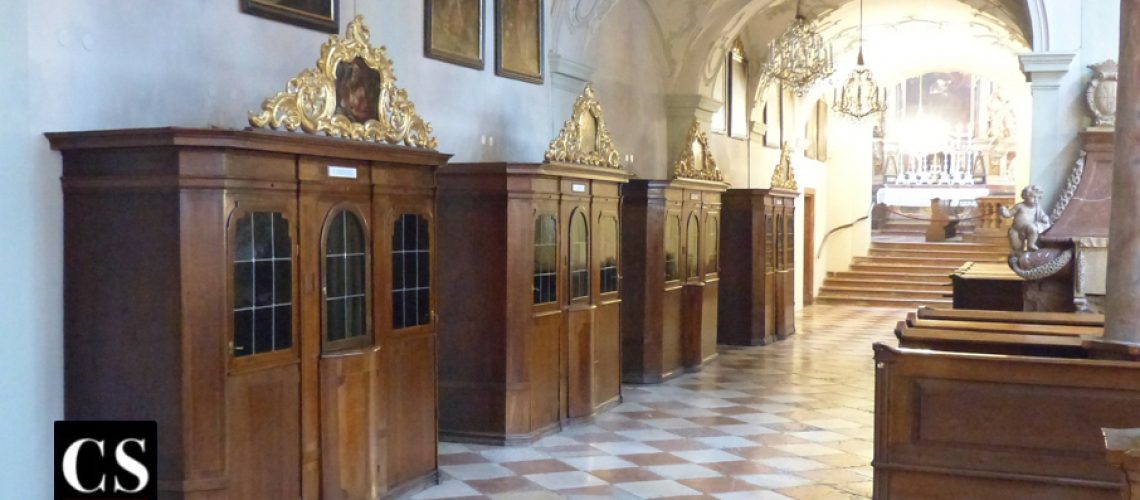
Lent is the ideal season for Confession. Of course, all seasons are ideal for Confession in their own ways; but Lent is the best. Especially if you’ve been away from the Sacraments for any reason, the Sacrament of Confession is the first step on the road back, and Lent is a season of returning.
For some people, the year of pandemic has led to a year of no Masses. I know of so many families who have spent the year grieving for lost Sacraments either through fear of the virus or because of the burdensome restrictions. Whatever the reason for staying away from Mass, a year without the Sacraments is devastating to the soul.
Livestreamed Masses and faith groups are incapable of administering Sacraments, and in many cases only lull us into a false sense of connection. It looks like Mass, and we are able to pray along with our priests as they offer the Mass, but the spiritual nourishment of a livestreamed Mass can only go so far. In many ways, watching the Mass online is similar to watching a video of two friends having a conversation: it can make us feel connected, but it offers very little beyond images and emotions.
A year after the US lockdowns, you may not be ready to step back into parish life. You may not be ready even for a quiet, weekday Mass; but I promise, you are ready for Confession!
The Need for Confession
In fact, if you haven’t been to Confession since March of 2020, your soul is aching for it. If it’s been longer than a year, the idea of confessing your sins might feel pretty overwhelming, but trust me, the joy of finally having your sins forgiven is absolutely unforgettable.
I remember once, after a period of rebellion in which I neglected my faith and chased recklessly after darkness, reaching out to a crabby, old, ex-military priest at my local parish for Confession. I’d prayed for anyone but Fr. Army, but of course, I saw only that gruff old man after the Saturday vigil Mass. A few deep breaths, and I stammered out a request. In the quiet confessional (really an unused cry room at the side of my hopelessly suburban parish), he listened, counseled, prayed, and absolved me. To this day his image in my mind is enshrined in mercy and merged with every other gentle confessor I’ve met. In the blurred lines and mingled features, they all start to look like Christ.
These days, I confess most often to two priest friends. The priests who hear the worst of me, also spend time eating, drinking, and laughing with me outside of the confessional. While that sort of intimacy can feel awkward at first, after a while it begins to feel gloriously Christological. After all, Christ who knew all the sins of His friends laughed with them and loved them in their frailties.
How to Confess
One of the fears that kept me from Confession when I was away from the Sacraments, was the simple fear of messing up. No one wants to step into the confessional and then sit awkwardly – saying and doing the wrong things. Of course, your priest isn’t going to mind, he’s used to that. He hears confessions from rambling, eager, young children and 80-year-old converts. It’s likely that nothing you do or say in the confessional will surprise him.
All the same, it’s nice to go in confidently. If it’s been a while since your last Confession, you can even write out a brief outline. My favorite way to begin is with the traditional: “Bless me Father, for I have sinned. It’s been ___ days/weeks/months/years since my last Confession…”
(Remember again, you can’t shock Father. You could say 2 hours or 90 years. You could tell him that this is your very first Confession. He’s ready for whatever you have to tell him.)
Naming Your Sins
After that beginning, launch into your sins. I like to spend some time preparing before Confession. I write my sins in a little notebook with “Sin List” in bold at the top of the page. After Confession, I burn the list in my little woodstove. But during Confession, I can simply read down the list – no option to “forget” the more embarrassing sins, no chance I’ll ramble on and on about a habitual sin while the rest of the line waits for me to finally stop talking. The list takes time to prepare, but it makes my time in the confessional more focused and intentional.
Some people like to tuck their more embarrassing sins in between more innocuous ones, while others like to get them out of the way at the beginning. But to be honest, the longer I spend in the confessional, the less those little choices seem to matter. These days my sins come tumbling out as I see them on the page; and when I’m done, I close the list with a delightful little drawstring phrase: “For these and all the sins of my past life, I am heartily sorry.”
That phrase is a lovely way to calm your mind on late nights, when you think back over all those venial sins that may or may not have made it to the confessional. Of course, if you remember an unconfessed mortal sin, head back into Confession with it. But otherwise, take comfort in closing your sin list with that gentle, collective repentance.
Act of Contrition
After Absolution, the priest calls on the penitent to pray the Act of Contrition. It’s a simple prayer, with a few variations.
O My God, I am heartily sorry for having offended Thee,
and I detest all my sins because
of Thy just punishments; but mostly because they have offended Thee, My God,
who are all good, and worthy of all my love.
And I firmly resolve, with Thy Grace, to sin no more, and to avoid the near occasion of sin. Amen.
There are a variety of ways to pray the Act of Contrition, but each follows the same path: Contrition, love of God, and determination to avoid future sin. The simplest form is:
My God, I am sorry for my sins with all my heart. In choosing to do wrong and failing to do good, I have sinned against you whom I should love above all things. I firmly intend with your help to sin no more, to do penance, and to avoid whatever leads me to sin. Amen.
While most confessionals have at least one Act of Contrition posted, it’s easy to bring your own copy as well. If all else fails, your priest will neither laugh nor refuse to guide you through the prayer himself. Even those of us who go regularly blank out occasionally and need a bit of support gathering our words again.
Working with God
Whoever confesses his sins … is already working with God….
The beginning of good works is the confession of evil works. You do the
truth and come to the light. — St. Augustine
The opportunity to work with God is what we all long for, and Confession allows us to begin. Remember that the Church commands us to “faithfully confess serious sins at least once a year,” and of course “anyone who is aware of having committed a mortal sin must not receive Holy Communion, even if he experiences deep contrition, without having first received sacramental absolution” (CCC 1457).
“The beginning of good works is the confession of evil works,” as St. Augustine writes. To truly begin, we have to humble ourselves, confess our sins, and embrace the enthusiastic forgiveness that Christ is eternally offering through his priests.
So take the opportunity to go to Confession this Lent, and greet Easter with a heart full of joyful hope.


[…] Guide to St. Joseph Will Grow Your Relationship with This Saint – Fr Briscoe OP/Aleteia Lent: The Perfect Time for Confession – Masha Goepel at Catholic Stand Two Years After Easter Attacks, Sri Lankan Catholics Still […]