

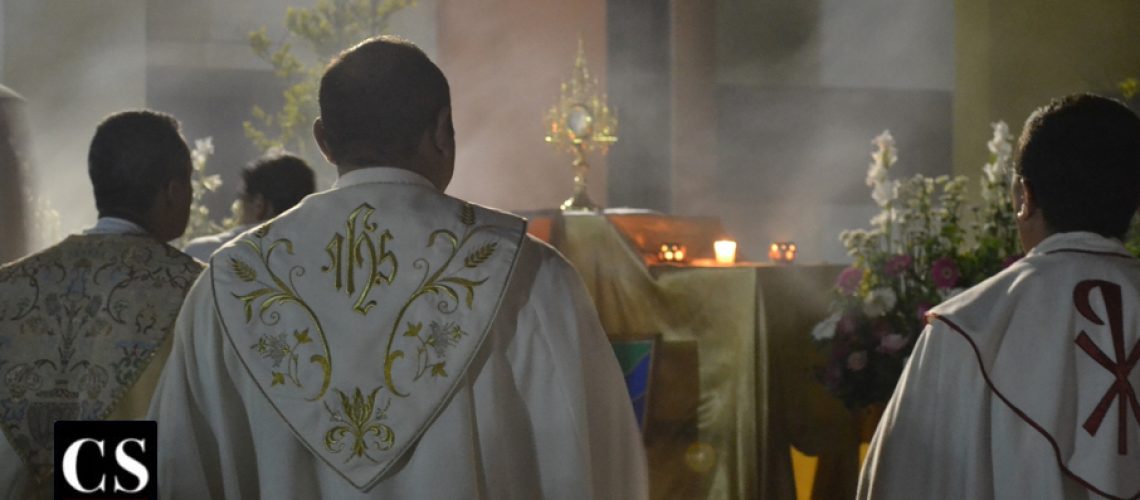
The Tridentine Rite of Mass is the Latin Mass which was celebrated prior to the 1969 introduction of the new form of Mass (the Novus Ordo).
Some Catholics say that they have a right to continue using the older form of Mass.
Is that so?
1. Quo Primum and Perpetual Permission
One argument for a perpetual right is provided by Quo Primum. That is the document published by Pope Pius V, which promulgated the Tridentine missal. It says:
Let Masses not be sung or read according to any other formula than that of this Missal… We order… that nothing must be added to… omitted from… nor changed within it… We grant and concede in perpetuity [perpetuo] that… this Missal… may freely and lawfully be used. (Quo Primum, 1570)
Pius V sounds as if he is granting a perpetual right which prohibits changes and permits the use of the 1570 missal.
As a result, Archbishop Marcel Lefebvre (d. 1991) justified a rejection of the new version of Mass, stating:
I appeal to St. Pius V, who…said that, in perpetuity, no priest could incur a censure… for saying this Mass. (A Bishop Speaks, 1979, Sermon on 29 June 1976)
Yet Pius V, himself, changed his missal barely a year after its publication. Viewing the Battle of Lepanto (1571) as a miraculous intervention of Our Lady of the Rosary, he honored her by adding a feast to the missal.
Once that feast was added, no priest was allowed to claim a perpetual permission to use the original 1570 version of the missal. All priests had to follow the new version.
So, perhaps Pius V did not intend to fix a particular version of a missal in perpetuity? Perhaps he just intended to stop the contemporary liturgical changes and arguments which the Reformation was causing?
2. Perpetuity and Intentions
The importance of clarifying intentions can be seen with another perpetual command. The fourteenth-century Council of Vienne asserted a “perpetual edict” (edicto perpetuo) prohibiting “monks from living alone in houses” (Vienne, 1312, #14).
This edict was intended to prevent monks separating themselves from their monasteries and then treating themselves to scandalous luxurious lifestyles.
But there are other types of “living alone.” In England, for example, Benedictine monks such as Blessed George Gervase ministered to persecuted Catholics by hiding and living alone to secretly provide Mass. He labored selflessly and courageously, and was martyred by public execution in 1608.
It could be said that George Gervase broke the perpetual command of the Council of Vienne. But, arguably, the council did not intend its injunction to apply to his situation.
So, just because an instruction is perpetual, we still need to think about the intention behind the instruction, as there might be a good reason for exceptions.
3. Perpetuity and Exceptions
The thirteenth-century Fourth Lateran Council provides an example of a perpetual prohibition which has exceptions. Dealing with marriage impediments the council said:
Although the prohibition of marriage is now restricted to the fourth degree, we wish the prohibition to be perpetual [perpetuam]. (Lateran IV, 1215, #50)
Lateran IV’s perpetual prohibition continues to make it unlawful for Catholics to marry close relatives. But there can be exceptions.
In medieval politics royal marriages were often linked to international treaties for peace and prosperity. So the common good of nations could be directly affected by whether a marriage took place. The Church never intended its marriage prohibitions to harm the good of nations. So it generally allowed exceptions (dispensations) to its perpetual prohibition for royal marriages. This can be seen clearly in the Spanish Habsburg line which culminated in Charles II (d. 1700).
This shows that there can be exceptions to perpetual prohibitions.
But this example is taken from an Ecumenical Council. Perhaps papal appeals to “perpetual” are stronger and exceptionless?
4. Perpetual and Irreversible?
Some papal uses of the word “perpetual” do seem to imply an irreversibility.
Pope Eugene IV condemned the enslavement of the inhabitants of the Canary Islands. He ordered that they be released immediately to a “perpetual freedom” (Sicut Dudum, 1435, #2). Presumably, a “perpetual freedom” is meant to be one that cannot be reversed, by re-enslaving the freed slaves.
Pope Paul VI distinguished between two types of sterilization, according to whether they were “temporary” or “perpetual,” (perpetuo) (Humanae Vitae, 1968, #14). A perpetual sterilization is clearly meant to be an irreversible sterilization.
These examples show that when a pope says that something is “perpetual” then it can imply that it is irreversible.
But does that irreversibility apply to future popes?
5. Perpetuity and the Franciscans
After the death of St. Francis of Assisi (1226), there were tensions amongst his followers. Some interpreted his views radically, and some took a moderate interpretation.
Towards the end of the thirteenth century Pope Nicholas III tried to arbitrate. He gave a judgement and insisted that all Franciscans must obey it, as it had a “perpetual (perpetue) validity” (Exiit Qui Seminat, 1279, #26).
But disagreements continued. By 1517 Pope Leo X decided to split the Franciscans into two separate branches: Observants and Conventuals.
If Pope Nicholas III’s solution was perpetually valid, how could Pope Leo X ignore it and come up with an entirely different solution?
Pope Leo’s actions only make sense if popes have the power to reverse the perpetual instructions of earlier popes.
Or, perhaps Pope Leo X was acting idiosyncratically in this incident?
6. Perpetuity Can Be Reversed
There are many examples of popes reversing “perpetual” instructions of predecessors.
Pope Julius III declared that the religious vows of the Jesuits were “perpetual” (Exposcit Debitum, 1550, #1). But Pope Clement XIV cancelled all perpetual Jesuit vows when he suppressed the order, leaving them with just the obligations which apply to any other priest (Dominus ac Redemptor, 1773).
Pope Paul VI described priestly celibacy as a “perpetual celibacy” (Sacerdotalis Caelibatus, 1967, #42). But priests can be dispensed from that vow if they are laicized.
Pope Pius IX explicitly notes the reversibility of perpetual sanctions when he referred to those who:
shall incur the penalty of perpetual [perpetuae] disability from preaching… and that it shall not be possible to absolve them from such a penalty, or remove it, save through ourselves, or the Roman Pontiffs who shall succeed us. (Ineffabilis Deus, 1854)
When popes say that something is perpetual, they are asserting a high degree of irreversibility. But future popes can reverse perpetual prohibitions of earlier popes.
Pope Leo XIII is particularly clear that Catholics cannot reject a current pope by appealing to a previous pope’s instructions or injunctions. He says:
It is… far from sincere to set up some kind of opposition between one Pontiff and another. Those who… reject the present one to hold to the past, are not giving proof of obedience to the authority which has the right and duty to guide them;… they resemble those who, on receiving a condemnation, would wish to appeal to a future council, or to a Pope who is better informed. (Epistola Tua, 1885)
7. Vatican I and Papal Supremacy
The First Vatican Council (1870) explains why popes can change perpetual permissions and prohibitions of predecessors.
Vatican I declared that popes have a “supremacy of jurisdiction” across the whole Church. They have “supreme authority” over everything which relates to faith, morals, governance and discipline. This means that they can make whatever judgments are necessary, to resolve disagreements and ensure Church unity (Pastor Aeternus, 1870, chapter 3).
If a past pope could issue binding perpetual permissions or prohibitions, then current popes would not possess the “supremacy of jurisdiction” which Vatican I says that they do possess.
As Pope Pius IX put it:
[The pope] has the right of loosing again what any pontiffs have bound, since this See possesses the right of judging the whole Church, and no one may judge its judgment. (Quartus Supra, 1873, #10)
However, there is one exception to the supremacy of papal powers and that relates to doctrine.
8. Perpetuity and Doctrine
When a pope makes a doctrinal pronouncement, it cannot be changed by a successor.
In 1950, Pope Pius XII said that the doctrine of the Assumption was a Truth. No future pope can ever change that doctrine. This is because changing a truth would make it false, and a belief cannot be both true and false (i.e., contradictory).
Sometimes popes have referred to doctrinal issues as “perpetual.” Pius XI declared that:
[Marriage]… was divinely instituted in such a way that it should carry with it a perpetual [perpetuum] and indissoluble bond. (Casti Connubii, 1930, #34)
The Church cannot change perpetual marriage vows, as the indissolubility of marriage is a doctrine (revealed in the Bible). But the Church can change perpetual religious vows (see section 6) as it has no doctrine saying that they are indissoluble.
Pope Leo XIII described doctrine about Scripture and Tradition as a “perpetually held and professed” belief (Providentissimus Deus, 1893, #1). As it is a doctrine, we know that this perpetuity must be irreversible, but that is not entirely clear from Leo’s language.
To be more precise, Leo XIII sometimes stated that a doctrine is “perpetual and immutable” (Satis Cognitum, 1896, #8), explicitly linking the words to show the irreversibility of a doctrinal perpetuity.
9. Does Quo Primum Establish a Perpetual Right?
Historical examples show that popes can reverse the perpetual permissions and prohibitions of previous popes, as long as they relate to “disciplinary” matters, rather than doctrinal issues.
Could Quo Primum be asserting an irreversible doctrinal perpetuity?
That is implausible because Quo Primum gives permissions and prohibitions which relate to behavior, such as saying Mass, or changing a missal. Behavioral matters are issues of discipline, not doctrine.
This interpretation of Quo Primum was held by the twentieth-century popes who changed the Tridentine liturgy (which Quo Primum promulgated).
In 1956 Pope Pius XII changed the Easter week liturgy. In 1962 Pope John XXIII changed a word in the canon of the Mass. In 1969 Pope Paul VI implemented the new form of Mass. Since then, Popes John Paul I, John Paul II, Benedict XVI and Francis have all accepted the legitimacy of setting aside Quo Primum’s permissions and prohibitions.
During Vatican II, 2147 bishops voted in favor of Sacrosanctum Concilium (1963) with just 4 bishops voting against it. That document authorizes changes to the Mass. So it also represents a judgment by the overwhelming majority of Catholic bishops that Quo Primum is dealing with disciplinary matters which the Church has the authority to set aside.
Even in the nineteenth century, Pope Leo XIII asserted his right to amend the missal “notwithstanding the constitutions of Pope St. Pius V, and other apostolic documents on the reform of the breviary and the Roman Missal” (Grande Munus, 1880, #20).
Pius XII was even more explicit about papal powers over the liturgy:
The Sovereign Pontiff alone enjoys the right to recognize and establish any practice touching the worship of God, to introduce and approve new rites, as also to modify those he judges to require modification. (Mediator Dei, 1947, #58)
These papal comments and actions mean that it is hard to see how Quo Primum could establish perpetual permissions or prohibitions, which could bind future popes.
10. Conclusion: Is There a Right to the Tridentine Rite?
Although Quo Primum cannot establish a right to the Tridentine rite, perhaps the Second Vatican Council could do so?
Vatican II stated:
The sacred Council declares that holy Mother Church holds all lawfully acknowledged rites to be of equal right and dignity; that she wishes to preserve them in the future and to foster them in every way. (Sacrosanctum Concilium, 1963, #4)
Pope Benedict XVI recognized that the Tridentine rite had never been abolished, so it would seem to count as a “lawfully acknowledged rite” (Summorum Pontificum, 2007).
This means that there is an arguable case that it falls under Vatican II’s injunction that it should be “preserved” and “fostered.” Of course, only those who recognize the authority of Vatican II would be in a position to argue such a case.



17 thoughts on “Is There a Perpetual Right to the Tridentine Rite?”
Thank you for this brilliant article and for all of your research. You write that: “Quo Primum gives permissions and prohibitions which relate to behavior, such as saying Mass, or changing a missal. Behavioral matters are issues of discipline, not doctrine.” Therefore it can be reversible, you assert. However a Pope can decide issues of “Faith and Morals” according to the First Vatican Council. Morals include behavior – think of immoral behavior. Oxford dict. for morals: “a person’s standards of behavior or beliefs concerning what is and is not acceptable for them to do.” Ergo Quo Primum is a valid, and possibly infallible, definition based on faith and morals.
Thank you Frank, that’s a thoughtful suggestion. Ethics can indeed involve infallibilities about behaviours, but it only does so when there is an underlying doctrine which is infallible. For example the doctrine that ‘murder is wrong’ underlies the behavioural wrongness of killing a neighbour.
So, if Quo Primum is infallible, then it must express a specific doctrine. But the document seems to just command behaviours. This is why people struggle to articulate a specific doctrine that the document could be (infallibly) teaching.
Furthermore, the words of Leo XIII, the actions of Pius XII and the discussions of Vatican II show that Quo Primum was not traditionally interpreted by popes or bishops as expressing an infallible doctrine. Even bishop Marcel Lefebvre seems to have shared that view when he wrote in 1964 praising the ‘excellent’ proposed changes to the first part of the mass, so that a priest might interact more with a congregation.
The view that Quo Primum is infallible seems to emerge in the post conciliar era.
Rory,
Thank you for your excellent and informative article.
I do not necessarily disagree with anything here but … even in areas of discipline … there must be some level of respect for tradition. So for example BXVI says Priests need no permission to celebrate TLM. PF says no they need permission. If the next Pope decides to do away with the Novus Ordo … but then the next creates a completely new rite the New Novus Ordo if you will and so forth …
If every Pope is a politician that dictates something completely different then what we have had in tradition the idea of truth gets totally annihilated … even if it is “just a discipline.”
So the distinction between discipline and doctrine in this matter seems insufficient …
How does one deal with this?
Yes, I agree that there is a very important issue of ‘respecting tradition.’ Boiling the issues down to disciple vs doctrine is indeed an over-simplification, albeit one focused in this piece upon exploring a specific misunderstanding.
The underlying issues of Tradition and traditions will undoubtedly need significantly more reflection. And Church reflection tends to be measured in ‘longer’ time spans…, so it may be a while before a settled outcome emerges.
How do we deal with the current situation? Perhaps all we can do is work together peacefully and charitably, to create the kind of calm and respectful context of reflection, which is conducive to thoughtful outcomes emerging… ?
Hi Rory,
The TLM and the Traditional calendar are so intertwined that you cannot use the same calendar as the NOM. To do so would do harm to the spirituality of the TLM. I’m not sure why it is even necessary for the TLM to have a similar calendar; the Eastern rites in the Church have their own calendars and it does not seem to fluster anyone.
Regards,
Yvonne
Thanks Yvonne, that’s a very fair point about the difficulties of transposing the old rite to the new calendar – especially as it would involve writing new content for the old missal. I only mentioned it as an example of a possible policy which would have such a significant impact upon the old rite that it could even raise the question in some people’s minds about whether it would amount to a de facto abolishing of the old rite.
However, on the question of the old rite calendar perhaps its worth bearing in mind that there are saints like Padre Pio, who died in 1968 after spending 50 years celebrating the Tridentine rite. Yet he cannot have a feast in a calendar which is frozen to 1962. He isn’t an argument for calendar reform, as the complexities of reform cannot be underestimated. But perhaps saints like Padre Pio are a question about what it means to have a rite which continues to live in the life of the Church?
Hi Rory,
A few years back Pope Francis “freed” the Traditional calendar so new saints can be added. It was stipulated that the calendar would not be forced to accept any specific saint. This allows for organic development within the Traditional rite, which is extremely important for people who attend. Change, per se, is not an issue. Drastic change or change to something fundamental is.
Here is a link that you may find noteworthy:
https://www.vaticannews.va/en/vatican-city/news/2020-03/recent-saints-and-new-prefaces-added-to-1962-roman-missal.html
Regards,
Yvonne
Thank you Yvonne, that was a useful link to add. Yes individual ad hoc additions are possible, but the larger issue is the difficulty, and even impossibility, of continuing to add festivals to an old calendar. What about martyrs of the French Revolution? And martyrs of the Spanish Civil war? And… so on. Its like trying to accommodate new books in an old library. Yes a few can be squeezed in, but at some point it becomes necessary to do a major move or remove of older stock. In fairness this has always been a problem in Church calendars. What it means is that an ad hoc solution of adding festivals ad lib is a temporary fix to a bigger problem which I think you were right to identify as very complicated.
Hi Rory,
I guess I don’t see an issue. There have always been changes to calendars without there being a need for a major overhall. The same principles that have applied in the past can still be applied today. This is not an issue for those who are Eastern Catholic and have long seated calendars; it need not be for us.
Thank you for your exchange and have a blessed weekend!
Regards,
Yvonne
Pingback: VVEDNESDAY EDITION – Big Pulpit
I’m no expert. I have the Ten Commandments, the New Testament, the Holy Sacraments and the Baltimore Catechism. Do I need anything from V2 to gain salvation? No, I do not.
I’m no expert but there is nothing wrong or defective, whatsoever, with the Traditional Latin Mass of the great saints and the great popes. It will survive. Bet on it.
God bless Holy Benedict.
Sometimes I, too, would like to go back to 1962 and first grade in Catholic School. I had a happy home life and the nuns were nice. I got straight A’s. I felt protected, the world was easy to figure out, right was right and wrong was wrong, and things were simple. (Actually they weren’t simple, but a child has only limited knowledge of the world.)
Yes, there is surprisingly little that is necessary. This can be seen in the Japanese Church which survived for centuries amongst laity, completely cut off from the rest of the world.
Makes one wonder how many rites there were around the circle at Stonehenge.
Perhaps there were relatively few rites at Stonehenge, given its ‘open plan’ architecture and the notoriously wet English weather? Even the seventh century missionaries didn’t want to try and convert it to a Church.
Thanks for this exhaustive review.
I assume the “right” to celebrate Tridentine belongs to the bishop, not the laity.
I don’t think Francis will do it, but does a future Pope have the right to forbid Tridentine? It would seem so, since Popes have forbidden other types of Masses.
And what about the (many) versions of the Mass that were still allowed after Tridentine was declared in 1570? Does a bishop have the right to allow celebration of those? That would be interesting.
Thank you Captcrisis, yes the word ‘right’ isn’t quite… right, but it conveys some elements of the issues in a simple way. So Priests might discuss ‘right’ to celebrate, whilst laity ask about the ‘right’ to attend.
And yes, presumably Pope Francis could forbid the Tridentine rite. Perhaps one day it will be revised to share the same calendar as the novus ordo, at which point the 1962 version would be forbidden (?).
When the hierarchy was restored in England in 1850, the Pope asked the English Church if it wanted to revive the medieval Sarum rite. But people were so familiar with the Roman rite that it was thought that it would be unnecessarily disruptive to revert back, so the offer was declined.