
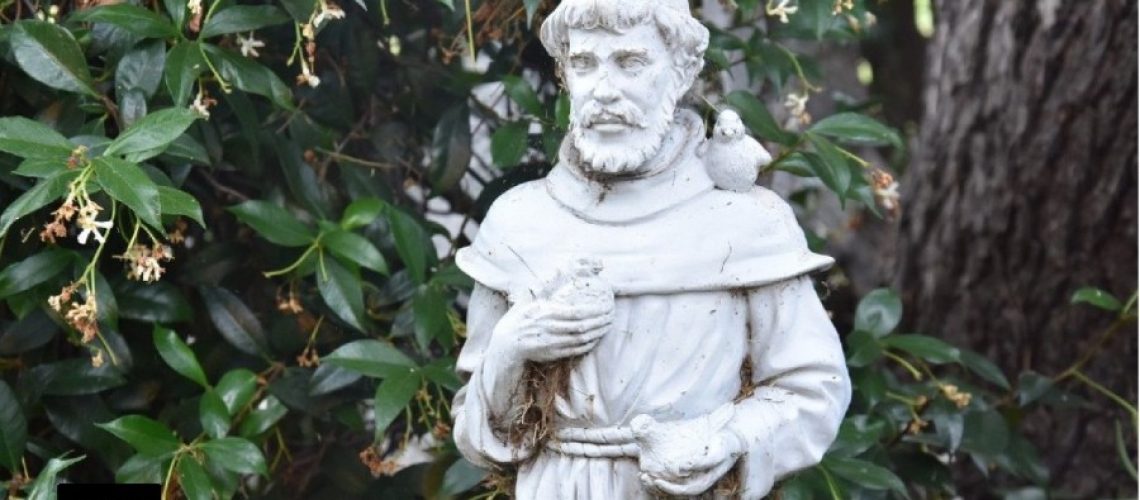
Recently I listened to a talk given at a Franciscan retreat center. I felt right at home among the colorful, sprightly paintings of St. Francis and St. Clare dancing joyfully with the sun and the moon. I had reverted to Catholicism while working at a Franciscan eco-spirituality center, and that is still a huge part of my faith life.
The speaker did not share that affinity. She opened her talk with “We all think of St. Francis as just a nice, hippy guy who talks to animals in the forest like some fairy tale princess, like on those garden statues you used to see everywhere. But he was actually a revolutionary.”
I paused. Where did that animosity come from?
Did she have a problem trusting the historical accuracy of saint hagiography? You can’t hold the Medieval imagination to the standard of our post-Enlightenment understanding of history.
I don’t think the umbrage is with any of those things. I hear comments like this enough that I’ve come up with possibly a too-analytical explanation of what is probably not meant to be dissected too thoroughly.
Are Men Allowed to be Nurturing?
Conversations about gender, and gender roles, are top of mind right now as Catholics listen to the lived experiences of sexual and gender minorities (to use my bishop’s language) and how that relates to Church teaching. Sometimes, when defending male and female as distinct ontological categories, Catholics will assert that gender is a fact of creation that can’t be reduced to stereotypes which change over time. Which I agree with. But elsewhere I notice a seeming resurgence of gender stereotypes.
At least among guys. I have seen “manly” metal rosaries. An increase in rhetoric about men being strong and assertive in comparison to women’s beauty and receptivity. And not to be rude, but if a man has a traditional office job and family obligations and makes time for men’s Bible studies and other groups, I think he probably is not also strangling bears and pumping iron and fighting in underground cage matches. I don’t know why men need these accessories to prove their masculinity if they don’t reflect their daily life. It seems like a distancing from reality.
From people who I notice this impulse in, I often hear cited Protestant author John Eldredge, who in his book Wild at Heart writes “Deep in his heart, every man longs for a battle to fight, an adventure to live, and a beauty to rescue,” and clarifies that this is not true from women because “A man needs a much bigger orbit than a woman.” I have also heard the new age counselor John Gray’s popular book Men are From Mars, Women are From Venus mentioned, in which he says things like “Men are motivated when they feel needed while women are motivated when they feel cherished.” To be fair to these books, I know men who have gotten a lot of motivation and commonsense advice from these sources which has helped them take responsibility for their lives, which is great.
I just think it is not helpful to say that men don’t desire to be vulnerable and cherished, and to say no woman has an adventurous spirit or wants to be needed. I think both men and women have the capacity for these.
St Francis challenges this sensibility. The beauty he pursues is Lady Poverty, as well as Christ. According to St Bonaventure in The Life of St. Francis of Assissi, St Francis
beheld in fair things Him Who is the most fair, and, through the traces of Himself that He hath imprinted on His creatures… (made) of all things a ladder… whereby he might ascend to lay hold on Him Who is the altogether lovely.
This is a beauty as a transcendent mystical experience, not beauty as surface level physical attraction. When Francis is depicted talking to animals, he is not treating them as objects of adventure, but neighbors. I think that Francis subverts, or broadens, the expectations of masculinity put forth by Eldredge and Gray.
While John Paul the Second’s Theology of the Body does insist on a difference between men and women beyond the biological necessities of procreation, it also is nuanced. In his Letter to Women, he writes “woman and man are marked neither by a static and undifferentiated equality nor by an irreconcilable and inexorably conflictual difference” but instead a “relational ‘uni-duality’, which enables each to experience their interpersonal and reciprocal relationship as a gift which enriches and which confers responsibility.” I’m not going to lie and say I fully understand this statement, I do not have a doctorate in Theology, but clearly a “relational ‘uni-duality’” is not reducing men to only strong warriors and women to only gentle nurturers.
But stereotypes are easier to understand than John Paul the Second’s Thomistic phenomenology. I understand why many folks are drawn to the simpler ideas. You can put them into bullet points. And I have nothing wrong with acknowledging that, in general, men have more affinity with certain virtues than women do. But all virtues feed into each other. It takes strength to deny one’s self enough to nurture others. Anyone who’s woken up in the middle of the night to take care of a crying baby knows that. So while allowing that, in general, men and women might have different affinities for different traits, I don’t think it’s helpful to build giant fences between “masculine” and “feminine” traits or virtues.
I personally find it soul-sapping to think that I can’t be masculine and caring at the same time. Genuine strength, that’s not rooted in pride or fear of judgement, naturally flows into gentleness. A Catholic man can spend all day strangling bears with his bare hands, pumping iron, and fighting in sketchy underground boxing rings, and also read poetry and care about the emotional lives of his friends and family. These don’t have to compete in a mature personality.
Okay, okay, you might be saying, now that you’ve worked through your personal insecurities, is there anything edifying about the image of St Francis speaking to animals? Is there something spiritually uplifting about it, or is it just an artistic theme some people like and others dislike?
St Francis as Alter Christus
The Catechism of the Catholic Church tells us that “witnesses who have preceded us into the Kingdom, especially those whom the Church recognizes as saints, share in the living tradition of prayer by the example of their lives” (CCC 2683). Even if that classic image of St Francis, standing with upraised arms preaching to his non-human neighbors, never historically happened, early Franciscan biographers like Thomas of Celano and Brother Leo must have thought these stories reflected something essential about their founder’s spirituality. And St. Francis would not be canonized if following his example did not lead us back to Christ.
I believe there is something Christlike in these images that is worth reflecting on prayerfully. Especially during this Jubilee Year of St. Francis.
In his Letter to the Philippians, St Paul writes
Let the same mind be in you that was in Christ Jesus, who, though he was in the form of God, did not regard equality with God as something to be exploited, but emptied himself… being born in human likeness (Phil. 2:5-7 NRSVCE.)
To me, St. Francis talking to animals is an example of a human having the same mind as Christ.
If you think of the classical Great Chain of Being, with God on top, and angels beneath Him, and humans beneath angels, and animals beneath humans, descending downward in order of importance, God relates to that chain by descending it and identifying- becoming entangled and involved- with beings beneath Him. A person talking to animals models that movement by descending the chain to be with beings beneath him. It means that the cosmic structure of things does not exist to perpetuate exploitation. Jesus says
You know that the rulers of the Gentiles lord it over them, and their great ones are tyrants over them. It will not be so among you (Matt 20: 25-26.)
This popular image of St. Francis illustrates what it means for a human, given dominion over other creatures, to not be a tyrant and to not abuse authority. Which is an important example both for saving our planet and for protecting vulnerable people.
To the extent that we use the chain metaphor in Catholic spaces to explain hierarchies in creation, the emphasis should be on that loving movement. I think of hierarchy as concerning abilities and obligations more than anything else. Animals are able to praise God just by existing, even while they live according to the laws of the Animal Kingdom, which does not follow the Ten Commandments. Humans are capable of more, so more is expected of us. We praise God by conforming out natures to the Church. That applies to the exclusively human community as well. If I babble with a baby, I don’t think I’m better than the baby just because I know more words, but I’m also not going to ask the baby for help doing my taxes.
My concern with Catholic spaces where men playact being more stereotypically masculine than they are, isn’t just that it puts pressure on men with more “feminine” traits and undermines efforts to welcome folks with minority experiences of sexuality and gender into the Church and holy chaste lifestyles, but it also seems like a prideful sense of entitlement. If men and women are naturally, ontologically distinct, then you don’t need to go out of your way to prove that. And if men and women equally reflect God’s image, then there should be no fear of traits or virtues more associated with one than the other, because all virtues are holy.
If we insist on rigidly dividing all traits and virtues into impenetrable, male or female fortresses, then we are not living in reality. This ironically gives weight to the arguments made by secular gender theorists who say gender is only those rigidly divided traits we can put into bullet points, and not something deeper, more mysterious and beyond control. It’s like how fundamentalist creationists and new atheists feed each other by competing on an extremely narrow field that ignores the broader scope of truth. It’s two sides of the same unhelpful coin.
So, let St. Francis talk to animals without being catty about it.


[…] RegisterDepartment of Justice Investigates Vandalism at California Catholic School – The CWRIn Defense of St. Francis Garden Statues – Alex Long at Catholic Stand MagazineSt. John Henry Newman Is Added to the General Roman […]