
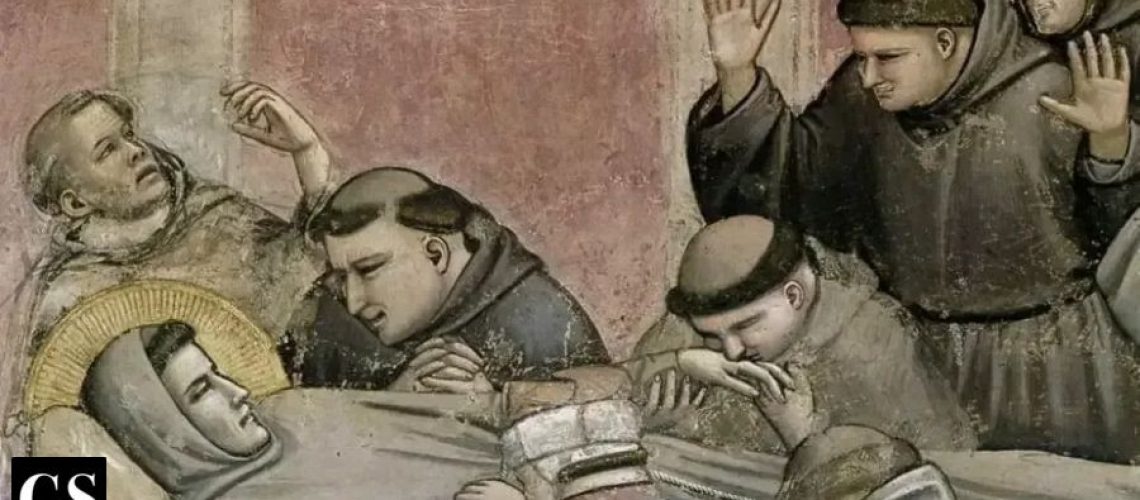
On Saturday 3rd of October 2026, Franciscans throughout the world celebrate their eight hundredth anniversary of the death of St Francis. So I want to take you back with them to introduce you to the events that immediately led up to what Franciscans call ‘The Transitus’ of their beloved Father.
St Francis was staying in the palace of the Bishop of Assisi when suddenly his illness took a turn for the worse and he was plunged into terrible agony. Although he accepted what he had in fact prayed for, he was forced to admit that the sufferings were far worse than the martyrdom that he had once sought with such simplicity. The dropsy that had bloated his lower body seemed to fade away, leaving him looking more like a skeleton than anything else. Thinking he was dying, he placed his hand on Brother Elias, the General of the Order, and blessed him and through him the countless generations of brothers who would follow him in centuries to come. It wasn’t the end but it wasn’t far off, so he begged to be taken to the Portiuncula, the little church that he had re-built with his own hand, many years ago. He saw this little church as the physical centre of his new order so it was understandable that it was here that he wanted to die in the poverty to which he had been accustomed all his life, surrounded by the brothers who loved it as he did.
The long procession that accompanied him came to a halt when it was half way to its destination and Francis was raised up by two of his brothers to gaze upon his beloved Assisi for the last time. He could hardly see the bare Rocca with the remains of the German Castle perched on its peak against the backcloth of the great Monte Subasio, with the hermitage of Le Carceri buried into her side. The walls he’d helped to build in his teens still frames an idyllic view of the town with its mediaeval houses huddled around the towers of the Cathedral of San Rufino where he was baptised. To the far right, outside the walls, was San Damiano that he had rebuilt with his own hands after he had heard Jesus speak to him from the cross. Clare and her community were living there now eager to hear any word about his well-being and his whereabouts and storming the gates of heaven on his behalf.
When he was settled into a small hut a few feet away from the little chapel of St Mary of the Angels he insisted that he should be placed naked on the ground. When he was given clothes to wear, but warned under holy obedience that they were not his to give away, he was overcome with a frisson of joy that reverberated through his emaciated body. Now he was indeed at home again away from the Bishop’s Palace and back in a squalid little hut surrounded by all that would please his ‘Lady Poverty’. For those of us who have never travelled further than the foothills of the spiritual life it is all but impossible to appreciate that for those who have reached the heights, their greatest joy is to express the otherworldly love that envelops them. Pleasure in suffering, which might elsewhere been seen as some perverse masochistic fetish, is for one who is bursting and brimming over with spiritual joy the only way to express their gratitude for the inexpressible love that they experience. Their joy is to suffer, at least for some of the time!
When he was placed into his simple bed he forgave all who asked his forgiveness and blessed all absent brothers who could not be there. Then he had a special blessing for Brother Bernard who was the first to give all his money away and embrace ‘Lady Poverty’ with him, and he commanded that all the Brothers in the order should honour Bernard as if he were himself. His thoughts were then with Clare and her community at San Damiano and he sent her a message promising that they would see his body before the burial. He was in the middle of writing a letter urging Brother Jacoba, the Roman Aristocrat who had followed him all her life to come quickly, if she was to see him alive, when to his surprise and joy she arrived with her retinue and her two sons, alerted by news of his mortal illness. She had brought all that was necessary for his funeral, including a cushion for his head in the coffin that he never permitted himself when he was alive, a veil for his face and a haircloth shroud. She also brought all the candles necessary for the funeral and for the wake and, confident that she would find him still alive, she brought some of the ‘sugared almonds’ that he had loved as a rare treat when he had visited her in Rome. Although no woman was allowed in the Portiuncula, an exception was made for Brother Jacoba who knelt at the bed of Francis bathing his body with her tears in such a way that her behaviour was later likened by the friars to Mary Magdalene at the feet of Christ. At her presence he seemed to rally for a while and she had thoughts of returning to Rome, but he knew the end wasn’t far off and he begged her to remain.
As the end drew near the strains of his ‘Canticle to Brother Sun’ could be heard coming from his poor abode with the verses that he had added in praise of ‘Sister Death’. On Friday October 2nd he re-enacted a scene from the Last Supper. Taking bread he broke it and shared it with the brothers who surrounded him. The following day at his request the Passion of St John was read to him. Then when he knew that ‘Sister Death’ was about to arrive he asked the doctor to announce her arrival and he opened his arms to welcome her and welcome her with joy, because it was she who was going to lead him to the gates of Eternal Life.
Acting on his orders Francis was stripped and laid down on the ground as naked as Brother Jesus had been when he was born into poverty and as naked as he had been when he died on the cross. Then, according to his wishes, dust and ashes were sprinkled over him as in no more than a whisper he intoned psalm forty-one – “Voce mea ad Dominum clamavi”- “With my voice I cry out to the Lord.” When his brothers bent over him at the end of the psalm it was to see that his prayer had been answered, ‘Sister Death’ had indeed led him to the gates of Eternal Life. The silence that followed was only broken by his favourite birds – a flock of larks which descended on the roof of his hut. They sang like larks ascending, half in sadness half in joy, as their brother ascended to the place whence they had all ultimately been conceived and into the Brother in whom they had all been created.
Once a body is relieved of the suffering that precedes death it often seems that it is bathed with a bygone beauty, as the muscles, that were recently so tense and tort trying to bare the pains of the final agony, relax and are at rest. By all accounts this was true of Francis, but there was something further. His whole body, once weather-worn and swarthy, seemed to take on the hew of pure white marble. In stark contrast to the black nails that remained embedded in the flesh, it seemed to be as white as snow and all but translucent. Later Brother Leo was to liken his body, at that moment, to the body of Christ when it was taken down from the cross and placed in Mary’s arms.
The contemporary descriptions remind me of that artistic masterpiece painted by Cimabue that stands in the apse of the church of La Santa Croce in Florence. The crucified Christ is depicted on the cross the very moment after his death. Despite the nails that keep the body fixed spread-eagled to the post and crossbeam it is nevertheless soft and supple now that the ravages of death have passed. But further to this, the delicate work of the master craftsman has made the body look transparent, as if you were gazing upon it at the very moment when it was beginning to fade away into another dimension. It is the closest that I have ever seen to a depiction of the beginnings of the glorification that began the moment Christ died.
The next day a massive procession of friars and towns folk followed the body of Francis to its place of temporary burial in the church of San Giorgio where St Clare had first heard him speak. This was of course not before the cortège had stopped at San Damiano, so that St Clare and her community could say their last farewells. Like Brother Jacoba, Clare bathed his body with her tears and reverently kissed the marks made by the stigmata.
During the days that followed his burial it was as if a heavy black pall was spread over the little Umbrian town. But gradually the pall lifted, lightened and evaporated to be replaced by a distinctive aura that to this day seems to surround and pervade Assisi. It is an aura of peace, the peace ‘that surpasses the understanding’, that speaks even to the most sceptical of the visitors, of the one characteristic above all others that impressed all who met the supreme ambassador of peace who once lived there. On July 16th 1228 Gregory IX, the one time Cardinal Hugolino, friend of Francis and protector of the order, canonised this ‘ambassador of peace’ and two years later on May 25 1230 his body was taken for burial to the newly completed Basilica of San Francesco.
With the agony and the ecstasy of the last years that Francis spent on earth there was a certain holy truce that bound all his family together as one. The stigmata, the only one that the church has ever officially recognised, seemed to have stamped the divine approval on his teaching in such a way that what was questioned before was now hardly questioned at all, at least for the time being. However, as so often happens once the funeral is over, family squabbles begin to assert themselves. Soon separate factions began to voice the different interpretations of how the teaching and the way of life of Francis should be understood in an ever-expanding religious order. The massive proliferation of writings that were produced within a generation of his death was witness to the myriad differences that threatened to destroy the order.
In the immediate aftermath of his funeral there can be no doubt that the spirit of the primitive observance lived on amongst the three companions, Brother Leo, Brother Angelo and Brother Rufino and those who looked to them for leadership. In the second order that same spirit lived on in St Clare and in her devoted sisters at San Damiano and in the third order it found a unique embodiment in Brother Jacoba, who did not return to Rome, but stayed on in Assisi where she lived out the rest of her life. Her home became the meeting place for the many faithful followers of Francis and her presence was a continual support to all who turned to her for whatever help she was able to provide. It would seem that she outlived St Clare, who died in 1253 and Brother Leo who died in 1274.
Although, in the centuries that followed, the authentic spirit of Francis was regularly diluted beyond all recognition this was happily not the whole story. Virtually every generation of Franciscans has produced its own reforms and its own reformers, eager to replicate in their own lives the primitive way of life that had first inspired Francis. The histories of these movements are deeply inspiring, but it is a history that will have to be explored elsewhere. What is written here is just to remind us today of the moving death of the man who the Medievals called ‘The Second Christ’.

