
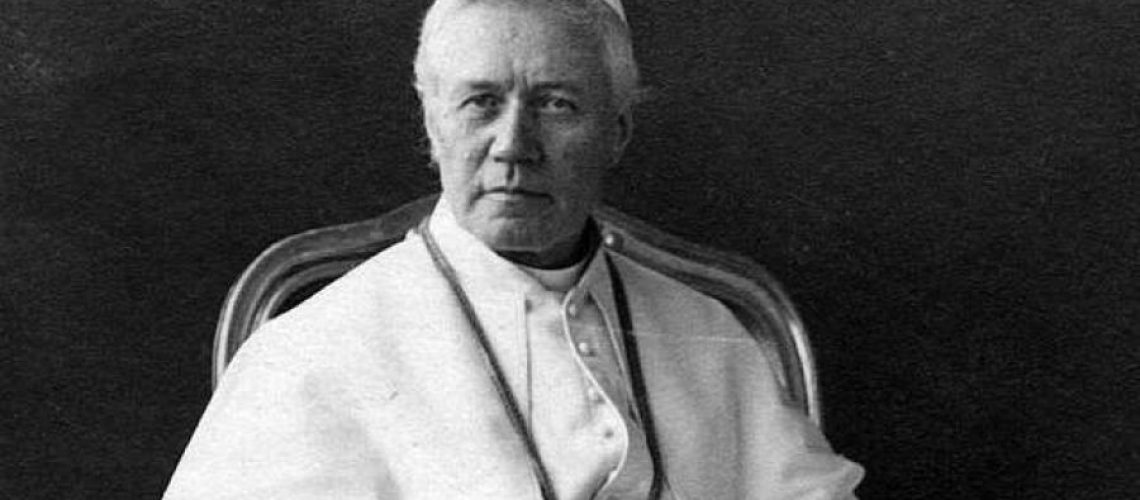
In the late 19th and early 20th century, the philosophy of “Modernism” was creeping into the Church. Its proponents spoke of a God within rather than an external God. These priests and laity championed the idea that Church teaching must evolve with the times. Wikipedia describes Modernism as “attempts to reconcile Catholicism with modern culture, specifically an understanding of the Bible and Sacred Tradition in light of the historical-critical method and new philosophical and political developments of the late 19th and early 20th centuries.” A central theme of Modernism was the idea that truth was subjective rather than objective.
The National Catholic Register states that Pope Pius X “who reigned as pope from 1903 to 1914 after the death of Pope Leo XIII, took charge of the Church in the aftermath of the Enlightenment era, which had spurred rationalist and liberal movements throughout Europe and the Americas.”
At this time, many priests and scholars were disobeying the Pope and his teaching. Some simply ignored him as outdated and out of touch, while others openly spoke confrontationally. These learned scholars of the day sought to undermine the leadership role of the Bishop of Rome.
In 1912 Pope Pius X gave a talk to members of the Apostolic Union of Clergy, a confraternity of secular priests in union with the Holy See. In his talk, Pope Pius X stated, “It seems incredible, and it is painful, that there are priests to whom this recommendation should be made, but unfortunately in our days we are in this harsh, unhappy condition of having to say to priests: love the Pope! And how are we to love the Pope? Not in word, nor in tongue, but in deed and truth. When one loves a person, one tries to conform to their thoughts in all things, to carry out their wishes, to know their desires. And if our Lord Jesus Christ said of Himself: If any one love Me, he will keep My word, to demonstrate our love for the Pope it is necessary to obey him.”
Obedience to the Pope is required from all sides. In this example, Pius X was condemning liberal purveyors of Modernism and their efforts to undermine core Catholic teaching. He could have just as easily been condemning modern day schismatics who disavow Church Councils and the authority of the Pope. For the one true and Holy Church to survive over 2,000 years and until the end of time, it will inevitably find itself under assault from all sides.
Perhaps no greater loyalty in recent memory was demonstrated by the beloved Saint Padre Pio of Pietrelcina. Padre Pio’s Holiness was unmatched. And yet, jealous and misguided powers in the Church persuaded Pope Benedict XV to punish Padre Pio and suspend his faculties. Padre Pio obeyed. He was Holy and innocent, but he obeyed the Pope. His loyalty paid off and he was eventually exonerated.
Disloyalty when one is on the wrong side of history is a whole other matter. The complaints of the Society of St. Pius X no longer center on Liturgy. An estimated 500,000 – 1,000,000 Catholics not affiliated with the SSPX attend authorized celebrations of the Traditional Latin Mass (TLM). The current complaints of the society focus on statements made by the Second Vatican Council regarding collegiality, ecumenism, and religious liberty.
The SSPX argues against what the call “collegiality.” They claim that the Second Vatican Council states that a “strict democratic process should govern the church at all times. The Pope is thus free to have his say, but his cardinals and bishops must always be allowed to voice their own opinions as well.” This is truly the opposite of what is stated in the primary document of Vatican 2, Lumen gentium. After a very brief history of the “collegiate character and aspect of the Episcopal order; and the ecumenical councils,” Lumen gentium paragraph 22 states, “But the college or body of bishops has no authority unless it is understood together with the Roman Pontiff, the successor of Peter as its head. The pope’s power of primacy over all, both pastors and faithful, remains whole and intact. In virtue of his office, that is as Vicar of Christ and pastor of the whole Church, the Roman Pontiff has full, supreme and universal power over the Church. And he is always free to exercise this power.” This clearly refutes the SSPX claim that Vatican 2 called for a democratically governed Church.
The second argument the SSPX makes against Vatican II is regarding ecumenism. The SSPX claim that the Vatican II document on ecumenism, Unitatis Redintegratio, states that “all religions are more or less good or praiseworthy and even portends to quote the document by selectively copying text saying, “Separated communities and churches as such …have been by no means deprived of significance and importance in the mystery of salvation. For the spirit of Christ has not refrained from using them as means of salvation.” According to the SSPX, “Clearly this leaves no place for the defined dogma, ‘Outside the Church, no salvation.’”
However, the SSPX article excludes critical language in their use of a deceptively placed ellipsis. The actual Vatican document states in full, “the separated Churches and Communities as such, though we believe them to be deficient in some respects, have been by no means deprived of significance and importance in the mystery of salvation.” The document continues:
Nevertheless, our separated brethren, whether considered as individuals or as Communities and Churches, are not blessed with that unity which Jesus Christ wished to bestow on all those who through Him were born again into one body, and with Him quickened to newness of life – that unity which the Holy Scriptures and the ancient Tradition of the Church proclaim. For it is only through Christ’s Catholic Church, which is “the all-embracing means of salvation,” that they can benefit fully from the means of salvation. We believe that Our Lord entrusted all the blessings of the New Covenant to the apostolic college alone, of which Peter is the head, in order to establish the one Body of Christ on earth to which all should be fully incorporated who belong in any way to the people of God.
This is pretty clear language the SSPX ignores. The Vatican II document is simply recognizing some possible fruits from other faith traditions, such as bible study and charity, but makes clear it is only through the Catholic Church that “they can benefit fully from the means of salvation.”
The third objection of the SSPX is regarding what they call religious liberty. They claim there is a contradiction between what the Second Vatican Council said about religious Liberty and how prior Popes had spoken against religious indifferentism. For example, in 1864 Pope Pius IX released his Syllabus of Errors which condemned the idea “that every man is free to embrace and profess that religion which, guided by the light of reason, he shall consider true.”
However, the Vatican II document Dignitatis Humanae, which the SSPX refers to actually states, “We believe that this one true religion subsists in the Catholic and Apostolic Church, to which the Lord Jesus committed the duty of spreading it abroad among all men.” The religious freedom it speaks of is to be free from coercion by the state. The freedom from coercion is different than the freedom to consider any religion as true. Dignitatis Humanae further states “religious freedom, in turn, which men demand as necessary to fulfill their duty to worship God, has to do with immunity from coercion in civil society. Therefore it leaves untouched traditional Catholic doctrine on the moral duty of men and societies toward the true religion and toward the one Church of Christ.” This is a far different definition of religious freedom that the SSPX accuses Vatican II of promulgating.
It is ironic that a society which claims to adhere to the Truth of the Catholic Church would find itself is such contradiction with the saint from whom they chose their name. Not only does the society contradict and disobey the Pope, but they lead their trusting flock into schism and error. Saint Pope Pius X said, “This is the outpouring of a sorrowful heart, which with profound bitterness I … deplore the conduct of so many priests, who not only allow themselves to discuss and scrutinize the wishes of the Pope, but are not ashamed to arrive at impudent and brazen disobedience, with much scandal and with much ruin of souls.” Saint Pope Pius X spoke prophetically of the treatment of his successors when he said,
When you love the Pope, you don’t say that he didn’t speak clearly enough, almost as if he were obliged to repeat in everyone’s ears that which will be clearly expressed so many times not only orally, but in letters and other public documents.


There was Liturgical abuse prior to Vatican 2. There was Liturgical abuse after Vatican 1, after Nicaea, After Trent, and After Jerusalem. There are always bad actors and mistakes, but the gates of Hell will not prevail because the Holy Spirit is with the Church. Following a schismatic sect never ends well for anyone in history. Ordination of bishops without a Papal mandate pretty much says you are no longer Catholic. Oboedientia et pax!
I can’t believe that there are still people who want to defend that worthless council after all this time. What a waste of breath, a waste of ink, and a waste of mental energy. “But the council used these words!” means exactly nothing. What matters is what was done in the real world beyond the correct verbal formulae. Give it up, already. This is tedious. And thank God for the SSPX, without which genuine Catholicism would have completely disappeared from the developed world by now.
yes, they have continued to carry the torch from the original dark years to the new current dark years.