
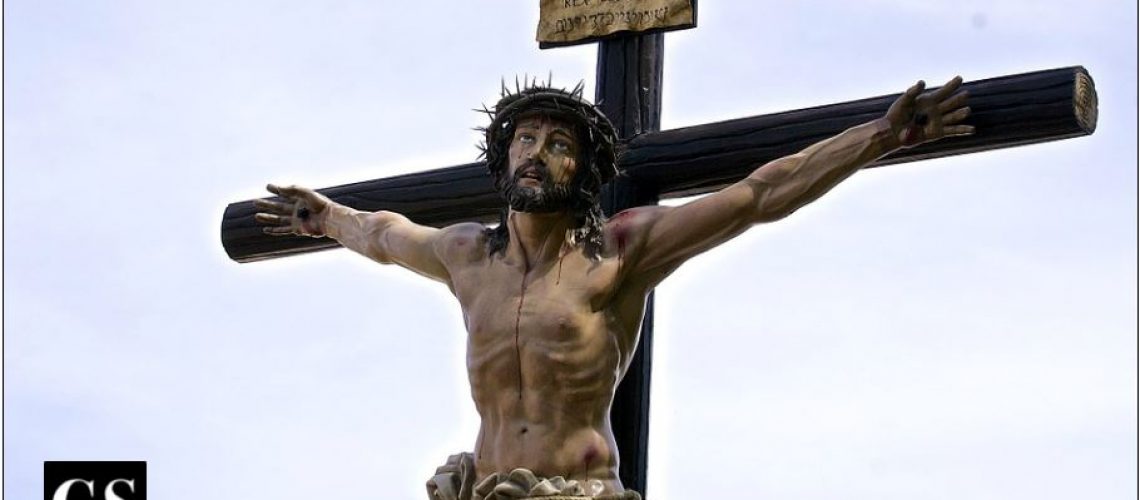
Crossing the Tiber is a euphemism for becoming a Catholic. Normally, a Protestant or other non-Catholic will attend Order of Christian Initiation of Adults (OCIA) classes for nine months and then get baptized, confirmed, and receive Holy Communion on Holy Saturday. All of this is great, but hardly anyone realizes that upon becoming Catholic, you also receive a heavy cross: the cross of future suffering. “Pick up your cross and follow me,” said Jesus in Matthew 16:24. This is a euphemism for uniting your suffering with that of Christ’s great agony. Colossians 1:24 talks about Paul: “Now I rejoice in my sufferings for your sake, and in my flesh I complete what is lacking in Christ’s afflictions for the sake of his body, that is, the church.” What this means is that OUR suffering in union with His makes Jesus’ sacrifice on the cross complete. This article will discuss the power of the cross.
Divinization
The goal of this life is divinization, to become like God as much as possible through His free gift of grace. If we would truly aspire to be made over into His image and likeness, then we must realize that His image and likeness is divine, not human. Of course, God is divine by His very nature; we would be divinized through the power of sanctifying grace, which is a share in His divine life. The more grace we accept through the sacraments, our faith, and obedience to His will, the more divinized we become. 1 Corinthians 6:17 says that “he who is united to the Lord becomes one spirit with him.” So how do we go from having a human (sinful) nature to becoming divinized (perfection)? Surely the grace-filled sacraments are part of that equation, but something else that is required is suffering (the Cross).
The Cross is The Way
When Jesus said to “Pick up your cross and follow me,” he meant that He is heading to His cross on Calvary to crush the head of Satan, and we are to follow in His footsteps. In Genesis 3:15, the Bible says that the seed of the Woman will crush the head of the serpent. (This woman has to be Mary, as no other women have seeds; they have eggs. Mary is The Woman of Genesis 3:15, because she conceived Jesus without the seed of a man, but virginally.) Mary’s seed is Jesus, and that head crushing was accomplished with the cross at Golgotha, “The Place of the Skull.”
Absolutely no one likes to suffer here on earth, but God knows that suffering brings us closer to Him. Time after time, God, who enables countries to go from poverty to abundance and to become prosperous by His grace, is always pushed to the side. The pursuit of wealth, luxury, and prosperity then take over. This pattern happened in the Bible with Israel, has happened in Europe, and is now happening here in the United States. In other words, the cross gives way to the easy chair.
The Geometry of the Cross
The cross is made up of two beams. The vertical beam represents God reaching down to man through the giving of grace and man reaching up to God with prayers of adoration, contrition, thanksgiving, and supplication; AND the horizontal beam represents man reaching out to man in love and forgiveness. When looked at from afar, these two lines form a huge plus sign in our lives. If the vertical beam is taken away and only the horizontal beam is left (man reaching out to man), a huge minus sign is formed in our lives. This sign means that God will one day withdraw His graces from us and then all hell will break loose in our homes, our families, and our country. ALWAYS strive to have both beams, because doing so fulfills Jesus’ two commandments of loving God with our whole mind, heart, soul, and strength and loving our neighbor as ourself.
Different Types of Suffering
Some people suffer as a direct result of their sins, including me. A law in physics says that for every action there is an equal and opposite reaction. This truth also exists in the spiritual world, although the suffering we endure for our sins seems to be anything but equal to the pleasure we once got out of our sins. In fact, for every ounce of pleasure I derived from sin, the payback was 1000 times worse.
Others suffer voluntarily through fasting or some other kind of self-imposed denial of a good. Some even wear a hairshirt, which is like a “pebble in your shoe” for your upper torso.
And then some people are victim souls who are chosen by God. These people suffer greatly their whole lives to make up for the sins of others they don’t even know!
The Bible and the Cross
“He himself bore our sins in His body upon the cross, so that, free from sin, we might live for righteousness. By His wounds you have been healed.” (1 Peter 2:24)
“For the word of the cross is folly to those who are perishing, but to us who are being saved it is the power of God.” (1 Corinthians 1:18)
“For he is our peace, who has made us both one, and has broken down the dividing wall of hostility, by abolishing in his flesh the law of commandments and ordinances, that he might create in himself one new man in place of the two, so making peace, and might reconcile us both to God in one body through the cross, thereby bringing the hostility to an end.” (Ephesians 2:14-16)
St. Thomas Aquinas’ Holy Advice
“If you would like to know God, look at the crucifix! If you would like to love God, look at the crucifix! If you want to serve God, look at the crucifix! If you hope for eternal Happiness, look at the crucifix! If you wonder how much God loves you, look at the crucifix! If you wonder how He tries to prevent you from the yawning jaws of hell, look at the crucifix! If you wonder how much He will help you to save your immortal soul, look at the crucifix! If you wonder how much you should forgive others, look at the crucifix! If you wonder how much your faith demands of you, in humility, poverty, charity, meekness and every virtue, look at the crucifix! If you want to know what unselfishness and generosity are, look at the crucifix! If you wonder how far your own unselfishness should go to bring others to Christ, look at the crucifix! If you want to understand the need for self-denial and mortification, look at the crucifix! If you wish to live well, look at the crucifix! If you wish to die well, look at the crucifix!”
+ St. Thomas Aquinas, priest (1225-1274 A.D.)
Wisdom of the Saints Regarding the Cross
- “The cross is the glory of all the apostles, the crown of the martyrs, the sanctification of the saints.” + St. Theodore the Studite, bishop (759-826 A.D.)
- “The cross is the Father’s will, the glory of the only begotten, the joy of the Spirit, the pride of the angels, the guarantee of the Church, Paul’s boast, the bulwark of the saints, and the light of the entire world.” + St. John Chrysostom, bishop (347-407 A.D.)
- “Had there been no cross, death would not have been trodden underfoot, nor hell despoiled. Therefore, the cross is something wonderfully great and honorable.” + St. Andrew of Crete, bishop (650-712 A.D).
- “The Catholic Church glories in every deed of Christ. Her supreme glory, however, is the cross.” + St. Cyril of Jerusalem, bishop (315-387 A.D.)
- “No type of cruelty can tear down the religion established by the mystery of Christ’s cross.” + St. Leo the Great, pope (400-461 A.D.)
- “For our sake Christ offered himself to the Father upon the altar of the cross.” + St. Thomas Becket, bishop (1118-1170 A.D.)
- “In the cross there is no mingling of good and evil, as in the tree of paradise: it is wholly beautiful to behold and good to taste.” + St. Theodore the Studite, bishop (759-826 A.D.)
- “Christ’s glory is his cross and his exaltation upon it, as he plainly says: When I have been lifted up, I will draw all men to myself.” + St. Andrew of Crete, bishop (650-712 A.D.)
- “On the cross Christ effected a great exchange. There the purse containing the price to be paid for us was opened.” + St. Augustine, bishop (354-430 A.D.)
- “The cross stands for Christ’s suffering because on it he freely suffered unto death. But it is also his trophy because it was the means by which the devil was wounded and death conquered.” + St. Andrew of Crete, bishop (650-712 A.D.)
- “The cross is honorable because it is both the sign of God’s suffering and the trophy of his victory.” + St. Andrew of Crete, bishop (650-712 A.D.)
- “The cross was the tree on which Christ, like a king on a chariot, destroyed the devil, the Lord of death, and freed the human race from his tyranny.” + St. Theodore the Studite, bishop (759-826 A.D.)
- “The cross is our trophy raised against the demons, our sword against sin, and the sword of Christ used to pierce the serpent.” + St. John Chrysostom, bishop (347-407 A.D.)
- “No one, however weak, is denied a share in the victory of the cross.” + St. Leo the Great, pope (400-461 A.D.)
- “It was clear through unlearned men that the cross was persuasive, in fact, it persuaded the whole world.” + St. John Chrysostom, bishop (347-407 A.D.)
- “No one should be ashamed of the cross of Christ, through which the world has been redeemed.” + St. Leo the Great, pope (400-461 A.D.)
- “Anyone who refuses to admit the testimony of the cross is of the devil.” + St. Polycarp, bishop and martyr (69-155 A.D.)
- “What is water without the cross of Christ? Only an ordinary element without sacramental effect.” + St. Ambrose, bishop (340-397 A.D.)
- “My spirit is given over to the humble service of the cross which is a stumbling block to unbelievers but to us salvation and eternal life.” + St. Ignatius of Antioch, bishop and martyr (35-98 A.D.)
- “By the cross we, the sheep of Christ, have been gathered into one flock, destined for the sheepfolds of heaven.” + St. Theodore the Studite, bishop (759-826 A.D.)
- “How marvelous the power of the cross; how great beyond all telling the glory of the passion: here is the judgment seat of the Lord, the condemnation of the world, the supremacy of Christ crucified.” + St. Leo the Great, pope (400-461 A.D.)
- “You have observed Christ’s outstanding triumph, the splendid achievement of the cross.” + St. John Chrysostom, bishop (347-407 A.D.)
- “The cross of Christ’s passion is his invitation to you who are the members of his body.” + St. Ignatius of Antioch, bishop and martyr (35-98 A.D.)
- “Whoever wishes to live perfectly should do nothing but disdain what Christ disdained on the cross and desire what he desired, for the cross exemplifies every virtue.” + St. Thomas Aquinas, priest (1225-1274 A.D.)
- “God grant that our hearts may find no rest and seek no other food in this world, save in hardship and suffering beside the Lord’s cross.” + St. John of Avila, priest (1499-1569 A.D.)
Summary
Except for fasting and self-denial, we shouldn’t go out and seek crosses. God will send us crosses perfectly suited for us that more than likely will be the polar opposite of the particular vice that we need to overcome. So when you get your cross, bear it patiently, and unite it to His cross with a smile and a “thank you”! Many graces will then come your way!


Awesome Ray.
Thanks Maureen!