
Classical thermodynamics… is the only physical theory of universal content which I am convinced… will never be overthrown (Albert Einstein).
CONVERSION FROM SCIENTISM
My conversion wasn’t from Judaism to Catholicism—I was an ethnic Jew, not a religious one. It was from scientism: the faith that physics could explain everything that mattered. Old faiths leave stains clouding our vision, and thirty years after entering the Church, I still think in terms of thermodynamic analogies.
Each Lent I recall my first Ash Wednesday 31 years ago, before I was formally received into the Church. Not quite sure what to do or say, I received the prompting (and ashes) from the priest in good grace and went back and prayed for enlightenment about what it all meant. As I replay the scene in my mind, I wonder, was my spiritual state changing during this conversion? If so, it was a gradual, not a sharp, discontinuous change. More like liquid water cooling, the random motion of the water molecules slowing down, until finally the liquid turns to ice and the H₂O molecules are in a nice ordered array. No visions, no blinding lights, just thoughts about what faith in Jesus Christ entailed—enlightenment increased as I pondered the mystery of Christ’s suffering for us and The Resurrection.
VISIONS AND CONVERSIONS
I also think about those who have sudden conversions, visions of our Lord or His mother. Three instances come to mind, among several others—Rabbi Israel Zolli, Alphonse Ratisbonne and Andre Frossard:
Rabbi Israel Zolli was the Chief Rabbi of Rome during World War II. In his autobiography, Before the Dawn, Zolli said that while presiding over the religious service in the synagogue on the holy day of Yom Kippur in 1944, he experienced a vision of Jesus. In that vision, Jesus said to Zolli: “You are here for the last time.” Zolli and his wife converted to Catholicism.
Alphonse Ratisbonne, whose family were wealthy Jewish bankers. On January 20, 1842, while waiting in the Church of Sant’Andrea delle Fratte for a friend, he experienced an instantaneous vision:
I had only been in the church a short while when, all of a sudden, I felt totally uneasy for no apparent reason. I raised my eyes and saw that the whole building had disappeared. Only one side chapel had, so to say, gathered all the light. In the midst of this splendor, the Virgin Mary appeared standing on the altar.
He became a Jesuit priest and later co-founded the Congregation of Our Lady of Sion.
André Frossard was raised as a complete atheist in an environment where religion wasn’t even worth opposing. His father, Louis-Oscar Frossard, was one of the founders of the French Communist Party and served as its first Secretary-General. On June 8, 1935, Andre entered a chapel in Paris and he saw a vision:
Having entered a chapel in the Latin Quarter of Paris at 5:10 in the morning to look for a friend, I left at a quarter after 5 in the company of a friendship that was not of this earth.
THE PARABLE FROM THERMODYNAMICS AND INFORMATION THEORY
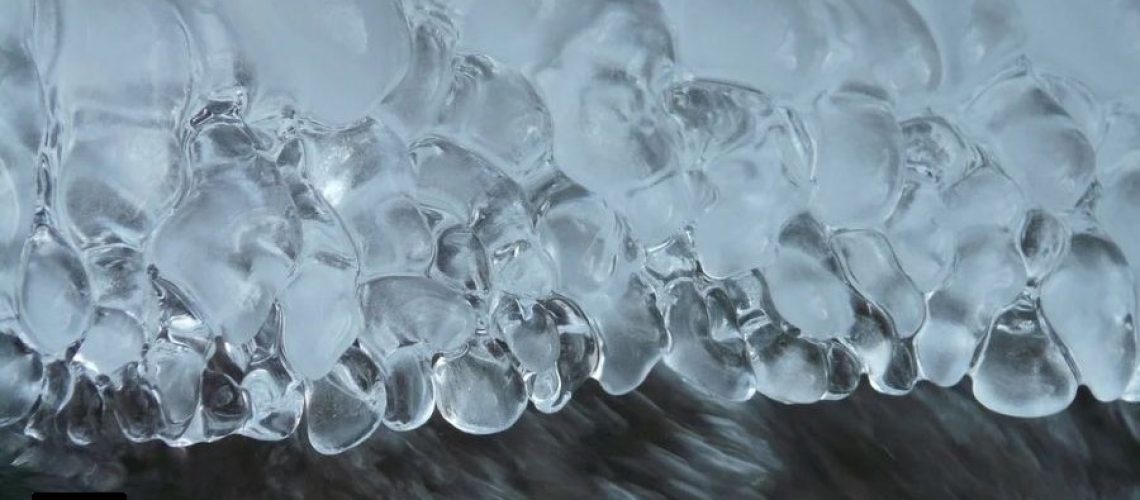
What thermodynamic process do these accounts remind me of? Supercooled water comes to mind. Very pure water can be chilled to temperatures below the normal freezing point of 0 degrees C. If the water is shaken or something added to it, ice will form and in so doing heat is released (remember: you have to add heat to melt ice, so the reverse process will release heat) and the temperature of the water (ice) rises until it reaches the normal freezing point. So, this sudden freezing I take as an analog of the sudden conversion.
Here is the thermodynamic moral or parable I want to make. There are two states, initial: liquid water at a temperature above the freezing point; final: ice at its normal freezing point. There is an entropy decrease in going from liquid water to solid, crystalline form, ice. This entropy change depends only on initial and final states, not on the path (process) taken in going from one to the other. Thus the entropy change is the same for both gradual cooling/gradual freezing and supercooling/sudden freezing. The decrease in entropy can be taken as an increase in our information about the system.
Since the relation of entropy to information is the crux of this parable, let me explain briefly what that relation entails. Entropy is a measure of disorder; the more disordered a system is, the greater its entropy. Information is a measure of what we know or can predict about a system; the more disordered a system the less we know of it or can predict about it. Thus liquid water with randomly moving H2O molecules is more disordered than ice, solid water where the molecules are at fixed, defined positions. We have more information about ice than about liquid water; the entropy of ice is less than that of liquid water.
If we take enlightenment and information as equivalent in this parable, then the moral is clear. Enlightenment, spiritual change can take place suddenly via a vision or more gradually after study and meditation. Saint John Henry Newman came to the Catholic faith after a long period of study and reflection. St. Augustine’s journey was more like supercooled water suddenly freezing. But both are Doctors of the Church with all that means. In both the random motion of doubt and uncertainty was replaced by an ordered structure of faith. And, to go beyond the parable, spiritual growth does not end at conversion.
LENT AND CONTINUING CONVERSION
This Lenten season, thirty-one years after that Ash Wednesday, I’m reminded that conversion isn’t finished. Each Lent offers another decrease in spiritual entropy as we move closer to the ordered beauty of holiness. I continue to learn, to understand, to explore the mysteries of our Catholic faith, renewed each Lent by reflection and meditation. Whether our conversion was gradual like Newman’s or sudden like Zolli’s or Ratisbonne’s, we arrive at the same final state of enlightenment—the same crystalline structure of faith, the same apostolic teaching, the same sacraments, the same Church.


[…] pulls objects toward each other, ensuring planets orbit stars. Thermodynamics, as Bob Kurland recently explained here at CS, dictates energy flow, from heat transfer in engines to the cooling of […]
[…] *Previously published on Catholic Stand 19/2/2026 […]
[…] WeltgeistDemoniac: The Beginning of a Long Road to God – Nathan Krupa at The Country DiscipleConversion: A Thermodynamics Parable – Bob Kurland, Ph.D., at Catholic Stand Magazine9 Things to Ask the Sacred Heart in These […]
On a lighter note, this must be the case where the ‘salt of the earth’ doesn’t offset all that entropy going on.