

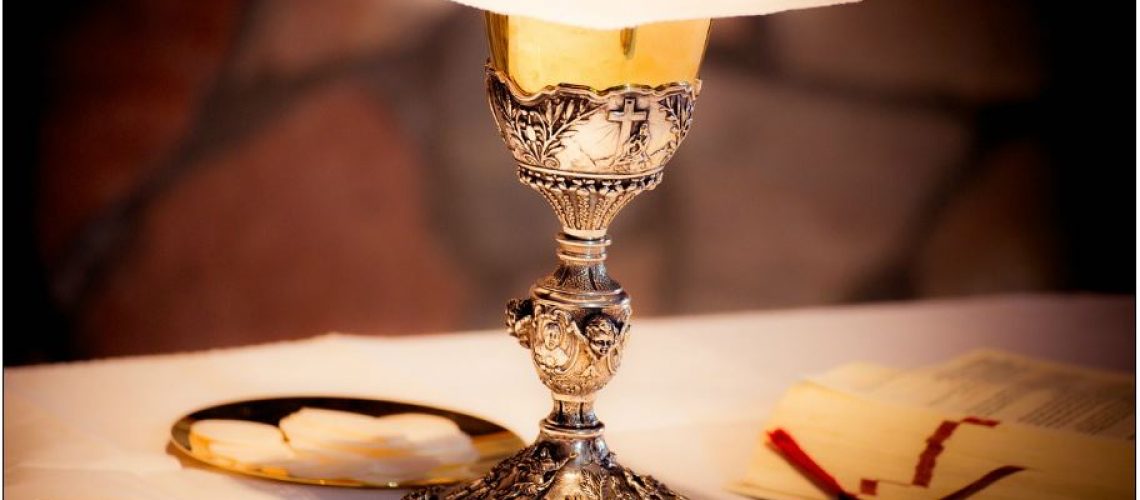
Are Lay Eucharistic Ministers, i.e., Extraordinary Ministers of Holy Communion (EMHCs), like Costco sample ladies?
A recent essay here at CS by Dan Fitzpatrick asked this question and the essay elicited a number of comments. Most of the comments supported his assertions but a couple did not.
In his essay Fitzpatrick was questioning the role of EMHCs at Mass. In so doing he, perhaps inadvertently, cast aspersions on those who feel called to be EMHCs. One of the commenters seemed to think this was the case. The commenter also defended EMHCs distributing Holy Communion at Mass.
No one responded to the commenter’s statements so I am going to do so here.
An Unintended Slight?
While I cannot read Fitzpatrick’s mind, I tend to think he was not trying to chasten those who feel called to be EMHCs. His essay questioned the use of EMHCs at Mass, not the spirituality of EMHCs or what motivated them to become an EMHC.
As the commenter rightly pointed out, EMHCs “do more than assist at Mass. They also visit the homebound and those in hospitals and nursing homes.” And in bringing the Eucharist to those unable to attend Mass, EMHCs actively participate in the laity’s mission. This is a good thing.
But in some dioceses, the “ministries of extraordinary ministers of Holy Communion at Mass and extraordinary ministers of Holy Communion to the sick are regarded as two distinct ministries.” And there is logic in this position. All dioceses should take this position.
Saying Mass and Consecrating the Eucharist during Mass is something only an ordained priest can do. The priest alone presides at Mass – in persona Christi.
Bringing Holy Communion to the infirmed and homebound is a ministry that is separate from the Mass. It is a lay-priestly ministry. But only a priest can say Mass. EMHCs distributing Holy Communion at Mass blurs the lines between the priests’ role in the Church and the laity’s role.
Called to be an EMHC
I’ve often wondered about those who feel called to be EMHCs. As such I‘m grateful to the commenter on Fitzpatrick’s essay who explained what compelled him or her to become an EMHC. The commenter also called being an EMHC an “undeserved honor.”
I suspect the training that EMHCs undergo is spiritually profitable for those called to the ministry. As such I found the “undeserved honor” statement gratifying.
Perhaps because I am a Catechist, I’ve been asked a couple of times to become an EMHC. My reply was the same both times. I do not feel worthy to touch a Consecrated host. In fact, I don’t feel it’s proper to take the Consecrated host out of my left hand with my right hand to put it in my mouth.
And like Fitzpatrick and some of the other commenters, I would much rather receive Communion from a priest or deacon, on my tongue, while kneeling, than from an EMHC, in my hand, while standing. I imagine quite a few Catholics feel this way.
Yet while EMHCs are ubiquitous at Masses today, no less than seven Vatican documents say EMHCs should distribute Communion at Mass only in extraordinary circumstances.
For the record, the seven documents are:
Fidei custos (1969), Immensae caritatis (1973), Holy Communion and Worship of the Eucharist (1973), Dominicae coenae (1980), Inaestimabile donum (1980), Inaestimabile donum (1980), “On Certain Questions Regarding the Collaboration of the Non-Ordained Faithful in the Sacred Ministry of the Priest” (1997), and Redemptionis Sacramentum (2004).
EXTRAordinary, not Ordinary
The commenter on Fitzpatrick’s essay also wrote, “The Church has permitted the use of EMHCs for the last 50+ years because of the shortage of priests in the US and in other countries.”
This is not an accurate statement. EMHCs may be distribute Holy Communion at Mass only in extraordinary circumstances.
As Redemptionis Sacramentum (an Instruction “On certain matters to be observed or avoided regarding the Most Holy Eucharist”) issued in 2004 by the then Congregation for Divine Worship and the Discipline of the Sacrament says (158), “Indeed, the extraordinary minister of Holy Communion may administer Communion only when the Priest and Deacon are lacking, when the Priest is prevented by weakness or advanced age or some other genuine reason, or when the number of faithful coming to Communion is so great that the very celebration of Mass would be unduly prolonged” [Italics added].
The United States Council of Catholic Bishops reiterated these instructions in a 2010 document “Extraordinary Ministers of Holy Communion at Mass.”
Unfortunately, it seems the extraordinary is now ordinary. Even at Mases in my parish where a priest and deacon are both present, there are usually no less than six EMHCs present.
Eastern Rite Catholics
The commenter also wrote that “Eastern Rite Catholics are *fully* Catholic and have received standing from Day One. Are you saying they are less than Catholic, and less than reverent, because they receive standing?”
But this also is not quite accurate.
As Joseph Shaw explains in a recent article, “Up until the time of the Second Vatican Council, lay Catholics received Holy Communion under the species of bread alone, kneeling, and on the tongue. They had done so for many centuries. Reception on the tongue was mandated by a local council, at Rouen, in 878, and St. Thomas Aquinas explains that only the consecrated fingers of a priest should touch the host (Summa Theologiae IIIa, Q82, a3). In the East, leavened bread is consecrated, and soaked in the Precious Blood, and Holy Communion is distributed directly into the mouth with a spoon.”
So there are significant differences in Communion in the Eastern and Latin Rites, and, yes, Eastern Rite Catholics do stand while receiving Communion. But this was not so “from Day One.”
Eastern Rite Catholics also receive Communion on a spoon, directly into the mouth, from the priest (not an EMHC), and not in the hand. Allowing the recipient to stand makes it easier for the priest to distribute Holy Communion in this manner. So comparisons between the two rites need to take all of this into account.
No Communion Plates and Other Changes
What’s more, in the Latin Rite, the Communion plate is rarely used any more. However, Redemptionis Sacramentum states, “[93.] The Communion-plate for the Communion of the faithful should be retained, so as to avoid the danger of the sacred host or some fragment of it falling.”
But six EMHCs and a priest and deacon all distributing Communion, poses a problem. Such a scenario requires eight Communion plates with someone holding them. It’s “easier” to forego the use of the plates.
Prior to Vatican II, altar boys (not altar servers) held the Communion plate for the priest. These days, however, many parishes are fortunate to have two altar servers. And in many parishes the altar servers are girls.
So today we have un-ordained men and women distributing Communion at Mass, girls as altar servers, no Communion plates, and Communion in the hand, received while standing instead of kneeling. And two or three generations of Catholics view this all as normal – all because liberal bishops, priests, and parish worship directors have made it the new norm, despite instructions to the contrary from the Vatican.
Impatient Americans
A survey highlighted in an article in the Tennessee Daily News Journal, found that patience is no longer a reality for Americans. I suspect this may be the main reason for the use of EMHCs at Mass. Americans just don’t like waiting in line!
EMHCs do speed up distribution of Communion at Mass. The question is, is this necessary? Or does the use of EMHCs at Mass desacralize the source and summit of the Mass, as Fitzpatrick contends.
Recently, while my wife and I were on vacation, we went to on All Saints Day and the following Sunday. We were delighted to see Communion rails still intact in the small church. Both Masses were very reverent Novus Ordo Masses, said by the priest, versus populum.
Just as an aside here, the church had somehow been spared a ‘wreckovation.’ The only new thing in the church was the free-standing altar in the sanctuary. Statues, and the existing marble altar were all still in place, with the tabernacle squarely in the center of the old altar. The organ (not a keyboard) was in the balcony above the entrance to the church and the hymns sung during mass were traditional hymns.
My point in bringing this up is that everyone who received Communion did so while kneeling at the rail, and on the tongue. Communion was given by the priest or an EMHC, wearing a cassock and surplice (because he was also an altar server). But even at both Masses an EMHC was not necessary because the worshippers numbered fewer than 100 people.
Mistakes Were Made
Priests and bishops, and even popes, do make mistakes. In my opinion, a big mistake was made in allowing a small cadre of liberal Catholic priests and bishops to take control of steering wheel when it came time to interpret and implement the changes called for in Sacrosanctum Concilium following Vatican II.
The sad truth is, none of the changes to the Mass we have been living with since 1964 were called for in Sacrosanctum Concilium. (For a good explanation of how these changes came about see “The Day the Mass Changed, How it Happened and Why?” parts one and two.) But here we are in 2024.
Vatican II and Sacrosanctum Concilium did not call for EMHCs to distribute Holy Communion at Mass. And the Vatican has unequivocally stated that EMHCs should only distribute Holy Communion at Mass under extraordinary circumstances. Yet EMHCs are distributing Holy Communion at almost every Saturday Vigil or Sunday Mass in the U.S.
And Pope Francis has also virtually outlawed the Traditional Latin Mass (TLM), even though the number of TLM attendees continues to grow. Many think Pope Francis made a big mistake in doing so. Cardinal Cupich may have also made a mistake recently. He inaccurately stated “ . . . the norm established by Holy See for the universal church . . . is for the faithful to process together as an expression of their coming forward as the Body of Christ and to receive Holy Communion standing.”
Misunderstanding the Mass
As I wrote eight years ago here at CS, “even after 40+ years of the Novus Ordo I still have a problem “Celebrating the Mass” as opposed to participating in “The Sacrifice of the Mass.” And it seems like this ‘celebratory’ approach is trending stronger every year as parish Worship Commissions continue to tweak the Mass in an effort to make it “friendlier” and more “welcoming.”
“Maybe taking the solemnity and reverence out of the mass and replacing it with friendly and welcoming has not been such a good idea. Just maybe this new way of ‘Celebrating the Mass’ also has people thinking about Mass today in a whole new way as well: Maybe Mass is now thought of as more of a social gathering-type “celebration” where people are free to come and go as they please, as opposed to a solemn re-enactment of Christ’s death on the cross.”
Today, in my parish at least, our music minister plays songs (not hymns) like “All Are Welcome” and “Table of Plenty.” Both songs offer a faulty relationship between a faulty Eucharistic theology and a faulty ecclesiology.
Many people also raise their arms to the priest when they respond, “And with your spirit” in the same way they raise their arms to pray the Our Father. And I see people sitting down and chatting with one another as soon as the priest and deacon descend the steps from the sanctuary to distribute Holy Communion.
The Bottom Line
The EMHC ministry is a legitimate and needed ministry in the Church. Taking Holy Communion to the infirmed, bedridden, and homebound is a wonderful way to show love of neighbor.
But EMHCs should not be distributing Holy Communion at Mass. I wholeheartedly concur with Fitzpatrick’s closing statement.
“Pray that the Church hierarchy and all parish priests begin to stress to the faithful that we can show how much we love Jesus and believe in His Presence by returning to the tradition of three fundamental actions – kneeling for Communion, receiving the host on the tongue, and discouraging the use of extraordinary ministers.”
And maybe do some fasting and extra penance as well.
In the meantime, Catholics who also think EMHCs should not distribute Communion at Mass might take action. Those not easily intimidated might seek out others in their parish who are like minded. Then, as a group, meet with your pastor and have a frank discussion about the practice. It is an aberration and a practice that no bishop should sanction.
As someone once said, a small yet vocal minority can bring about big changes. Liberals learned this lesson well. Maybe it’s time conservatives and more traditional Catholics started getting vocal.




17 thoughts on “Clearing the Air on the Use of EMHCs at Mass”
That EMHCs are routinely scheduled adds fuel to the fire. A better word is ‘available.’ Sure, a schedule makes them available, but is call-up always needed? No, of course not. How did we EVER get by without them and attendance average twice as many as now? One part: EVERYONE (just about) comes up for communion. In 1965, maybe two-thirds did. Are people too ashamed to stay seated when they have no business doing up?
What has frosted me the most about EMHCs are the chunky ones with tight clothing and with big smiles on their faces when they utter ‘The Body of Christ’ to the communicant. I have never seen a priest or deacon smile in that duty. Nor have I seen Walmart-level of dress on a priest or deacon.
Lastly, I would do away with the cup altogether.
Wow!
Do away with the Chalice? The blood of Christ?
Even with it’s problems, still a great thing.
This past Summer when the Eucharistic Congress was being held, Trad gangs were roaming the streets of Indianapolis, one gang yelled to some attendees of the Congress “Well, aren’t we the good Catholics, are you going to receive Communion in the hand” and one of the attendees retorted “God bless you brother. One might remember, we have the blood of Christ! Do you?”
And that quieted them down.
My friend told me that Communion wine is basically like what is called a desert wine as I was thinking, it might be nice to have some such wine at home while acknowledging that it is not consecrated, not the blood of the Messiah. Still my friends suggestion has been of no help so far.
Echoes of Danny Fitzwillie here and the Back to Tradition debacle.
Father forgive them for what they do!
Could be another sock puppet as when Dan F was slamming Bishops for the Eucharistic conference, something forbidden by the rules of this forum. Sorry for venting but if Trads now, decide the blood of Christ and the Chalice, this is beyond repugnant.
A very gracious – and true – comeback to Susanne, Gene.
I will add to the stew, perhaps one day, some can discuss the blood of Christ! The wine “transubstantiated”? Hey, I like that at Mass but, unfortunately, I do think some people will drink too much. Yes, you might have some smart alecky-kid, etc. But this is not to deny it then to others.
And, I have largely stopped taking that at this point.
Perhaps, it has been a part of Our Orthodox cousins Masses.
I would feel unworthy to distribute communion too but if it was in a situation where a parishioner just can’t get to Mass…I would in an urgent situation.
I have received the blood of Christ in the past 6 months where the chalice was nearly empty, a drop, it is a bit disheartening. Then, one of the Eucharistic Ministers was keeping a tight control on things, almost grabbing the chalice before one finishes. She seemed to step down from her role. This is all recent, I have received it plenty of times with, I hope full Communion with God.
Who is the real representative of Christ here? The celibate male who, fleetingly, says the “magic words” in the remote and ornate church and passes onto the next person? Or the often female and married parent who spends time with the shut-in, and takes the time to listen and understand?
I believe I may be the commenter the author quoted. This sounds like something I wrote.
In regard to the comment on the “Communion plate”, it is correct that many parishes no longer use a paten held by an altar server (yes – altar server – even parishes that do not permit females to serve have full-grown men who do) under the chin of the person receiving Communion:
At my parish, we use full-sized ciboriums to distribute Communion. When I brought the Blessed Sacrament to a local hospital pre-Covid, the Catholic hospital chaplain, who was a Tanzanian priest of the Apostles of Jesus Order, instructed me to hold the ciborium under the hands or chin of the person receiving – depending on if they received in the hand or on the tongue. I found this to be reverent and practical, in that the chance of having particles bounce off a paten was nearly eliminated by holding the ciborium directly under the hands or chin. And so, I have been doing this ever since that time, with no problem of dropped hosts or particles.
I am sorry you and others do not approve of my service. As I mentioned in the original article, it is indeed undeserved. I am an EMHC at the pleasure of my Bishop and pastor, and the day either of them tells me I am no longer needed, I will gladly step aside. But until then, I will continue to assist as needed. I respectfully and humbly stand by my comments, and wish the author and all here peace and all good.
If your takeaway from reading this article is that I and others do not approve of your service, you might want to read it again. Extraordinary Ministers of Holy Communion provide a necessary, wonderful and much needed lay service in bringing Holy Communion to the infirmed, homebound, and bedridden. Having EMHCs distribute Holy Communion at Mass, however, is only a needed or a necessary lay service in extraordinary situations.
Pingback: VVEDNESDAY MID-DAY EDITION | BIG PULPIT
“show how much we love Jesus and believe in His Presence by returning to the tradition of three fundamental actions – kneeling for Communion, receiving the host on the tongue, and discouraging the use of extraordinary ministers.”
That doesn’t show Jesus your love, who sees in secret. It does show the world how much you love to be seen loving Jesus. A thing serving self-love, not Jesus.
Yes, Jesus sees what we do in secret. He also sees everything we do in public. And because He knows what is in our hearts He also knows if we are being hypocrites, like the Pharisees, or if we are truly trying to honor Him. He also knows when we are thinking uncharitable thoughts about others instead of charitable thoughts about others.
Gene & Dan, magnificent!
Your comments about the communion paten were appreciated. Starting as an altar boy in 1969, I recall that there were arguments about whose turn it was to hold the paten – little kids instinctively knew this to be a great honor! Our “Eucharistic Renewal” would see lots more success by active reminders about worthiness to receive, returning to altar rails, refraining from receiving in the hand, and without the use of EMHCs at Mass.
“… While I cannot read Fitzpatrick’s mind, I tend to think he was not trying to chasten those who feel called to be EMHCs. His essay questioned the use of EMHCs at Mass, not the spirituality of EMHCs or what motivated them to become an EMHC.
As the commenter rightly pointed out, EMHCs “do more than assist at Mass. They also visit the homebound and those in hospitals and nursing homes.” And in bringing the Eucharist to those unable to attend Mass, EMHCs actively participate in the laity’s mission. This is a good thing…”
Ummm….I sort of think you CAN read my mind! 😏
I wouldn’t have written anything differently than you did here and throughout your article!
Well done follow-up, Gene!
Gene-Simply: Thank you. Merry Mary CHRISTMAS! Guy, Texas
And Merry Christmas to you, too!