
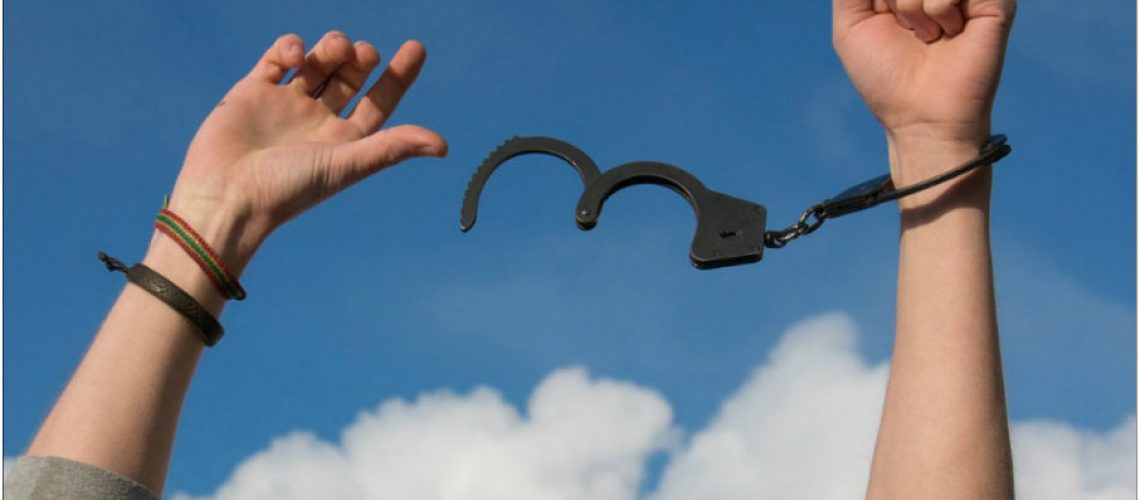
Bound
Sin. It binds us. Our hands which were meant to reach out and love. Our feet which were meant to walk forward in a life with Christ. We find in both the Old Testament and New Testament, stories about being bound. God ultimately breaks the binds and brings us and those we witness to everlasting life.
But before we focus on breaking bonds, we must shortly note what our bonds—including everlasting bonds—can do.
Binding
We must remember and be careful not to be bound when we reach the end of our lives. As gruesome as it may be, the truth is that those who go to Hell are bound by their sin and a lack of repentance. “Then the king said to the attendants, ‘Bind him hand and foot, and cast him into the outer darkness, where there will be weeping and gnashing of teeth.’ For many are called, but few are chosen” (Matthew 22:13). In short, Hell is evil—everlasting evil—and if we want to escape the bonds of sin and Hell, we are going to need God.
Isaac
Let us start early on in our history. You know the story well, so I will point out one detail that seems to go a very long way. God asks Abraham to sacrifice his son Isaac. Abraham obeys and binds Isaac’s hands and feet and is about to sacrifice his son until an angel comes and tells him to stop. Abraham had proven his true trust in God, all the way to death; the death of his son.
The text reads: “When they came to the place of which God had told him, Abraham built an altar there, and laid the wood in order, and bound Isaac his son, and laid him on the altar, upon the wood” (Genesis 22:9). Note the word “bound.” Isaac is bound (probably with ropes). Bound and about to die. Though the text does not state it, we can conclude that once the angel appears, Abraham unbound his son, freeing him; preserving his life when he was about to die.
Samson
Moving right to the point with Samson, “Then the lords of the Philistines brought her [Delilah] seven fresh bowstrings which had not been dried, and she bound him with them” (Judges 16:8). Samson snaps the bowstrings with ease. Later, “Delilah took new ropes and bound him with them and said to him, ‘The Philistines are upon you, Samson!’ And the men lying in wait were in an inner chamber. But he snapped the ropes off his arms like a thread” (Judges 16:12). Like Isaac who was bound for his death, Samson was bound for his death to the Philistines by the trickster, Delilah. Yet, like Isaac, Samson’s bonds were broken, preserving his life when he was about to die.
Lazarus
Though there are many Old Testament stories that include being bound, I find Isaac’s and Samson’s “binding” to be the most prominent, especially regarding the fact that they were meant for death, but ended in life. It will be easy, then, for us to understand this theme in the story of Lazarus. “The dead man came out, his hands and feet bound with bandages, and his face wrapped with a cloth. Jesus said to them, “‘Unbind him, and let him go.’” Again, the bonds are broken. Lazarus does not just preserve his life; he is brought back to life. He is free from the bonds of Hell and has been raised to life.
Jesus
Jesus ultimately broke the bonds of death. In nearly every Gospel, we find evidence of this.
Close to the beginning of Jesus’ passion, we read, “And they bound him and led him away and delivered him to Pilate the governor” (Matthew 27:2).
Furthermore, “and they bound Jesus and led him away and delivered him to Pilate” (Mark 15:1).
And then, “So the band of soldiers and their captain and the officers of the Jews seized Jesus and bound him” (John 18:12).
Later in John, when Jesus has died, we read, “They took the body of Jesus, and bound it in linen cloths with the spices, as is burial custom of the Jews” (John 19:40). We know what happens after that. Jesus’ bonds break, he opens up the gates of Heaven and is resurrected. All that is left is the linen cloths lying in the tomb (see John 20:4-10).
The Veil of the Temple
In all examples, the bonds are broken/ripped/untied/torn. Right when Jesus dies, the veil of the temple is torn in two. “And Jesus cried again with a loud voice and yielded up his spirit (Matthew 27:50). Immediately following that verse we read, “And behold, the curtain of the temple was torn in two, from top to bottom; and the earth shook, and the rocks were split” (Matthew 27:51). What is so important to know is that the curtain of the temple blocked the ordinary and the sinners from entering the most holy place, which was reserved for the chief priests, the supposed “best” in society. In our terms, the veil hung as a sort of block between the people and the All-Holy God. With it being torn in two, our union with God is restored by Christ’s death. We are no longer separated by a veil or curtain, but now, we have access to holiness and access to Heaven (see Matthew 27:51 Notes, pg. 59. Ignatius Catholic Study Bible New Testament Second Catholic Edition RSV).
In breaking our bonds, God is pulling us closer to Himself. We may not be physically bound, but we are bound to our sins, our bad habits, and even bound to death. But death takes no hold on us who believe. Christ came to break the bonds of death and bring us into everlasting life. If we recognize that we are bound to gluttony or lust or greed, we confess our sins to God so that he may break those bonds! What a gift, for the Lord to continually unbind us who continually sin. The closer we get to God, the more bonds are broken and we receive more freedom. Continually turn to Jesus, for he has proven to and continues to break the bonds of death. With your free hands, go and lovingly touch the lonely, hold the weary, caress the lost, and free the bonds of the sinful. With your free feet, do not lead others to the sin that will bind them, but lead others down the path toward heaven.


[…] 6. The Soul’s Choice of a Devout Life – St. Francis de Sales via Tan·Direction Blog 7. Breaking Bonds – Jacqueline St. Clare at Catholic Stand 8. Being Who We Are Meant To Be – Jane […]
Dear Jacqueline ,
Thank you for an inspiring commentary. I am Jewish, but I draw much spiritual nourishment from the teachings of your faith. I share the views of the late Chief Rabbi of Britain ,Lord Jonathan Sacks ,who told the late Pope Benedict of the many commonalities between our two communities including emphases on community,respect for marriage ,parenthood and ” the poetry of everyday life when itis etched in homes and schols with the charisma of holiness and grace. ”
The Binding of Isaac is an important text in my faith because it epitomises a Jew’s determination to serve God no matter how difficult the circumstances,the very reason for Israel’s existence.
According to tradition ,the Akedah ,or Binding of Isaac ,took place on Rosh Hashanah ( the New Year ),which connects the sounding of the ram’s horn ( the Shofar ) on that day with the ram that took Isaac’s place as a sacrifice.
When Abraham took Isaac away for the sacrifice he was 137 and Isaac 37. So there was no way Abraham could force Isaac to go .Rather he was to take him by persuasion to do the will of God. And according to the Rabbis ,Isaac asked to be tightly bound so that he would not flinch when is father raised the knife .
However ,there was a one sad outcome to this story. Sarah ,Isaac’s mother, was said to have died at the age of 127, caused in part by the events of the Akedah.
And finally ,on one visit to Israel I prayed at Abraham’s tomb in the Cave of Machpelah , a truly awe inspiring experience.
What a wonderful piece. I will go back and read all those passages where the words bind/bound appear with a new clarity.
Thanks for sharing. I always look forward to seeing your name.
Thank you for reading, Ida!