
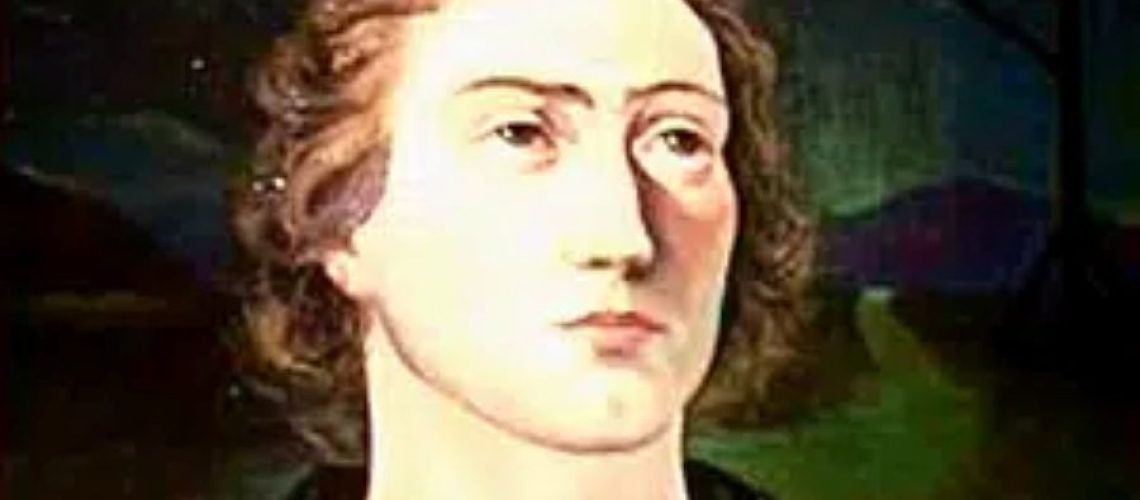
For most of the Irish, the events of the sixteenth and seventeenth centuries are difficult to comprehend. The scale of national devastation that transpired seems almost mythical in its scope. One in five inhabitants of the island died directly in the Cromwellian conquest alone. Long-held institutions central to the nation were torn down, and civil law and social order periodically collapsed in the crucible of the wars of religion. Some of the Irish were able to take asylum abroad, founding brigades in the French and Spanish armies as the famed “Wild Geese.” Others were captured in war and sent as slaves to the farthest reaches of the English empire. In places such as Barbados, their descendants, the Redlegs, still recall their passage and the full destructive rage of the Cromwellian armies.
Bertolt Brecht, speaking through the voice of Galileo Galilei in his play of the same name, remarked, “Unhappy the land that needs heroes.” This is perhaps a fitting characterization of Ireland in the seventeenth century: financially devastated, war-torn, cracking under the weight of English colonial rule, and effectively friendless in Europe. What is more, this had been the status quo for nearly four hundred years, since the time when the English armies of Strongbow first came ashore and laid claim to suzerainty over Ireland and her people.
Folk wisdom holds that “man’s extremity is God’s opportunity.” As a recurring feature of history, the darkest circumstances often bring forth men and women of exceptional courage, commitment, and virtue, witnesses to the faith and defiant voices against the illegitimate rule of law. For Ireland, several independent witnesses stepped forward to minister to a beleaguered nation and her weary children. Among them was William Tirry, one of the most compelling figures of the turbulent seventeenth-century Irish Catholic experience: an Augustinian friar who chose fidelity to conscience and the Gospel over his own life.
William Tirry was born into a prominent Hibero-Norman Catholic family in Cork. His uncle, also named William, had served as bishop of Cork and its environs, and his grandfather had once held the office of Lord Mayor some years before. The family’s standing among the Irish landed gentry granted William access to the nation’s intellectual and spiritual inheritance, preserved in partial continuity since the dark ages. William entered the Order of Saint Augustine at a young age, likely exposed to the order through his classical education. At the time the Augustinians still maintained a monastic house at Red Abbey in the city of Cork, and were among the few educational institutions in the region. Gifted in Latin and Greek, as well as his native Gaelic tongue, William was sent abroad to study in Valladolid, Paris, and Brussels with other members of the order. Continental Europe offered educational opportunities unavailable at home, and he continued his mendicant work among the urban poor wherever the Augustinians sent him. Upon his return to Ireland in the late 1630s, he served within the Irish Augustinian community in Cork and later County Mayo. Although Henry VIII had officially dissolved the abbeys in his dominions in 1541, the Augustinian house in Cork remained occupied by friars and active for a time.
The wider religious and political upheavals of the seventeenth century, however, would soon engulf Ireland. With the Cromwellian conquest and the 1653 law declaring any Catholic priest in Ireland guilty of high treason, punishable by death, Friar William joined countless clerics forced into clandestine ministry in the forests and countryside of Munster. For several years he lived as a fugitive in his native land, sheltered by a distant English cousin in Tipperary and anyone sympathetic to the mission of the friars. Despite legal prohibitions, he continued to administer the sacraments to the faithful who actively sought him. His days were largely spent in secret prayer, penance, and quiet service to Ireland’s rural poor.
On Holy Saturday, March 25th, 1654, Friar William’s hiding place was betrayed. He was arrested while vested for Mass; his priestly garments and writings defending the Catholic Church in Ireland were seized. By order of the local English magistrate, he was transported to Clonmel Gaol and put on trial for treason. He made no statements regarding the legitimacy of Confederate Ireland, acts of Parliament, or the Crown (then defunct). His work among the poor was not political, nor was he an agent of any military venture. At trial, Friar William acknowledged the authority of civil rulers in temporal matters, but insisted, as conscience bound him, that in matters of faith he could answer only to his religious superiors. The authorities offered to spare his life if he would renounce his vocation and the Catholic faith, which he flatly refused.
On May 12th, 1654, Friar William Tirry was hanged at Clonmel’s gallows, clothed in the black habit of the Augustinian order. Accounts from fellow prisoners and witnesses describe him walking to his execution praying the rosary, blessing the gathered crowd, and publicly forgiving the three men who betrayed him for the £5 bounty. Even a Puritan minister present at the gallows, failed to silence him.. Friar William boldly reaffirmed his duty to the truth, to the Church, and to God. He was buried at the Augustinian friary in Fethard, closed recently in 1650 by Cromwellian forces. He was interred in the grounds rather than within a church crypt. His grave remains unknown to this day. The tenacious Augustinian friars would continue their mission at Fethard until 1687, when they were banished to the Continent by royal edict.
Friar William’s death was not an aberration of an age uniquely cruel, but a clear expression of what fidelity demands in a world where the institution of the law had been severed from justice. His martyrdom stands as a rebuke to the idea that faith is solely a private enterprise, a consolation detached from civil life, or a negotiable identity. In choosing obedience to his conscience over survival, Friar William embodied true resistance, not in histrionic grandstanding, but in the refusal to allow political power to dictate truth.


[…] Di Giorgio at ZenitWhy We Need Wayside Crosses – Amelia McKee at Art For The Liturgical YearBlessed William Tirry: Friar, Fugitive, Martyr – D.P. Curtin at Catholic Stand MagazinePostliberalism & Christian Revival At Oxford […]
For a long time I have been intrigued by martyr-priests–Bl. Miguel Pro and especially those of the English reformation as well as the lay people who sheltered them. However, I was not aware of Cromwell’s 1653 edict or of Blessed William Tirry. Thank you for writing about him.