
And so I tell you, every kind of sin and slander can be forgiven, but blasphemy against the Spirit will not be forgiven (Matthew 12:31).
Does the Modern Protestant Church in Sweden Blaspheme Against the Holy Spirit?
Let us examine this question. Before we do, we should address some anticipated critiques. In confronting this question—this accusation—we must use the Bible and its narratives in a way that may appear heterodox to some, that we are not conforming to orthodox beliefs. It may seem as though we are reducing the Incarnation and the people involved in these events to mechanical abstractions, intellectualizing miracles such as the Incarnation or the Annunciation, or turning Jesus himself into mere metaphor. But this is not the case, especially if we remain faithful to the biblical story as we explore its meaning.
Christ was not merely a messenger of divine words—he was the Word. He was the message itself. This means that everything about Jesus is meaningful: every aspect of his life is instruction from God. His birth, for example, was not only a singular historical event—the birth of a child who happened to be God—but the manifestation of the Messianic principle of creativity itself. When God becomes incarnate, creativity and generation are also revealed. They always existed, just as Christ did, but now they become visible, material, and perceptible.
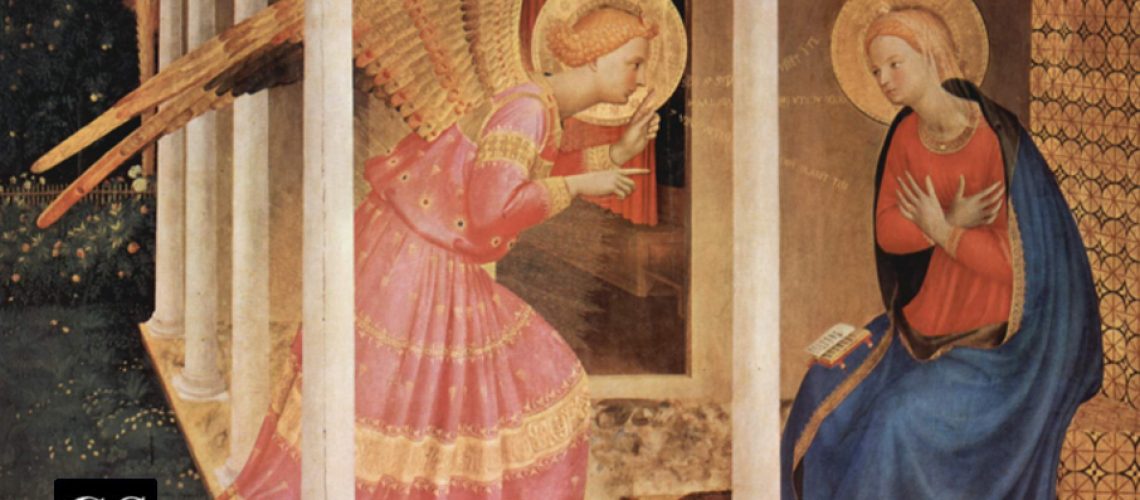
Perception and conception are the two key elements of this hypothesis. But we are getting ahead of ourselves. First: what is the “Holy Spirit”? If we can concretize it beyond the abstraction of living a righteous and spiritual life. Well, the religion is pretty clear about what it is: it is the way in which Christ, the Messiah, is begotten. So, how is Christ, the Messiah, begotten? To answer this question, we go to the Annunciation and verse that tells us about it, Luke 1:34, which says:
Then said Mary unto the angel, How shall this be, seeing I know not a man?
For obvious reasons, Mary has her doubts: she cannot perceive herself conceiving in this supernatural and unconventional way. But she does. She conceives, she creates and God indirectly creates through her. Born is Immanuel – God is with us, as if to show that from now on, through the redemption of this child, we are allowed to create with God, in His image.
If we deconstruct and analyze this verse, there are a few key things that stand out: creating and conceiving, seeing and knowledge, knowing. In other words: how can Mary see herself doing this, taking on this creative “office” or divine task, without knowing something prior to it, knowing the flesh of a man.
Here we see the congeniality with Eve, and what subsequently once opened the door the wrong way, so to speak, seeing she had known a man: she was made flesh from flesh. Which is very reminiscent of the psychogenesis of, for instance, a feminist since a feminist conceives of her identity and female subject as the result of negating a man. She has to “know a man” before conceiving of herself and proceeding to create, whatever it may be (art, politics, religion, sociology etcetera). Before the feminist, just as Eve, knows herself, she knows the flesh of a man. Through this a posteriori, she will always live in the shadow of a male body, or as the atheist De Beauvoir famously stated, as a second sex.
Not all that surprising, since the counter “religion” of spiritual Christianity is materialism. A teaching that states all is matter in motion and there is no such thing as spirit. Matter in itself, if it has perception, only relates to other objects of matter outside of itself. In order for a mind that conceives itself as only matter (no soul or spirit or any of the designations that comes with the teachings of Christ) to know itself it must first know something outside of itself, something different and separated. If it was a woman trying to conceive of herself, she must first know a man.
If we therefore invert the verse it becomes less opaque: if the Holy Spirit is the way in which Christ is begotten, and this way is described in how Mary gives birth to him – seeing that she has not known a man – then whatever is blasphemous against the Holy Spirit would be the opposite: a conception of oneself and one’s creative choices after knowing a man.
These intellectual charades might seem silly. They might seem like self-absorbed reasonings of a vain intellectual. As per usual, not really going anywhere and merely entertaining a subversive sparring with other intellectuals. But faithful believers have a problem here, because Jesus himself – the one that redeemed all sins – stated that all sins may be forgiven but one: blasphemy against the Holy Spirit. In all of God’s divine grace, forgiveness and forbearance, it is but this one thing that will not be forgiven. And this coming into a world ridden with sin, proven by the silent faith of Christ in his last days, explicitly forgiven by the same.
There is a practical dimension to this sin against Spirit. We saw that theories and ideologies like feminism, in a social sense, or materialism, in an anti-hypostatic sense, are forced to essentially “know a man” or know a foreign substance prior to conceiving of its synthetic self. Both these examples actively blaspheme against the ontological structure of Christ’s birth, drawing their method from the inversion of it, and then immunizing their practice by simply claiming that there is not such thing, no Spirit, no divinity, no Incarnation.
So, is it heterodox to interpret the phenomenon of Luke 1:34 as an intellectual method, applicable? In an attempt to explain what the Holy Spirit may be, rather than what it is not, now, since it is currently applied intellectually in the world in an opposite form? Is the devil the only one allowed to use the Bible?
If we fail to recognize holistic patterns, both in nature and Creation and in the world of thought and intellect, we might become too rigid and remove ourselves from the interconnectedness of things. If we imagine a sun rising from beyond the horizon of an ocean, bringing with it light and life, doesn’t it seem reminiscent of a virgin giving birth? These things are not detached from the life and story of Christ, nor is the intellectual agency, speech and relations of man. Christ even compares us to suns, binding the celestial bodies together with our actions.
The point we’re trying to make, is that there is no heterodoxy in expanding the Biblical lens when looking at the world, as long as the teachings of Christ remain the fundamental optic system or principle of seeing. If we don’t practice our religion, our religion is dead, and if we don’t practice what is taught in our religion, we are practicing a dead religion that is not our own. With that said, let’s apply Luke 1:34 as a message and an intellectual method and thank God for the expressive and detailed lives of Mary and Christ.
Today, the protestant Church of Sweden is between 50-60% female deaconry. A result of Marxist-feminist identity politics. In Sweden’s biggest morning paper, DN, in May 2025, there was an interview with an eminent Swedish priest that openly admitted that she wasn’t really that interested in Jesus but originally went to church and communion to meet other lesbian girls. In 2013, a female archbishop was elected based on the premise that she was the first, and that this act was a negation of a patriarchal and misogynic culture.
As possibly correlated fact: from the year 2000, the Church of Sweden has lost about 2 million members; that’s about 25% of the congregation. But the point is not whether or not they are women – Mary was a woman – but that the emergence of feminist deaconry is based on the premise of “knowing a man”, a patriarch in negation, which Mary hadn’t. To counter any such critique, we can conclude that there are women on either side of the intellectual practice of Spirit, some that serve it, some that blaspheme against it, and in the latter example, some of them are priests.
Again, the point is not the female gender itself, this method applies to men too, but rather of how a person conceives of herself and sees herself in relation to her creative servitude and ability. Mary had not known a man when she decided to creatively serve God, the female priests of the protestant church of Sweden has. If the life of Jesus was a message in itself – if he is truly the Word – then the qualifying tradition of female priests in the protestant church of Sweden goes against how he was born.
What is commonly referred to the Holy Spirit, since Christ is begotten in the Holy Spirit. Which is problematic, to say the least, that the qualifying premise of Christian clergy has to implicitly blaspheme against the Holy Spirit. They are after all there, in their office as representatives of God, through the reactive tradition of feminism and the negation of a past that was very patriarchal and sometimes misogynic, yes, but that is hardly what ought to incentivize a servitude to God. God should be the history of someone serving God, so that you don’t conceive of yourself by ways of somebody else (and subsequently become their servant or creation).
But by now this shouldn’t come as a surprise. Because it is not just in the implicit story of Luke 1:34 we find this, we also find it in the most famous of religious scenes: that of Eden, Adam, Eve and the serpent. God tells us don’t eat knowledge and don’t do it flesh from flesh. Furthermore, the mind eats as well. It eats through seeing, observing and conceiving of its own intellectual agency. God said, don’t eat the flesh of other bodies to perceive of yourself. And don’t do it to incentivize or motivate the conception of your creative choices. The only one that can forgive this sin is Christ, hence why we reenact the ceremony of eating his body, but then in physical form.
This might seem speculative and abstract, like vivid speculations of a delusional believer. But it is more palpable than one might think. Because consider this: what is happening with our once amazing and prestigious artforms, now that feminism conceives of itself creating after “knowing a man”? Why are art, movies, music and theatre – the artistic churches of the world – simultaneously losing their members? We might have gotten the message wrong all along, a blasphemous act against the Holy Spirit might not be an offense in the traditional sense, it might just be something that deviates from the identity of God and creation – something that just won’t work. Sort of like trying to breathe underwater or turn off the lights in a room and still trying to see.
If anything, this we know: Jesus as the redeemer and establisher of a culture, the door to heaven, was not begotten by Mary after her “knowing a man”. The presence of more than half of the deaconry of the protestant Church of Sweden is. Maybe that’s why God is removing so many followers.


And maybe we are entering a post religious age, and this is just one manifestation.