
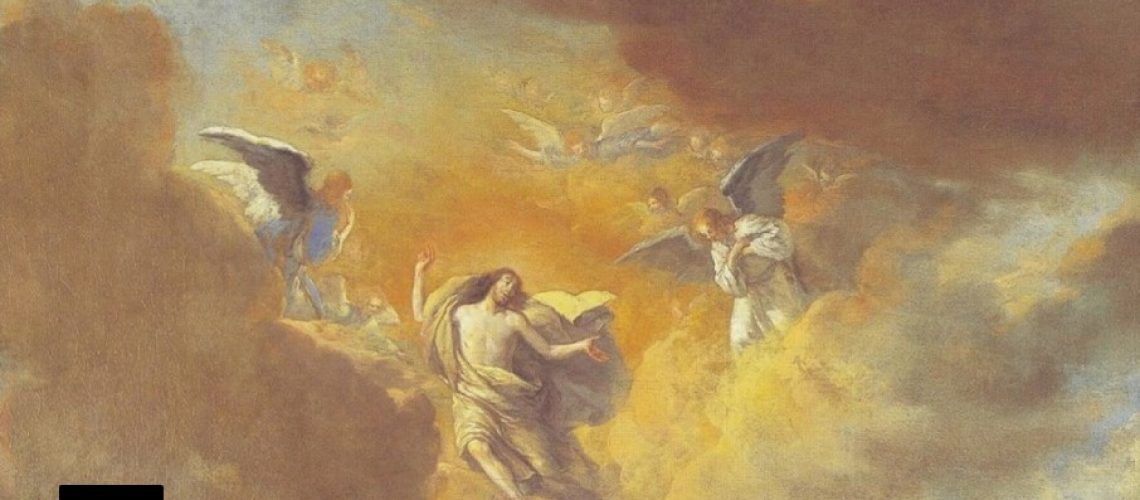
Belief in heaven, after this earthly life, is a belief in mystery. We say out loud, publicly, on a regular basis, not that “we know,” but that we believe in “heaven”:
I believe in one God, the Father Almighty, Maker of all things visible and invisible. . . He suffered, and the third day he rose again, ascended into heaven; . . . And I look for the resurrection of the dead and the life of the world to come. Amen.
He Will Light Your Morning Sky With Burning Love
We have no first-hand knowledge of this heaven because we have not yet been “there” and we are not now “there” – this ”there” itself being an inadequate way to refer to the mystery of heaven. We want it to be real. We hope it is real, and this hope is often the primary “taste of heaven” with which God our Papa gifts us. This earth is not a heavenly paradise, but every once in a while we experience something or someone here that is awesomely joy-filled and happy. We even call such things “heavenly” and they make us think “So that’s what heaven is.” We really don’t have a clue:
But as it is written, eye has not seen, nor ear heard, neither has it entered into the heart of man, the things which God has prepared for them that love him (1 Corinthians 2:9).
In addition to the earthly “heavenly” moments, God our Papa also gifts us with all sorts of hints, clues, directions, lures, urgings, signposts, and “tastes” to help us get home to Him. Some of them are, in earthly terms, bitter, hard, agonizing, painful, or “dis-tasteful.” Still, these are His gifts, proof of His divine love, that He knows can help bring us back to Him.
Heaven: Church Teaching
The Catechism of the Catholic Church, Part One, The Profession of Faith, Article 12 deals with heaven:
I BELIEVE IN LIFE EVERLASTING II. HEAVEN
(CCC 1023) Those who die in God’s grace and friendship and are perfectly purified live for ever with Christ. They are like God for ever, for they “see him as he is,” face to face [citing 1 John 3:2, 1 Corinthians 13:12; and Apocalypse 22:4]
By virtue of our apostolic authority, we define the following: According to the general disposition of God, the souls of all the saints . . have been, are and will be in heaven, in the heavenly Kingdom and celestial paradise with Christ, joined to the company of the holy angels. Since the Passion and death of our Lord Jesus Christ, these souls have seen and do see the divine essence with an intuitive vision, and even face to face, without the mediation of any creature. [from Benedict XII, Benedictus Deus (1336):DS 1000; cf. LG 49].
1024 This perfect life with the Most Holy Trinity – this communion of life and love with the Trinity, with the Virgin Mary, the angels and all the blessed – is called “heaven.” Heaven is the ultimate end and fulfillment of the deepest human longings, the state of supreme, definitive happiness.
1027 This mystery of blessed communion with God and all who are in Christ is beyond all understanding and description. Scripture speaks of it in images: life, light, peace, wedding feast, wine of the kingdom, the Father’s house, the heavenly Jerusalem, paradise
Restless Hearts: Saint Augustine
The writer of Ecclesiastes said that God “has put eternity into man’s heart” (Ecc. 3:11). It is this eternity that we, as believers, want to achieve. This “want” is what St. Augustine was referring to in his masterpiece, Confessions, when he said:
You have made us for yourself, O Lord, and our hearts are restless until they rest in You.
We are not restless on our own accord. We do not create our own restlessness. God wants us with Him – this restlessness is His gift. This is a longing to be somewhere, somehow with Him, forever- and it doesn’t – usually – gobsmack us with one huge divine thunderbolt out of the blue, but comes daily in little tastes of heaven He sends to us, knowing full well what we need to spur us on to want to be “in” this heaven with Him.
Here is Augustine’s famous “restless hearts” saying in Latin: “Fecisti nos ad te, Domine, et inquietum est cor nostrum donec requiescat in te.”
The preposition “in” as in the Latin “in te” signifies rest in an object — in this case, rest in Him. The Latin words “ad te” are typically translated as “for yourself.” They have a deeper meaning. The preposition “ad” expresses dynamic movement toward an object. By making our hearts “restless” for Him, God has made us “toward” Himself. Until we get to heaven, we are “in motion to” Him. Despite our own choices, He has inclined the pinball table of our lives toward Him, and, but for our choices contrary to His will, we will end up going with the divine flow and “Scoring” with Him.
The “Tastes” of Heaven Will Not Force Us To Choose Eternal Bliss
God does want us with Him forever in heaven. He cannot force us to come to be with Him, since in His infinite love and almighty power He made each of us, not only in His image and likeness, but with free will. Still, with all His gifts, all His “tastes of heaven,” we are free to say, and He will absolutely respect us when we say, “Not Thy will, but mine be done.” However, imagine, based on how much He wants us with Him, the extent and the level and the intensity of the tastes of heaven He will give us.
One of the most powerful such tastes will be when another person He has made loves us with selfless love. This will not be an impasse in which an immovable object meets irresistible force since we have free will, but it will be to the max on the heavenly taste scale.
God Is A Hunk, A Hunk of Burnin’ Love
Full disclosure: I did say the prayer to the Holy Spirit in getting ready and in then writing this. It wasn’t until I was doing some online browsing re: Augustine’s “restless heart” quote that it hit me about the Elvis song, Burning Love. [I so hope this is NOT of the devil]. The more I thought about it, the more I thought, “Hey – change just a few words – and this is EXACTLY how God our Papa, the real ‘King,’ loves us.” To those who may be offended by this comparison, I would ask that you sit back, calm yourself, think serene thoughts, and then, quietly, peacefully, listen: https://www.youtube.com/watch?v=REHLFCR4y0I.
By accident, I clicked on a link that played the song with the lyrics imposed on the screen in Spanish. They begin with “Senor, todopoderso,” [Lord almighty] and they include “Senor, ten misericordia” [Lord, have mercy].
And You’ll Be God’s Someone
God our Papa has made each of us lovingly unique. He will give us every needed “taste of heaven” because He wants each of us to “Be His someone, forever and a day.”
I’ll Never Find Another You
[Artists: The Seekers Songwriter: Tom Springfield]
There’s a new world somewhere
They call the promised land
And I’ll be there someday
If you could hold my hand
I still need you there beside me
No matter what I do
For I know I’ll never find another you
There is always someone
For each of us, they say
And you’ll be my someone
Forever and a day
I could search the whole world over
Until my life is through
But I know I’ll never find another you
It’s a long, long journey
So stay by my side
When I walk through the storm
You’ll be my guide, be my guide
If they gave me a fortune
My pleasure would be small
I could lose it all tomorrow
And never mind at all
But if I should lose your love, dear
I don’t know what I’d do
For I know I’ll never find another you


While I want to agree with you, I suspect that church teaching seriously conflicts with the Bible. Is there a passage in scripture that clearly states the “saints” are in heaven? Jesus says the exact opposite in John 3.
Daniel is told in 12:13 to “take your rest, you shall rise for your reward at the end of days”.
Further, He tells the apostles in John 14 that He will come back for them. Has Jesus returned?
The Book of Revelation doesn’t say anything about believers going to heaven. It talks about the kingdom of God being established on the new earth in Chapters 20 and 21. Then, take a look at 22:12.
Paul tells us in 2 Thessalonians 2 that our gathering to the Lord takes place after two events. Has the antichrist been revealed? He also tells us about a mystery in 1 Corinthians 15:20-58. Immortality for true believers occurs at the last trumpet when Jesus returns, doesn’t it?
There are other scriptures that could challenge the comfortable message from the church that we will join the saints and our loved ones in heaven.
[…] at Monday Vatican Is Robert Barron a Bishop of Baal? – John Zmirak, Ph.D., at The Stream A Taste Of Heaven Is Not Always A Taste Of Honey – Guy McClung, Ph.D., J.D., at Catholic Stand The Protestant Roots of the Pronoun Wars […]
Thanks for the song. I remember it well from my “folk Mass” days! Also was popular with the born again Christian crowd.
https://m.youtube.com/watch?v=wZf41UudAbI
The recently deceased Judith Durham.